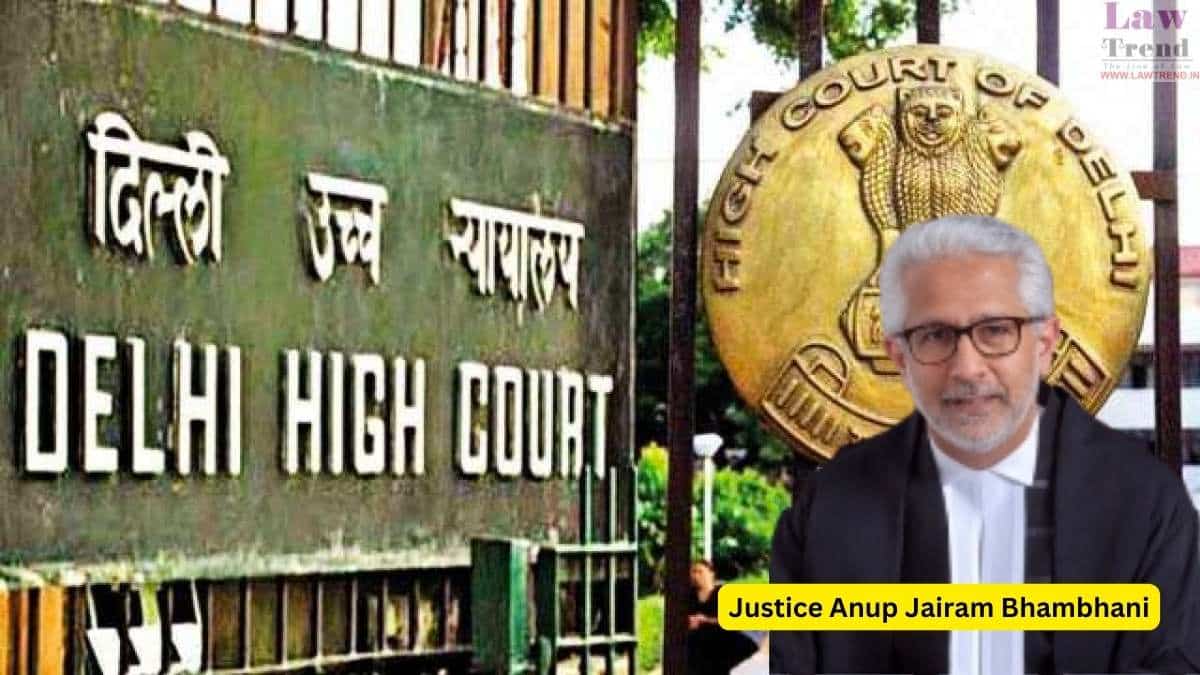
The Delhi High Court has quashed a criminal case registered under the Bharatiya Nyaya Sanhita (BNS) and the Protection of Children from Sexual Offences (POCSO) Act against a man who married the prosecutrix after a consensual relationship that began when she was a minor. Justice Anup Jairam Bhambhani observed that continuing the prosecution would lead to “manifest injustice” and the “re-victimisation” of the de-jure victim and her infant child.
Background of the Case
The case involved a petitioner (the husband) and respondent No. 2 (the prosecutrix). At the time of the alleged offence in September 2024, the petitioner was approximately 22 years old, and the prosecutrix was 17 years and 02 months old. The parties married according to Sikh rites and rituals in Ambala, Haryana, on September 4, 2024. A male child was born from the wedlock on June 12, 2025.
The FIR was not registered at the instance of the prosecutrix. Instead, it was initiated on June 13, 2025, following an intimation by doctors at Safdarjung Hospital, New Delhi. The attending doctors discovered the prosecutrix was a minor at the time of delivery and informed the police to comply with their legal obligation under Section 21 of the POCSO Act. The petitioner was subsequently charged under Section 64(1) of the BNS and Section 6 of the POCSO Act.
Arguments of the Parties
The petitioner sought quashing of the FIR under Article 226 of the Constitution of India read with Section 528 of the Bharatiya Nagarik Suraksha Sanhita, 2023 (BNSS). The petition was premised on the “consent” of the prosecutrix.
The prosecutrix filed an affidavit and appeared in court, stating she had married the petitioner of her own volition and was residing “happily and peacefully in her matrimonial home.” She stated that the petitioner “has committed no offence against her” and that she was a “willing participant in the physical relationship.” She argued that if the petitioner were sentenced, it would leave her and her child “bereft of any support and sustenance,” destroying the young family they had started.
The State, represented by Mr. Anand V Khatri, ASC (Criminal), confirmed that the State had no objection to the FIR being quashed in light of the specific facts and the volitional stand taken by the prosecutrix.
Court’s Analysis and Observations
The Court addressed the “complex legal dilemmas” of applying penal provisions that result in grave consequences for a de-jure victim. Justice Bhambhani noted that while the law declares a minor a “victim,” the statutory definitions under Section 2(wa) of the Cr.P.C. and Section 2(1)(y) of the BNSS require a person to have suffered “loss or injury.”
The Court highlighted a “conceptual dissonance” where a minor is constructed as a victim by statute despite an absence of “felt injury or grievance” in reality. Referring to the works of social philosopher Joel Feinberg, the Court discussed “crimes without a victim” in the context of consensual adolescent relationships.
Key observations by the Court included:
- On Statutory Rigidity: “The life of the law has not been logic; it has been experience… [this case] exposes the disconnect between a rigid legal construct and the human lives it seeks to govern.”
- On De-Facto vs. De-Jure Victims: “Where there is no de-facto victim, the commission of a crime remains a mere jurisprudential construct… prosecuting a person on the shoulders only of a de-juré victim would not be the prudent approach; muchless so, when the consequences of such prosecution would befall the de-juré victim herself.”
- On Re-victimisation: “The right course of action to secure the ends of justice and especially to prevent re-victimisation of the de-juré victim, would be to quash the criminal proceedings.”
The Court cited the Supreme Court’s decision in Ayyub Malik vs. State of Uttarakhand (2026), which held that subsequent marriage and peaceful cohabitation “outweigh the need to take the alleged offence… to their logical end.” It also referenced Jagjeet Singh & Ors. vs. Ashish Mishra @ Monu (2022) regarding the independent participatory rights of a victim.
However, the Court cautioned against “wanton misuse” of compromise quashing. It established “strong guardrails” for future POCSO quashing petitions, including evaluating whether the victim acted on free will, whether the stand has been consistent from the inception, the relative age difference, and the absence of violence or brutality.
The Decision
The High Court concluded that continuing the proceedings would be “an exercise in futility” and an “abuse of process of law.” It emphasized that the court’s principal duty is to do justice and prevent “manifest injustice.”
The Court noted that the parties had been living together as a family and that quashing the case was in the “best interests of the de-juré victim and the children.” Consequently, FIR No. 279/2025 and all subsequent proceedings were quashed.
Case Details:
Case Title: Harmeet Singh vs. State of GNCT Delhi and Anr.
Case No.: W.P.(CRL) 1985/2025
Bench: Justice Anup Jairam Bhambhani
Date: April 16, 2026