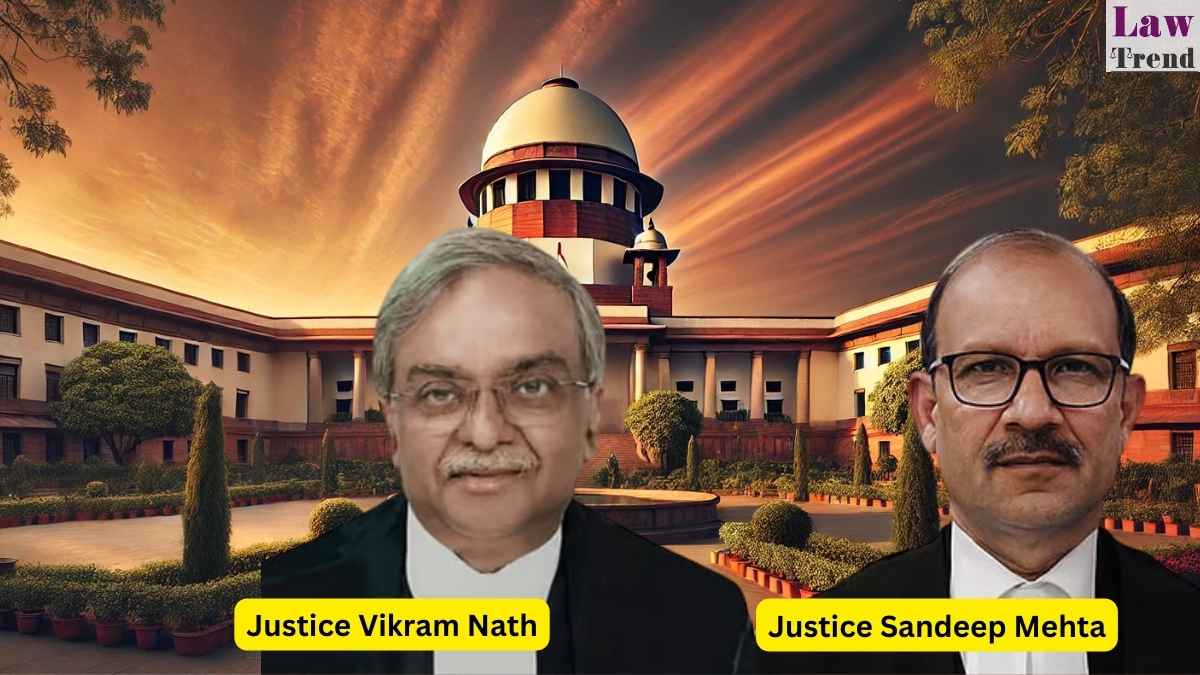
A two-judge bench of the Supreme Court of India comprising Justice Vikram Nath and Justice Sandeep Mehta has dismissed a Public Interest Litigation (PIL) challenging the constitutional validity of Section 354(5) of the Code of Criminal Procedure, 1973 (corresponding to Section 393(5) of the Bharatiya Nagarik Suraksha Sanhita, 2023), which mandates hanging by the neck as the sole method of carrying out a death sentence. The Court ruled that the petitioner failed to produce any compelling scientific or empirical evidence to doubt the correctness of the three-judge bench precedent in Deena v. Union of India (1983), which upheld the constitutionality of execution by hanging.
Background
The writ petition was instituted under Article 32 of the Constitution of India by advocate Rishi Malhotra in 2017, seeking to declare Section 354(5) of the CrPC ultra vires Articles 14 and 21 of the Constitution. The petitioner argued that hanging inflicts intense physical pain and mental agony, violating the right to die with dignity as established in Gian Kaur v. State of Punjab.
The judgment traced the evolution of execution methods in India, noting that prior to colonial rule, penal methods lacked uniformity. Hanging by the neck was introduced as the sole execution method in the Code of Criminal Procedure, 1861, and retained in subsequent codes in 1882, 1898, 1973, and most recently in Section 393(5) of the Bharatiya Nagarik Suraksha Sanhita, 2023.
The Court noted that while the constitutionality of capital punishment itself was affirmed in Jagmohan Singh v. State of U.P. and Bachan Singh v. State of Punjab—which established the “rarest of rare” doctrine—the method of execution remains subject to scrutiny under Article 21. Previous examinations included the Royal Commission on Capital Punishment (1949-53), the Law Commission of India’s 35th Report (1967), and its 187th Report (2003). In Deena v. Union of India (1983), a three-judge bench upheld hanging as a quick, simple, and decent method of execution. This view was subsequently approved by a Constitution Bench in Shashi Nayar v. Union of India (1992).
Arguments of the Parties
Petitioner’s Submissions:
Petitioner Rishi Malhotra, appearing in person, argued that hanging is barbaric, cruel, and unscientific. Relying on the 187th Report of the Law Commission of India (2003), he contended that hanging causes intense physical torture, pointing out risks of asphyxiation if the drop is too short or decapitation if too long. He submitted that State Jail Manuals illustrate prolonged agony and psychological trauma.
He further referenced Safeguard No. 9 of the UN Economic and Social Council (ECOSOC) Safeguards to argue that executions must inflict minimum suffering. Additionally, he asserted a violation of Article 14, pointing out that military statutes—such as the Army Act, 1950, the Air Force Act, 1950, and the Navy Act, 1957—provide shooting as an alternative mode of execution, creating arbitrary discrimination against civilian convicts. He urged the Court to strike down the provision or read it down to permit alternative methods like lethal injection or shooting.
Impleader’s Submissions:
Senior Counsel Meenakshi Arora, appearing for impleader Project 39A (National Law University, Delhi), presented medical and forensic literature, including a 1992 UK post-exhumation study and testimony from US Senate hearings, arguing that hanging is neither instantaneous nor pain-free. She cited Shabnam v. Union of India, which held that execution must bring immediate unconsciousness without mutilation.
However, to provide a complete picture, she also brought on record data regarding lethal injection in the United States, highlighting the decision in Baze v. Rees, concerns over the three-drug protocol, and documented botched execution rates (including a historical botched rate of approximately 3% cited in scholarly works and the failed 2024 execution attempt of Thomas Creech in Idaho).
Respondent’s Submissions:
Attorney General R. Venkataramani, appearing for the Union of India, opposed the petition on maintainability, arguing that prescribing or altering execution methods is an exclusive legislative function of Parliament under the principle of separation of powers, citing A.K. Roy v. Union of India, Supreme Court Employees’ Welfare Association v. Union of India, and Suresh Seth v. Commissioner, Indore Municipal Corporation.
He submitted that the issue is settled by Deena v. Union of India, which held that hanging satisfies Article 21. He highlighted that Parliament consciously re-enacted hanging under Section 393(5) of the BNSS, 2023. He argued that military laws govern a distinct class under military necessity, rejecting the Article 14 challenge. Citing Gian Kaur v. State of Punjab and Union of India v. Deoki Nandan Aggarwal, he stated Law Commission reports are merely recommendatory and courts cannot rewrite statutes. He also cited Asif Hameed v. State of J&K and Aravali Golf Club v. Chander Hass regarding judicial restraint in matters of legislative policy.
Court’s Analysis
The Court held that as a two-judge bench, it was bound by the principle of stare decisis not to depart from the decision of the three-judge bench in Deena v. Union of India, which had already been affirmed by a Constitution Bench in Shashi Nayar v. Union of India.
The bench noted that neither the petitioner nor the impleader produced unimpeachable scientific or empirical material demonstrating that execution by hanging has lost its efficacy or that lethal injection is superior. On the contrary, material submitted regarding lethal injections in the United States demonstrated high rates of botched executions and systemic complications.
Regarding the military statutes, the Court held that provisions allowing death by shooting operate in a distinct field governing a separate class of persons subject to military law and cannot be used to test civilian criminal procedure.
Re-examining the findings in Deena v. Union of India, the Court reiterated key observations from that judgment:
“The material before us shows that the system of hanging which is now in vogue consists of a mechanism which is easy to assemble. The preliminaries to the act of hanging are quick and simple and they are free from anything that would unnecessarily sharpen the poignancy of the prisoner’s apprehension.”
“The method is a quick and certain means of executing the extreme penalty of law. It eliminates the possibility of a lingering death. Unconsciousness supervenes almost instantaneously after the process is set in motion and the death of the prisoner follows as a result of the dislocation of the cervical vertebrae.”
“The system is consistent with the obligation of the State to ensure that the process of execution is conducted with decency and decorum without involving degradation or brutality of any kind.”
The Court held that the observations of the 187th Law Commission Report were recommendatory and that Parliament chose not to amend the mode of execution when enacting the BNSS, 2023. Furthermore, no evidence was placed on record showing a single instance of a botched execution under the existing framework in India.
Decision
Finding no compelling reason to refer the 1983 Deena decision to a larger bench, the Supreme Court dismissed the writ petition.
The Court clarified that its dismissal does not foreclose future constitutional scrutiny if compelling scientific, medical, or empirical evidence emerges showing that the factual basis of Deena v. Union of India has been displaced. It further observed that nothing precludes the Union Government from undertaking a comprehensive review of execution methods through an expert body of specialists in law, forensic medicine, neuroscience, and penology as a matter of executive and legislative policy.
Case Title: Rishi Malhotra & Anr. v. Union of India
Case No.: Writ Petition (Criminal) No. 145 of 2017
Bench: Justice Vikram Nath and Justice Sandeep Mehta
Date: August 18, 2026