

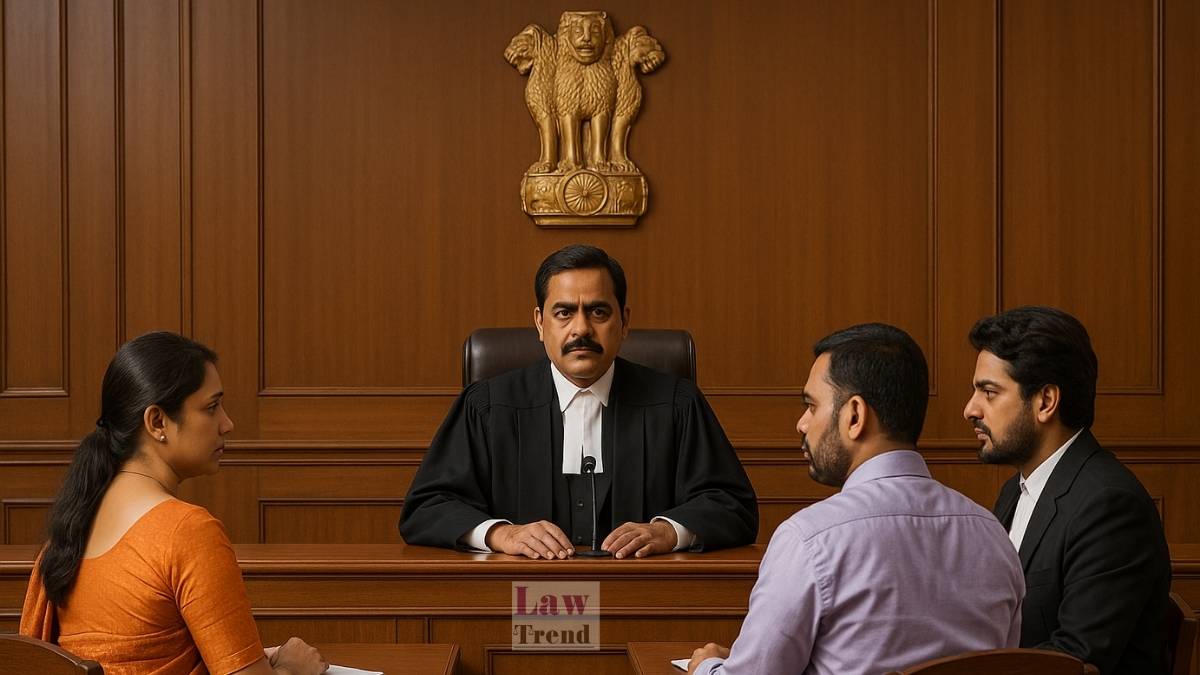
The Chhattisgarh High Court has held that a decree for restitution of conjugal rights under Section 9 of the Hindu Marriage Act, 1955 cannot be granted merely because a spouse is living separately, unless it is established that the withdrawal from the other spouse’s society was without reasonable excuse. A division bench of Justice Parth Prateem Sahu and Justice Sachin Singh Rajput dismissed a husband’s appeal against a Family Court order rejecting his plea for restitution of conjugal rights.
The Court found that the wife had furnished a reasonable and plausible explanation for staying away from her husband in view of the allegations of ill-treatment, physical assault, dowry demands, circumstances surrounding her miscarriage, domestic violence proceedings and the husband’s retention of her educational and other documents.
Background
The parties married on February 7, 2022 according to Hindu rites and rituals. According to the husband, their relationship remained cordial until October 2022. On October 19, 2022, he took his wife to her parental home after receiving information that her mother was unwell.
The husband claimed that he subsequently made several attempts to bring his wife back, including visits on October 23, October 31, November 7 and November 11, 2022. His parents also visited her parental home on November 24. He alleged that she refused to return and threatened to implicate them in a false case.
He also moved an application under Sections 97 and 98 of the CrPC before the SDO, Patthalgaon, which was rejected on March 31, 2023. A registered notice sent by him on March 6, 2023 also did not result in resumption of matrimonial cohabitation. He thereafter approached the Family Court under Section 9 of the Hindu Marriage Act.
The Family Court, Jashpur dismissed his suit on November 20, 2023, leading to the present appeal before the High Court.
Wife Alleged Dowry Demand, Assault and Harassment
The wife opposed the husband’s plea and alleged that she had suffered ill-treatment and physical assault at the hands of her husband and his family. She claimed that a Swift car given by her parents at the time of marriage was considered inadequate and that demands were subsequently made for a Creta car and ₹5 lakh in cash.
She further alleged that she suffered a miscarriage due to assault and harassment and had lodged complaints before authorities including the Sakhi Centre, Jashpur. She also initiated proceedings relating to domestic violence.
The wife also alleged that the husband had retained her educational certificates, Aadhaar card, caste certificate and bank passbook. She maintained that the circumstances made it difficult for her to continue living with him.
Arguments Before High Court
The husband’s counsel argued that the Family Court had failed to properly appreciate the evidence. It was submitted that the allegations concerning dowry demand, assault and harassment were false, subsequent developments and unsupported by reliable evidence.
The husband maintained that he had always been ready to fulfil his matrimonial obligations and had repeatedly attempted to restore the relationship, but his wife refused to return.
The wife’s counsel, however, submitted that she had not withdrawn from her husband’s society without cause. Her separate residence, it was argued, resulted from continuing ill-treatment, physical assault and dowry demands by the husband and his family.
Withdrawal Must Be Without Reasonable Excuse
Examining Section 9 of the Hindu Marriage Act, the High Court said that the relevant question was not simply whether the wife had left the husband’s company, but whether she had done so without sufficient and reasonable cause.
The bench observed:
“The question is not merely whether the respondent/wife has withdrawn from the company of the appellant/husband, but whether such withdrawal was without sufficient and reasonable cause.”
The Court noted that the allegations concerning ill-treatment, manhandling, demand for a Creta vehicle and ₹5 lakh, and the circumstances relating to the miscarriage had to be considered together with the complaints and domestic violence proceedings initiated by the wife.
It said these circumstances could not be brushed aside while determining whether she had a reasonable justification for living separately.
The High Court also considered it significant that the husband had retained the wife’s educational and other public documents despite her repeated requests for their return. The Family Court had directed him to return those documents and permitted the wife to take legal steps in case of non-compliance.
Repeated Attempts by Husband Not Sufficient by Themselves
The Court rejected the argument that the husband’s visits to his wife’s parental home and his legal notice were sufficient to establish that she lacked reasonable cause for refusing to return.
It observed:
“The mere fact that the appellant/husband made repeated visits to the parental home of the respondent/wife or issued a legal notice expressing his willingness to resume matrimonial cohabitation cannot, by itself, establish that her refusal to return was without reasonable cause.”
The Court added that such expressions of willingness had to be examined against the circumstances between the parties and the evidence already on record.
Appeal Dismissed
On a cumulative assessment of the pleadings, evidence and circumstances, the High Court found no perversity, illegality or material infirmity in the Family Court’s judgment.
Holding that the Family Court’s findings were supported by the material on record, the bench affirmed the dismissal of the husband’s application under Section 9 of the Hindu Marriage Act and dismissed the appeal.
Case Title: Praveen Kumar Yadav v. Smt. Priyanka Yadav
Case No.: FA(MAT) No. 5 of 2024
Bench: Justice Parth Prateem Sahu and Justice Sachin Singh Rajput
Date: September 18, 2026




