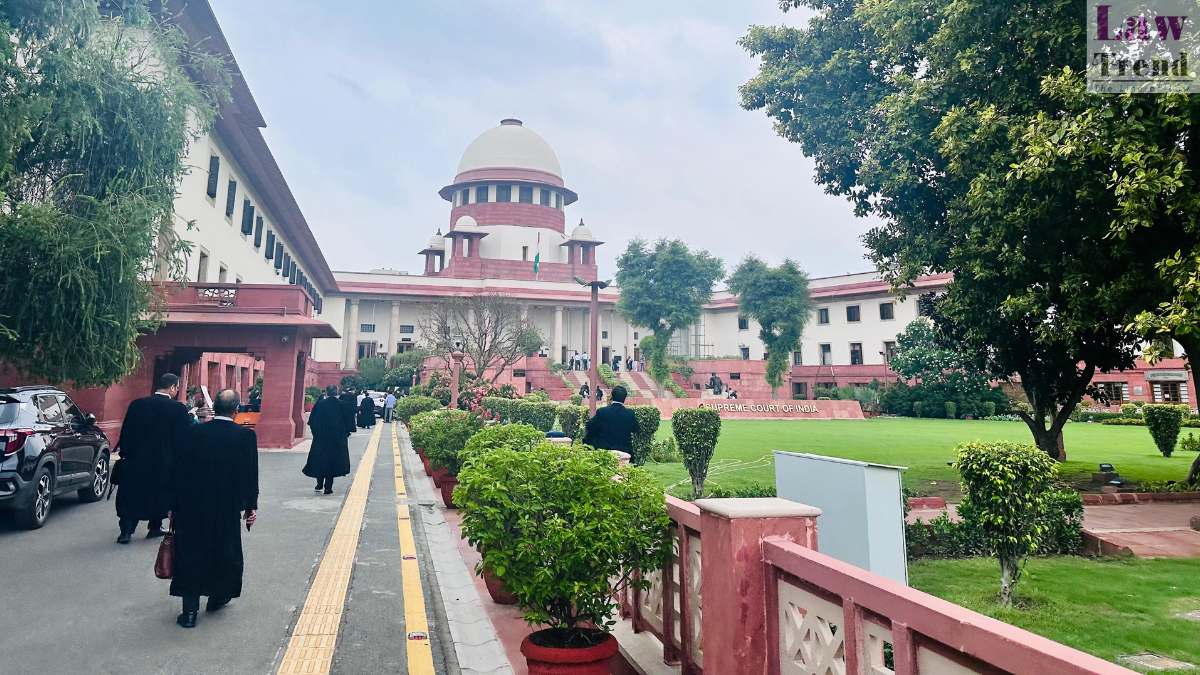
The Supreme Court of India, in a bench comprising Justice Sanjay Karol and Justice Augustine George Masih, held that revenue entries neither create nor extinguish title to immovable property and exist primarily for fiscal purposes, ruling that a mutation order cannot operate as a conveyance or relinquishment of proprietary rights. Allowing an appeal against a judgment of the High Court of Madhya Pradesh at Indore, the apex court set aside the High Court’s ruling and restored the concurrent decrees of the trial court and the first appellate court, which had declared the legal heirs of the late Ramprasad as co-owners entitled to partition and separate possession of their share.
Background of the Case
The dispute centers on agricultural land measuring approximately 12.41 acres in Survey No. 307, along with a house, situated at Village Kanadia, Tehsil and District Indore, Madhya Pradesh. The property originally belonged to Bhagwansingh. Upon his death, it devolved jointly upon his two sons, Ramprasad and Vasudev (Respondent No. 1), and revenue mutation was effected in their joint names.
According to the appellants (Jamnabai, widow of Ramprasad, and their children), Ramprasad held an equal proprietary interest in the property. They stated that Ramprasad suffered from alcoholism and was subjected to humiliation and physical assault by Vasudev, prompting Jamnabai to move him to her parental village while the family continued receiving agricultural produce from the land. Requests for formal partition were repeatedly deferred by Vasudev.
The cause of action arose on January 26, 2008, when a public notice was published in the Dainik Bhaskar newspaper at Indore, indicating that Vasudev had entered into an agreement to sell Survey No. 307/02. Upon obtaining certified copies of the revenue records on January 30, 2008, the appellants discovered that Survey No. 307/01 stood mutated in the name of Jaswant (Respondent No. 2, son of Vasudev) and Survey No. 307/02 in the name of Vasudev, with Ramprasad’s name completely removed from the revenue records.
On February 13, 2008, the appellants filed a civil suit seeking a declaration of co-ownership, partition, separate possession, and a permanent injunction restraining alienation.
The respondents contended that Ramprasad had been adopted in childhood by his maternal grandmother and received land in Village Achlukhedi, which was sold in 1980 to jointly purchase land at Village Upadinatha with Vasudev. They claimed a family partition occurred in 1981, mutating 1.927 hectares in Jaswant’s name. They further asserted that in 1990, Ramprasad agreed to relinquish his remaining interest in the Kanadia property in exchange for Vasudev consenting to the sale of the Upadinatha land, executing an affidavit dated April 11, 1990 (Ex.D19) and a statement before the Naib Tehsildar (Ex.D20).
Based on these documents, the Naib Tehsildar passed a mutation order on April 24, 1990 in Revenue Case No. 3A/6A/1989/90 (Ex.D22) recording Vasudev and Jaswant in place of Ramprasad. The respondents also relied on a written consent letter dated June 17, 1990 (Ex.D5). Ramprasad passed away in 1992.
Lower Court Rulings and High Court Reversal
The trial court (Civil Judge, Class-2, Indore) decreed the suit on May 4, 2016, holding that the plea of adoption was unproven, the acquisition and sale of Upadinatha land was inconsistent, Ex.D5 was vague and unregistered, and the 1990 removal of Ramprasad’s name was not done in accordance with law. It declared the appellants entitled to a one-tenth share each.
The first appellate court (Additional District Judge, Indore), after allowing an application under Order XLI Rule 27 of the Code of Civil Procedure, 1908 (CPC) to admit revenue records Ex.D17 to Ex.D24, affirmed the trial court decree on May 2, 2019. It found that the respondents failed to produce independent witnesses to prove Ex.D5, the stamp papers were purchased in January 1990 for a document executed in June 1990, and the signatures attributed to Ramprasad on Ex.D17 to Ex.D21 were denied without independent verification.
However, the High Court of Madhya Pradesh at Indore, in Second Appeal No. 1394 of 2019 dated May 9, 2025, reversed both concurrent judgments. Frame-setting two substantial questions of law on the bar under Section 34 of the Specific Relief Act, 1963 and limitation under Articles 58 and 100 of the Schedule to the Limitation Act, 1963, the High Court held that consent under Ex.D5 stood established because DW3 was not questioned on the signature, the 1990 mutation was unchallenged for 18 years, and the suit was consequently barred by limitation and the proviso to Section 34.
Arguments of the Parties
Before the Supreme Court, counsel for the appellants submitted that the mutation order Ex.D22 originated from an undated statement Ex.D20 without verifying Ramprasad’s presence or genuineness. They argued that DW3 was a purchaser in a separate 1988 transaction involving Upadinatha land and not an attesting witness to Ex.D5. They asserted that the High Court exceeded its jurisdiction under Section 100 of the CPC by disturbing concurrent findings of fact. The appellants relied upon citations including Daya Singh and Another v. Gurdev Singh (Dead) by LRs. and Others, Mansoor Saheb (Dead) and Others v. Salima (D) by LRs. and Others, P. Kishore Kumar v. Vittal K. Patkar, Jitendra Singh v. State of Madhya Pradesh and Others, Kale and Others v. Deputy Director of Consolidation and Others, and Yellapu Uma Maheswari and Another v. Buddha Jagadheeswararao and Another.
Counsel for the respondents submitted that the 1990 revenue proceedings were quasi-judicial and part of public record, and Section 257 of the Madhya Pradesh Land Revenue Code, 1959 barred indirect civil suit challenges. They argued that the non-examination of Ramprasad’s widow (Appellant No. 1) warranted an adverse inference and relied on the presumption of regularity of official acts under Section 114(e) of the Evidence Act, 1872.
Supreme Court’s Analysis
The Supreme Court examined the permissible scope of second appeals under Section 100 of the CPC, referencing Bholaram v. Ameerchand, Kulwant Kaur and Others v. Gurdial Singh Mann (Dead) by LRs. and Others, and P. Kishore Kumar v. Vittal K. Patkar. The Court reiterated that concurrent factual findings cannot be interfered with unless demonstrably perverse or vitiated by an error of law.
Addressing the validity of the alleged relinquishment and revenue entries, the Court held that the burden of proving relinquishment rested on the respondents. The Court noted that DW3’s testimony related strictly to a 1988 transaction and made no mention of Ex.D5.
On the legal effect of revenue entries, the Supreme Court explicitly observed:
“It is settled law that an entry in the revenue record neither creates nor extinguishes title and exists essentially for fiscal purposes, as held by this Court in Sawarni v. Inder Kaur and Others.”
The Court further stated:
“The statutory presumption of correctness attaching to a revenue entry under Section 117 of the Madhya Pradesh Land Revenue Code 1959 is a rebuttable evidentiary presumption and not a presumption of title, and it must be weighed along with the rest of the evidence…”
Regarding limitation and co-ownership, the Court cited P. Lakshmi Reddy v. L. Lakshmi Reddy, highlighting that possession by one co-owner is ordinarily treated as possession on behalf of all, and ouster requires an open assertion of hostile title with exclusive possession to the knowledge of the other co-owner. Addressing the starting point of limitation, the Court held:
“The starting point of limitation cannot be fixed merely by identifying the date on which a revenue entry happens to have been made. What matters is when the right to sue actually accrued, a question that has to be examined on the facts of each case.”
The Court accepted the concurrent factual findings of the lower courts that knowledge of the removal of Ramprasad’s name was acquired only through the public notice dated January 26, 2008 and certified copies obtained on January 30, 2008, bringing the 2008 suit within limitation under Article 58.
The Court rejected the bar under Section 34 of the Specific Relief Act, 1963, clarifying that the appellants did not seek a bare declaration but also prayed for partition, separate possession, and an injunction. It added that once a civil court adjudicates that title is unextinguished, a revenue entry cannot stand in the way of declared title.
Addressing the arguments on adverse inference and statutory presumptions, the Court observed:
“The presumption of regularity under Section 114(e) of the Evidence Act extends to the regularity of official procedure, but it does not extend to conclusively proving the bona fides of the underlying private transaction…”
Decision
The Supreme Court concluded that the High Court exceeded its jurisdiction under Section 100 of the CPC by reappreciating evidence and departing from concurrent factual findings without establishing perversity.
The apex court allowed the appeal, set aside the High Court judgment dated May 9, 2025, and restored the first appellate court judgment and decree dated May 2, 2019 (affirming the trial court decree dated May 4, 2016). The legal heirs of the late Ramprasad were held entitled to their declared share, subject to lawful partition under the Madhya Pradesh Land Revenue Code. The respondents remain restrained from alienating the suit property or creating third-party rights until lawful partition is completed.
Case Title: Jamnabai and Others v. Vasudev and Others
Case No.: SLP (C) No. 39 of 2026
Bench: Justice Sanjay Karol and Justice Augustine George Masih
Date: August 20, 2026