

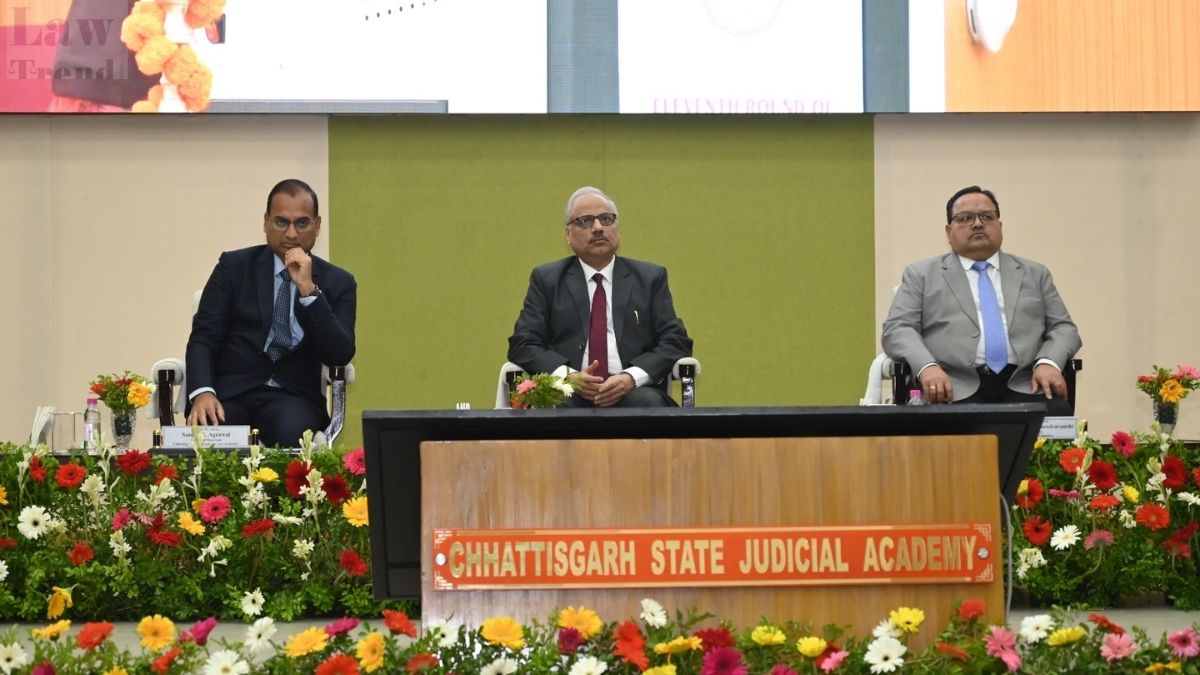
The Eleventh Round of the State-Level Stakeholders’ Consultation on the theme “The Juvenile Justice (Care and Protection of Children) Act, 2015 — A Decade of Implementation and the Way Forward” was organised at the Vivekananda Auditorium of the Chhattisgarh State Judicial Academy, Bilaspur, by the High Court POCSO Committee and Juvenile Justice Committee, in association with the Chhattisgarh State Judicial Academy and the Chhattisgarh State Legal Services Authority, Bilaspur.
The consultation brought together representatives from the Judiciary, Government Departments, Law Enforcement Agencies, NGOs and Civil Society Organisations to deliberate upon the effective implementation of the Juvenile Justice Act and the way forward. The programme was inaugurated by the Chief Guest, Hon’ble Mr. Justice Ramesh Sinha, Chief Justice, High Court of Chhattisgarh.
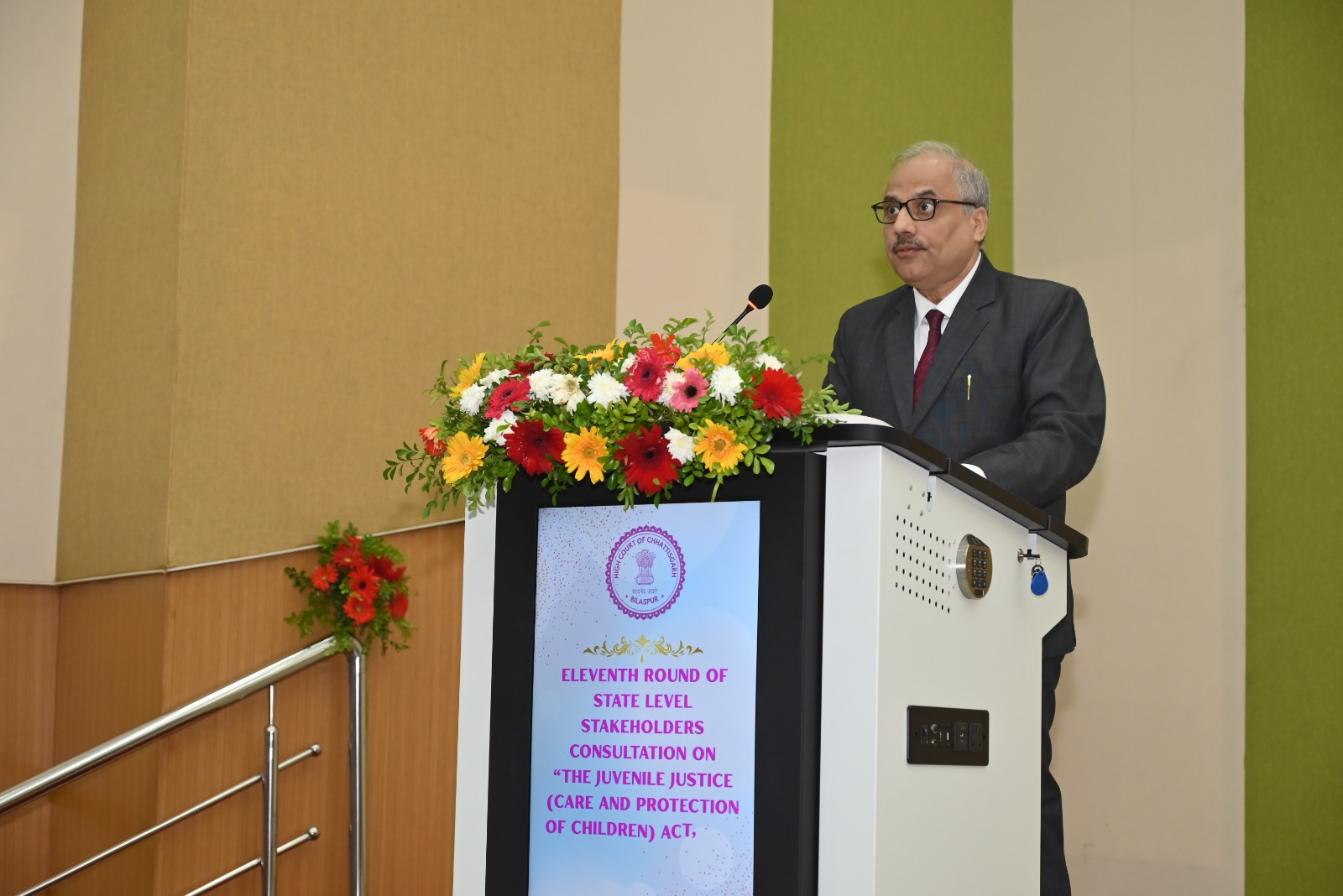
Addressing the consultation, Hon’ble the Chief Justice observed that a decade of implementation provides an opportunity not only to assess the achievements of the Juvenile Justice System but also to reflect upon the challenges that remain. The Hon’ble Chief Justice emphasised that the true measure of the success of the system should not be confined to the number of cases disposed of, institutions established or orders passed, but should be assessed by whether every child coming into contact with the justice system is treated with dignity, compassion, fairness and understanding, and is provided a genuine opportunity to rebuild his or her life.
Hon’ble the Chief Justice highlighted that the Juvenile Justice Act is founded upon a fundamental constitutional and humanitarian philosophy that children are not merely subjects of legal proceedings, but individuals possessing rights, potential and a future which society has a collective responsibility to protect.
Emphasising the “best interests of the child” as the central principle of Juvenile justice jurisprudence, Hon’ble the Chief Justice stated that a child in conflict with law should not be defined by the offence alleged against him or her. Similarly, a child in need of care and protection should not be reduced to the circumstances that brought the child before the authorities. Behind every case file, there is a child who may be facing poverty, neglect, abuse, abandonment, family conflict, substance dependence, exploitation or other vulnerabilities.
Hon’ble the Chief Justice stressed that the response of the justice system should therefore be restorative rather than merely punitive, rehabilitative rather than exclusionary, and compassionate without compromising the rule of law. Hon’ble the Chief Justice further emphasised the importance of early identification and early intervention.
Children living in vulnerable circumstances often require assistance long before they come into contact with the formal Justice system. Street-connected children, school dropouts, victims of abuse and exploitation, abandoned children and children exposed to substance abuse require timely and coordinated intervention.
Highlighting the importance of inter-institutional coordination, Hon’ble the Chief Justice stated that the Judiciary, Police, Child Welfare Committees, Juvenile Justice Boards, District Child Protection Units, educational institutions, health authorities, legal services institutions and civil society organisations must work in close coordination. No single institution can discharge this responsibility in isolation.
Hon’ble the Chief Justice also underlined the unique constitutional responsibility of the Judiciary in matters concerning children. Judicial officers dealing with children must possess not only knowledge of the statutory framework but also an understanding of child psychology, trauma, developmental needs and the social circumstances surrounding juvenile offending and vulnerability.
Hon’ble the Chief Justice further observed that the first interaction of a child with the Justice system often takes place outside the courtroom. The manner in which the Police and other authorities respond at this initial stage can determine whether the child experiences the justice system as one of protection or punishment.
Concluding the address, Hon’ble the Chief Justice remarked: “The way we treat our children today will define the kind of society we become tomorrow.”
The consultation had two technical sessions, both Chaired by Hon’ble Mr. Justice Naresh Kumar Chandravanshi, and Co-Chaired by Hon’ble Mr. Justice Rakesh Mohan Pandey, Hon’ble Mr. Justice Ravindra Kumar Agrawal & Hon’ble Mr. Justice Bibhu Datta Guru, Judges High Court of Chhattisgarh.
The event was also graced by Hon’ble Shri Justice Sanjay K. Agrawal, Hon’ble Mr. Justice Parth Prateem Sahu, Hon’ble Mr. Justice Radhakishan Agrawal & Hon’ble Mr. Justice Amitendra Kishore Prasad.
The event was attended by the Principle Secretary Law, Registrar General, Officers of the Registry, Director & Officers of the CSJA, Member Secretary and Officers of SLSA, Secretary, High Court Legal Services Committee, Presiding Officers of F.T.S.C/F.T.C Courts, Principal Magistrates Juvenile Justice Board, Secretaries of District Legal Services Authority, Principle Secretary Law, Representatives of Department of Women & Child Development, Chairperson of the Child Protection Commission, Principal Secretary, Child Welfare Committees, District Programme Officers (WCD), Representatives of Panchayat and Rural Development, Representatives of Department of School Education, Representatives of Social Welfare Department, Representatives of Public Health & Family Welfare/ Medical Education Department, Representatives of Chhattisgarh State Commission for Protection of Child Rights, Representatives of Department of Police, Nodal Officer/Incharge Special Juvenile Police Units, Representatives of UNICEF, Chhattisgarh.




