

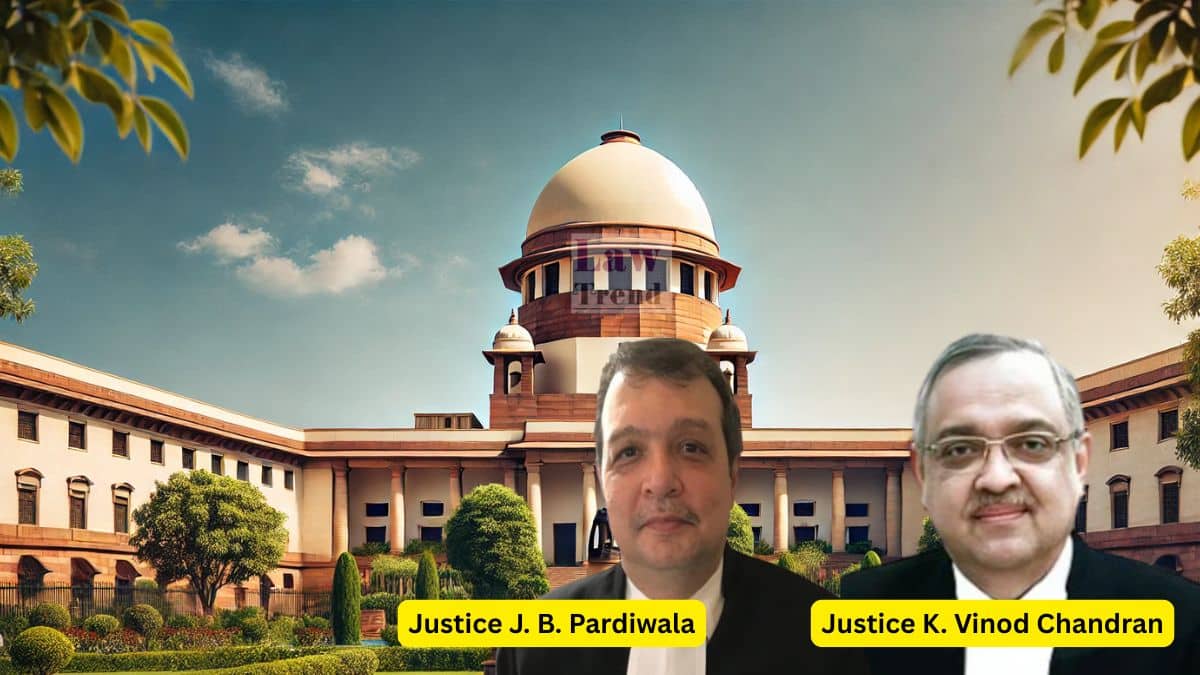
The Supreme Court has restored the Central Electricity Regulatory Commission’s (CERC) order holding that the generating company must bear the transmission charges for two LILOs (Line-In Line-Out) built by Power Grid Corporation of India Limited (PGCIL) at the Tuticorin Pooling Station. The liability runs until the generator commissioned its own Dedicated Transmission Line (DTL).
A Bench of Justice J.B. Pardiwala and Justice K. Vinod Chandran allowed PGCIL’s appeals and set aside the orders of the Appellate Tribunal for Electricity (APTEL), which had found that the LILOs were not used.
The Dispute
PGCIL, the Central Transmission Utility, built LILOs on both circuits of the Tuticorin JV–Madurai 400 kV line at the Tuticorin Pooling Station. They were commissioned on 04.01.2015 and 08.01.2015. The generating company, Moxie Power Generation Limited (formerly Coastal Energen), began generation on 23.12.2014. Under its agreements, it was required to build a DTL directly to the Tuticorin Pooling Station, which it commissioned only on 27.10.2016.
PGCIL claimed transmission charges for the LILOs for the period between their commissioning and 27.10.2016. In its order of 29.07.2016, the CERC accepted the commercial operation dates (COD) and held that the generating companies were to bear the charges until their DTL was commissioned. The generating company did not appear before the CERC.
APTEL reversed this order. It held that the LILOs were a permanent part of the transmission plan but that the COD had not been granted under Regulation 4(3)(ii) of the 2014 Tariff Regulations. It also held that no power flowed through the LILOs, since the upstream lines to Salem and Madhugiri were not ready. The non-PoC charges in dispute before APTEL were ₹15,43,26,909. In review, APTEL sent the matter back to the CERC to determine the COD.
Arguments
Senior Counsel Ramji Srinivasan, appearing for PGCIL, argued that the LILOs were permanent infrastructure approved in the Standing Committee meetings, and that the COD was accepted on the basis of the RLDC’s trial operation certificate and the CEA certificate. He submitted that the power generated was in fact transmitted to TANGEDCO through the LILOs. He argued that APTEL’s “beneficial use” test was unheard of in transmission and amounted to an artificial reopening of the COD.
Senior Counsel Sajan Poovayya, appearing for the generating company, argued that the LILOs were never used. He submitted that power flowed through the generator’s temporary LILO on the Tuticorin JV–Madurai line straight towards TANGEDCO, and that PGCIL’s LILOs started operating only after the upstream line came up on 13.11.2016. He argued that the generator had already paid STOA and MTOA charges, and that no liability could arise because the COD had not been declared as the Regulations require.
Advocate-on-Record Vrinda Bhandari, appearing for TANGEDCO, adopted these arguments. She relied on paragraph 72 of the CERC order and submitted that the LILOs could not serve their purpose until the upstream system was operational.
“Beneficial Use Is Clearly Established”
The Court rejected the generator’s argument that electricity simply flows along the path of least resistance and therefore bypassed the LILOs. It held that this argument “though indubitable is fundamentally flawed on the facts herein and does not support the contention of no beneficial use of the LILOs having been made.”
The Court found that once the LILOs intercepted the two circuits, power from the generating stations was necessarily routed through the Tuticorin Pooling Station before going back onto the line. It noted that in its appeal before APTEL, the generator had itself said it was using the Tuticorin Pooling Station to evacuate power. The Court held, “Hence, the use of LILOs was admitted and the contention was only of sharing, which cannot be raised without commissioning the DTL.”
On the delay in the upstream lines, the Court held that it did not affect the evacuation arrangement at all, because the LILOs worked as the upstream transmission path. After examining the layout, it concluded, “The beneficial use is hence clearly established.”
No Redetermination of COD Needed
The Court held that Regulation 4(3)(ii) applies only when a transmission element is prevented from regular service because of a delay by the generator or in the upstream or downstream system. Here, there was no impediment to transmission from the day generation began. The CERC had accepted the COD on the RLDC’s trial operation certificate and the CEA certificate. The Court held, “This calls for no-redetermination under Regulation 4(3)(ii) of the Tariff Regulations.”
Generator Liable for Delay in DTL
Relying on Power Grid Corporation of India Ltd. v. Madhya Pradesh Power Transmission Co. Ltd., PTC India Ltd. v. CERC and Energy Watchdog v. CERC, the Court held that the CERC can reasonably impose liability on a defaulting party. It held, “In the period between COD of the LILOs established by the CTU and the establishment of the DTL by the generating company, the liability cast by the CERC on the generating company is perfectly in order.”
The Court also found that APTEL wrongly relied on paragraph 72 of the CERC order. It held that this paragraph only recorded TANGEDCO’s contentions, while paragraphs 73 to 77 decided the question of liability against the generator. The Court further noted that the generator had never objected in the Standing Committee meetings.
Outcome
The Court answered all three questions of law in PGCIL’s favour. It held that the two LILOs are includable in the transmission tariff on a non-PoC basis from 04.01.2015 until the DTL was established on 27.10.2016. It also held that APTEL’s interpretation of the COD was wrong, and that the delay in building the DTL makes the generator liable for that period.
The Court set aside APTEL’s orders in both appeals, restored the CERC order and allowed the appeals.
Case Title: Power Grid Corporation of India Limited v. Tamil Nadu Generation and Distribution Corporation Limited (TANGEDCO) & Ors.
Case No.: Civil Appeal Nos. 14780-14781 of 2025 with Civil Appeal No. 13153 of 2026
Bench: Justice J.B. Pardiwala and Justice K. Vinod Chandran
Date: November 18, 2026


