

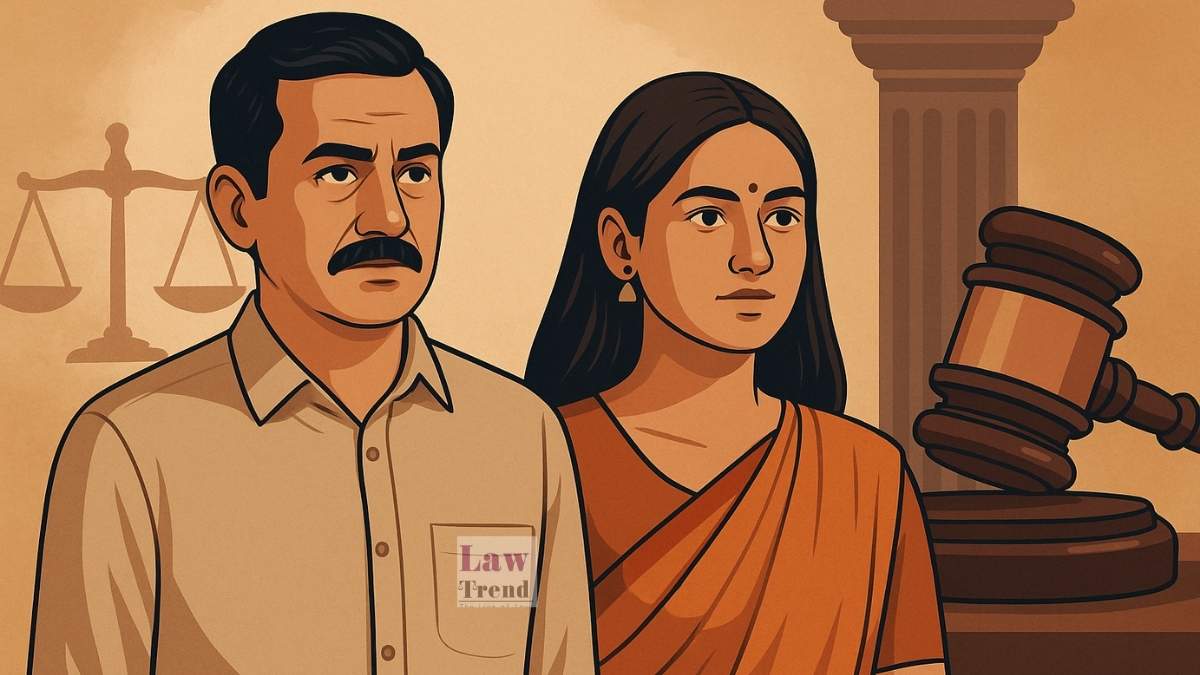
The Jharkhand High Court has held that a wife’s demand for a separate home cannot, by itself, be treated as matrimonial cruelty unless there is enough evidence of oppressive or abusive conduct along with it. The Court upheld a Ranchi Family Court decision refusing a husband’s petition for divorce on grounds of cruelty and desertion.
A Bench of Justice Sujit Narayan Prasad and Justice Pradeep Kumar Srivastava dismissed the husband’s appeal. It found that the Family Court’s judgment did not suffer from perversity.
Background
The parties married on 25.11.2007 at Arrah, Bihar, and have two daughters. The husband’s case was that his wife objected to his aged father and his deceased sister’s children living in the matrimonial home, and insisted on separate accommodation. He alleged that she left the matrimonial home on 04.05.2017 with both daughters.
He first filed a suit for restitution of conjugal rights. That suit was disposed of after a settlement before the Mediation Centre, Ranchi. After the settlement, the wife lived in a rented flat at Singh More, Ranchi. The husband then filed Original Suit No. 478 of 2020 seeking divorce under Section 13(1)(i-a) and (i-b) of the Hindu Marriage Act, 1955.
The wife denied all the allegations. She said the husband had assaulted her and thrown her out of the matrimonial home on 04.05.2017 with their two daughters because his demand for ₹3 lakh was not met. The Principal Judge, Family Court, Ranchi dismissed the divorce suit by a judgment dated 02.05.2025. The decree was signed on 16.05.2025.
Arguments
Advocate Atanu Banerjee, appearing for the appellant-husband, argued that the Family Court had not properly considered the evidence. He said the evidence showed the wife had assaulted and abused the husband and had lodged false criminal cases against him. He argued that once those cases failed, the cruelty was on the wife’s part.
Advocate Dilip Kumar Karmakar, appearing for the respondent-wife, argued that the Family Court had correctly evaluated the oral and documentary evidence. He said the husband himself had admitted that he stopped staying in touch with his wife and started living separately in another flat.
Jharkhand High Court on Separate Accommodation and Cruelty
The Court said a distinction has to be drawn between unreasonable conduct by a spouse and a demand for separate residence that may arise from the circumstances of the marriage. It observed that “A spouse’s preference for independent accommodation cannot, in every case, be treated as cruelty.”
The Bench said the surrounding circumstances, the needs of the parties, their obligations towards dependent family members and the manner of the demand must all be considered. It held that “A demand for separate accommodation, without sufficient evidence of accompanying oppressive or abusive conduct, cannot automatically be elevated to the level of matrimonial cruelty.”
On the husband’s claim that the wife’s complaints before the State Women Commission and the police amounted to mental cruelty, the Court said filing a criminal complaint does not automatically constitute cruelty. It noted that “a complaint cannot be treated as false merely because the other spouse disputes it or because the complainant fails to establish the allegations to the requisite standard in the relevant proceedings.” It found the evidence did not show that the wife knowingly made false allegations to injure the husband.
The Court also held that the husband’s psychiatric treatment did not, by itself, prove that the wife caused his condition through cruelty. It found that the allegations about jewellery taken from a joint bank locker had not been proved by reliable evidence. It also recorded the husband’s admission that he had no documents to support some of his allegations.
No Desertion Proved
The husband had admitted that he stopped paying rent for the Singh More flat in April 2019 after the wife’s parents began living with her. The Court said this admission showed that the separation could not be judged only by reference to the wife leaving in May 2017.
It held that the wife’s intention to abandon the marriage without reasonable cause had not been sufficiently established. It observed: “The statutory requirement is not merely prolonged separation but desertion as understood in matrimonial law.”
Outcome
Finding no perversity in the Family Court’s judgment dated 02.05.2025 and decree dated 16.05.2025, the High Court dismissed the appeal.
Case Title: Swami Nandan Singh v. Priya Bhardwaj @ Priya Singh
Case No.: First Appeal No. 136 of 2025
Bench: Justice Sujit Narayan Prasad and Justice Pradeep Kumar Srivastava
Date: 29.10.2026


