

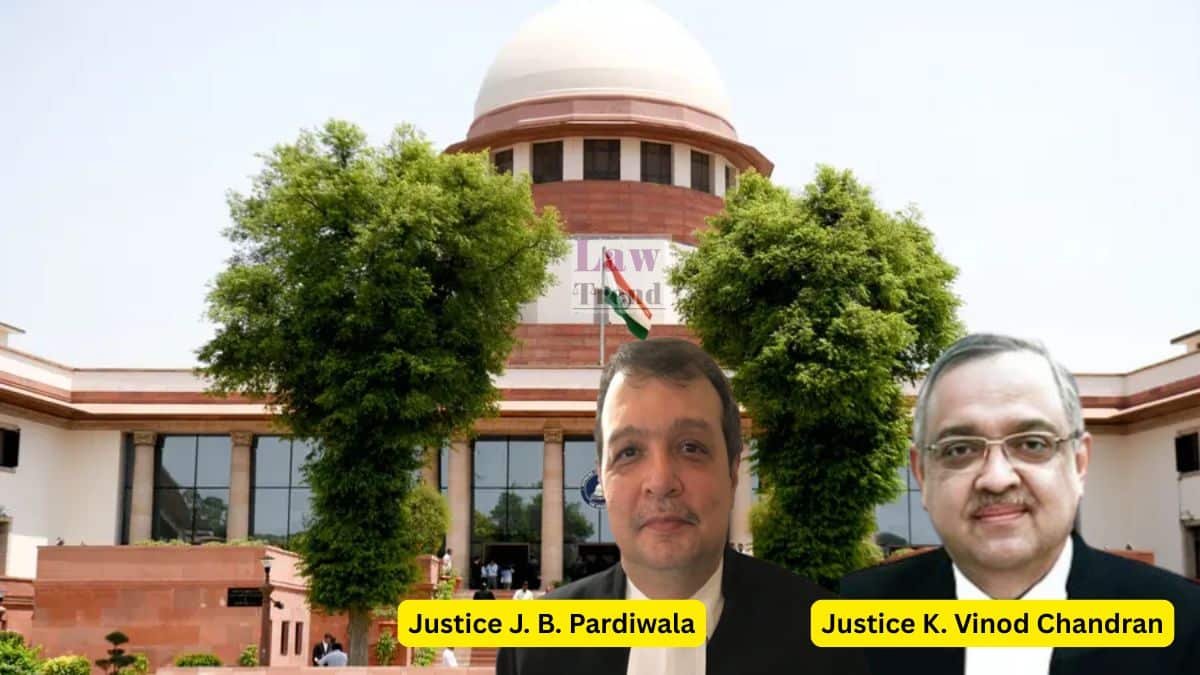
The Supreme Court has held that a court hearing an appeal under Section 37 of the Arbitration and Conciliation Act, 1996 cannot cut down an arbitral award just because the amount awarded seems too high to it. It restored an award in favour of a dredging contractor that the Calcutta High Court had halved.
A Bench of Justice J.B. Pardiwala and Justice K. Vinod Chandran allowed the appeal of M/s Marino Dredgeco Limited and set aside the High Court Division Bench’s judgment, which had modified the award in favour of the Board of Trustees of the Port of Kolkata.
Background
The contractor was engaged to dredge the approach channel and basin for a shore-based pilot station at Sagar Island. The work was to be finished in 18 months but was delayed by force majeure conditions, which the Court noted were not the contractor’s fault. The pilot station was inaugurated by the Port Trust’s Chairman on 17.04.2001, using the dredged channel.
Of the ₹2,86,56,200 payable for the original work, ₹2,79,32,865 had been paid. The arbitration was only about additional work, which the Port Trust had entrusted by its letter of 19.07.2000 after 100% siltation made repeated dredging necessary.
The Arbitrator’s award of 03.11.2003 was upheld by a Single Judge under Section 34. On appeal under Section 37, the Division Bench reduced the amounts to 50% and cut the interest to 6% from 08.02.2002. It did so because the claim for additional work was more than 70% of the original contract value, which it said shocked its conscience. It did this even though it had recorded that the award was not based on no evidence or insufficient evidence, and was not perverse, patently illegal or against the fundamental policy of Indian law.
Arguments
Senior Counsel R. Anand Padmanabhan and Amitava Mukherjee, appearing for the contractor, argued that the additional work arose from repeated siltation, wrong soil data supplied by the Port Trust and its failure to build protective walls. Relying on Gayatri Balasamy v. ISG Novasoft Technologies Ltd., they submitted that the powers under Section 37 are limited. They argued that the High Court made the modification on a mere assumption, without looking at the material the Arbitrator had relied on.
Senior Counsel Siddharth Bhatnagar, appearing for the Port Trust, sought to have the entire award set aside as against public interest. He argued that no completion certificate was issued, that no additional work was entrusted, and that the contract was terminated. In the alternative, he asked that the reduction to 50% with 6% interest be sustained. He relied on Batliboi Environmental Engineers Ltd. v. HPCL to argue that the quantification must not result in a windfall. The Court held that Batliboi had no application, since it dealt with damages and not with invoices validly raised for additional work.
Re-Dredging Was the Same Work
The Court noted that the original contract was for dredging to build a channel, and the additional work was re-dredging to keep the channel and basin usable. It held that the contractor’s claim that re-dredging was identical to the original work was, by the nature of the work, perfectly valid.
It held that modifying the award only because the claim exceeded 70% of the original contract, on the basis that the Court’s conscience was shocked, “cannot at all be sustained.” It noted that the Division Bench had itself found the award to be based on adequate evidence, including measurements of pre-work and post-work levels.
“Shocking the Conscience” Needs Substantive Reason
Referring to Ssangyong Engineering & Construction Co. Ltd. v. NHAI, the Court accepted that the ground of conflict with the most basic notions of morality or justice applies where an award shocks the conscience of the Court. It added that “the words are not to be applied on a mere lip service and there should be a substantive reason which blatantly and patently brings forth the conflict with the most basic notions of morality or justice, resulting in the conscience of the Court being shocked.”
Relying on Somdatt Builders–NCC–NEC (JV) v. NHAI, the Bench held that a Section 37 court cannot set aside an award merely by using expressions like “shocking the conscience of the Court”. It found that the High Court had used those words only because the bills crossed 70% of the original contract, without looking at the nature of the additional work.
No Severance, No Special Treatment for the State
On partial setting aside under Gayatri Balasamy, the Court held that the award could not be split into separate parts. It said, “The measurements and invoices raised are of one character, based on the additional work of re-dredging which cannot be compartmentalised as ‘valid’ and ‘invalid’.” It added that examining the measurements and invoices would itself be an adjudication on merits, which the Act prohibits.
Noting that the High Court’s shock was also linked to the Port Trust being a State entity, the Court relied on Pam Developments Pvt. Ltd. v. State of West Bengal. It held, “There can hence be no interference caused to the quantum of claim decided by the Arbitrator, based on valid material, merely for the reason that the award debtor is a Government entity and that the quantum appears to be excessive without any substantiation for such a ground being raised against the award itself.”
Outcome
The Court set aside the High Court’s judgment, allowed the contractor’s appeal and restored the arbitral award. The Port Trust’s appeal was disposed of.
Case Title: M/s Marino Dredgeco Limited v. The Board of Trustees of the Port of Kolkata
Case No.: Civil Appeal No. 14303 of 2026 with Civil Appeal No. 14304 of 2026
Bench: Justice J.B. Pardiwala and Justice K. Vinod Chandran
Date: November 18, 2026


