

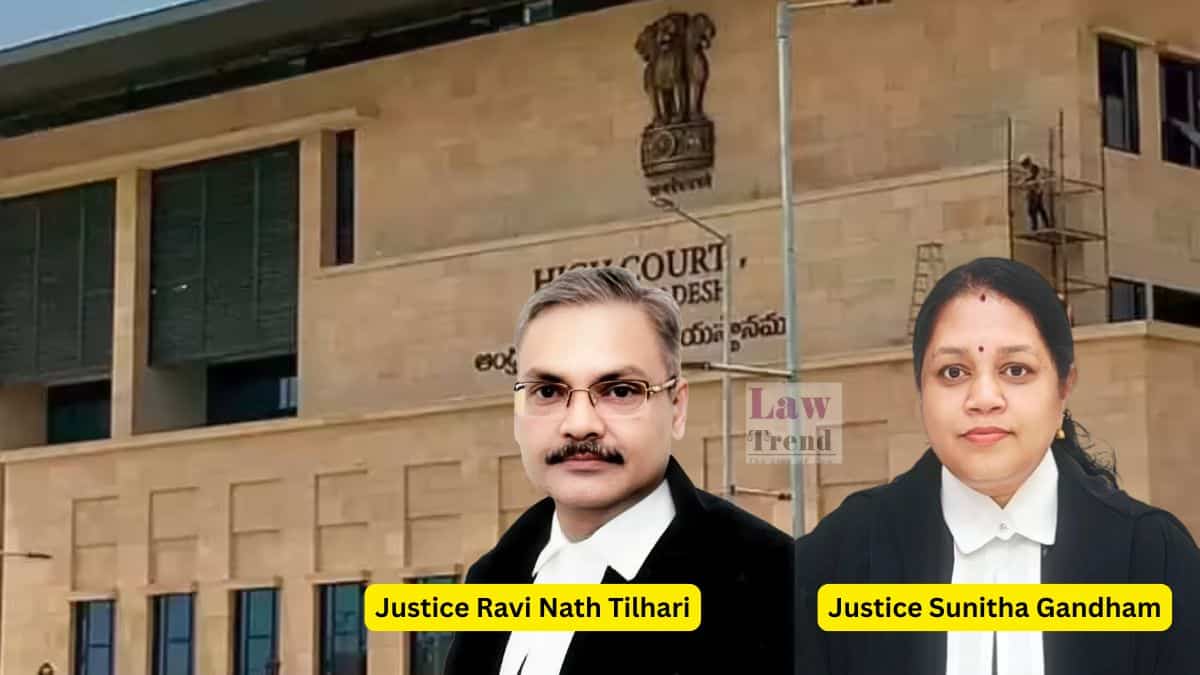
The Andhra Pradesh High Court has held that a writ petition seeking correction of electoral rolls is maintainable even after the election process has begun, if it is filed to advance the election rather than stall it. The Court dismissed an appeal by the Andhra Pradesh State Election Commission against a Single Judge’s order directing correction of the voter lists of two gram panchayats in Anakapalli.
A Division Bench of Justice Ravi Nath Tilhari and Justice Sunitha Gandham upheld the Single Judge’s order dated November 13, 2026. Justice Gandham delivered a separate concurring judgment.
Background
The writ petitioner, Botta Appalaraju, is a resident of Papayapalem Gram Panchayat and had earlier contested for the post of Sarpanch. He said that during the 2024 Assembly and Parliamentary elections, voters of Papayapalem and P.S. Palem Gram Panchayats were given a common polling booth in P.S. Palem because both fall in the same Assembly constituency. He argued that since the panchayats hold separate elections for sarpanch and ward members, there cannot be a common electoral roll for both.
According to the petitioner, Papayapalem’s roll showed 601 voters, while about 378 Papayapalem voters had been placed in P.S. Palem’s roll. Similarly, out of 776 voters shown in P.S. Palem, about 366 had been included in Papayapalem’s roll. He said his own name was retained in Papayapalem while the rest of his family, living in the same household, had been shifted to P.S. Palem.
The petitioner submitted a representation to the Revenue Divisional Officer on October 22, 2026. On October 24, 2026, the Tahsildar wrote to the Mandal Development Officer asking for action, but the petitioner said no action followed.
The Single Judge held that a common list for both gram panchayats “would result in utter breach of democratic process”. The Single Judge directed the authorities to “do the needful forthwith to undo the anomaly pointed out in the writ petition.”
Arguments
Advocate N. Ashwani Kumar, appearing for the State Election Commission, argued that once the election process had commenced with the issue of the notification, judicial intervention under Article 226 was barred by Article 243-O of the Constitution. Relying on State of Karnataka v. Gunjahalli Nagappa, he submitted that the electoral roll in force when the election process begins must remain unchanged throughout.
He also argued that the Supreme Court’s directions in Yuvajana Sramika Rythy Congress Party v. State of Andhra Pradesh were aimed at preventing obstruction of nominations. In his submission, they did not authorise interference with electoral rolls during an ongoing election.
Advocate N. Seshu Kumar, appearing for the writ petitioner, defended the Single Judge’s order as well considered. He submitted that the Single Judge had considered Gunjahalli Nagappa, Meenakshi v. Election Commission of India and Yuvajana Sramika Rythy Congress Party.
Court’s Findings
The Bench examined the line of Supreme Court decisions from N.P. Ponnuswami to Mohinder Singh Gill and Election Commission of India v. Ashok Kumar. It noted the principle that a decision does not amount to “calling in question” an election if it furthers the election and facilitates its completion. The Court held, “the mere commencement of the election process does not, in every circumstance, preclude the exercise of jurisdiction under Article 226 of the Constitution.”
Under Section 11 of the A.P. Panchayat Raj Act, 1994 and Rule 6 of the 2000 Rules, the Court explained, a gram panchayat roll must follow the Assembly constituency roll as amended up to the date of the election notification. Where the panchayat roll deviates from the Assembly roll, the District Panchayat Officer may correct the deviation, but has no power of suo motu revision.
The Bench held that when the representation was made, “it was the statutory duty of the concerned competent authority to have seen if the Electoral Roll of the concerned Gram Panchayats was as per the entries in the Electoral Roll of the concerned Assembly Constituency” and to correct it within the scope of Rule 6.
Referring to the prayer in the writ petition, the Court observed, “the writ petition was filed not to impede the election process but to advance the same after considering the objections representation filed and doing the needful.” It added, “By not considering the objections the Commission has failed to discharge its statutory duties for advancement of the election in a fair and transparent manner.”
The Bench also relied on the Supreme Court’s observations in Yuvajana Sramika Rythy Congress Party that free and fair elections are part of the basic structure of the Constitution. That case also held that judicial review is not wholly negated when the State Election Commission’s constitutional duty is hampered.
Outcome
Finding no illegality in the Single Judge’s order, the High Court dismissed the writ appeal. While reserving judgment on November 15, 2026, the Court had allowed the ward-wise electoral roll to be displayed, subject to the outcome of the appeal.
With the appeal dismissed, the Court held that any such publication “shall be of no legal effect and would not be conclusive.” The Election Commission and the respondents were directed to comply with the Single Judge’s direction and proceed in accordance with law.
Case Title: Andhra Pradesh State Election Commission v. Botta Appalaraju & Others
Case No.: Writ Appeal (SR) No. 48241 of 2026
Bench: Justice Ravi Nath Tilhari and Justice Sunitha Gandham
Date: November 16, 2026


