

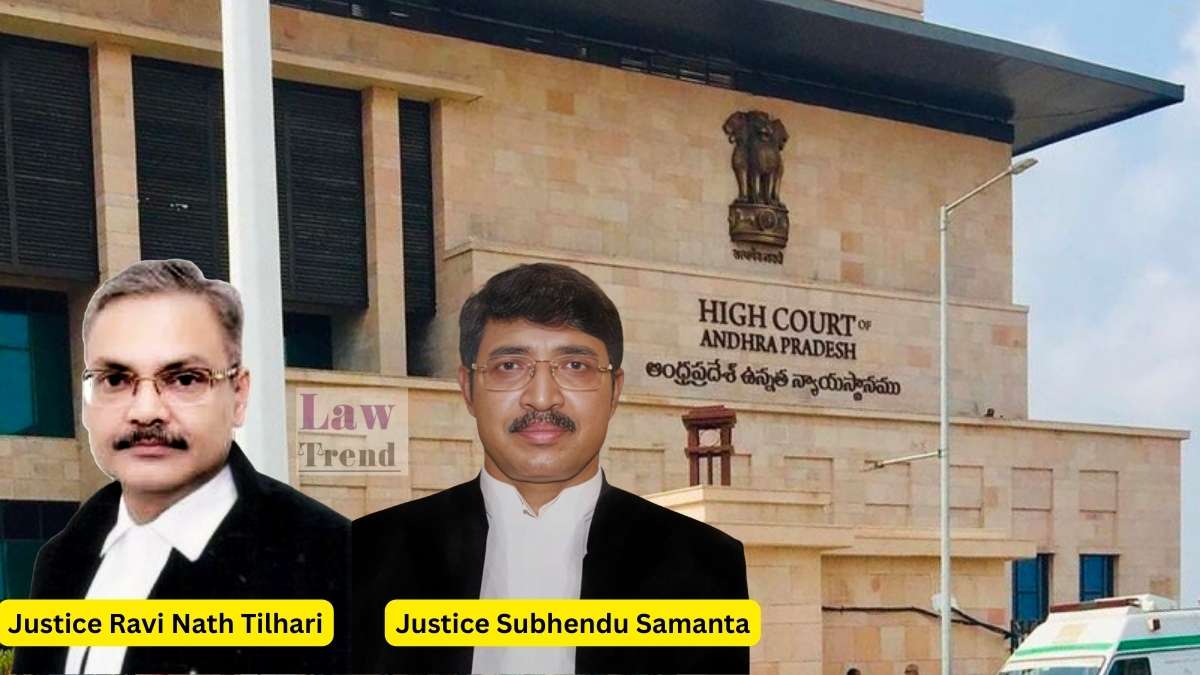
In a significant ruling clarifying service jurisprudence in police recruitments, a Division Bench of the High Court of Andhra Pradesh, comprising Justice Ravi Nath Tilhari and Justice Subhendu Samanta, has held that police personnel originally serving in reserve cadres who subsequently secure appointments to civil police posts through open direct recruitment cannot count their past reserve service for determining seniority. Setting aside orders of the Andhra Pradesh Administrative Tribunal, the High Court ruled that while Rule 15(c) of the Andhra Pradesh Police Subordinate Service Rules protects past seniority exclusively in cases of appointment by transfer, seniority for direct recruits is strictly governed by Rule 15(a) from the date of their fresh appointment to the civil post. The Bench also held that previous judicial orders passed on erroneous concessions by government pleaders cannot operate as binding precedent or entitle others to claim negative parity under Article 14 of the Constitution.
Background of the Case
The dispute arose from two separate original applications filed before the Andhra Pradesh Administrative Tribunal (Tribunal). In the primary matter, M.V. Durga Rao and other officers had originally been recruited as Reserve Sub-Inspectors of Police (RSI)—one in 1996 and others in 2003. They subsequently participated as open candidates in the 2004 direct recruitment process for the post of Sub-Inspector of Police (Civil), secured selection, and were appointed as Sub-Inspectors (Civil) in May 2005. Years later, they filed O.A. No. 3350 of 2012 before the Tribunal, seeking directions to count their previous service rendered as RSIs toward their seniority in the cadre of Sub-Inspector (Civil).
In the companion case, B.M. Chalam Babu and others, working as Head Constables, had initially entered service as Armed Reserve Police Constables (ARPC) and were subsequently selected and appointed as Police Constables (Civil) through direct recruitment. After a lapse of 15 years from their appointment as Civil Constables, they filed O.A. No. 2943 of 2011 demanding that their seniority in the civil cadre be reckoned from their initial entry as ARPCs.
The Tribunal allowed both original applications—relying on its previous orders in O.A. No. 6168 of 2011, which in turn followed a 2007 Division Bench decision of the Andhra Pradesh High Court in W.P. No. 22176 of 2004 and batch. In that 2007 batch, the High Court had extended the benefit of an earlier ruling, E. Shankar Reddy v. Government of A.P. (W.P. No. 2120 of 2000), after recording a concession by the then Government Pleader that the issue was covered. Aggrieved by the Tribunal’s directions mandating revision of seniority lists, the State Government approached the High Court through Writ Petition Nos. 24641 of 2014 and 1094 of 2016.
Arguments of the Parties
Appearing for the State of Andhra Pradesh, the learned Government Pleader submitted that the Tribunal completely misconstrued the statutory scheme governing the police subordinate service. It was contended that E. Shankar Reddy dealt exclusively with RSIs appointed to the post of Sub-Inspector (Civil) by way of “transfer” under the prescribed 5% transfer quota recognized by Rule 2, where Rule 15(c) creates a legal fiction protecting past service. In sharp contrast, the respondents were selected through open direct recruitment alongside independent candidates. For direct recruits, Rule 15(a) applies, fixing seniority strictly from the date of first appointment to that specific class or category. The State argued that the 2007 order in W.P. No. 22176 of 2004 was premised on an incorrect concession by the then Government Pleader, which did not decide rights on merits and could not override statutory rules.
Opposing the State’s petitions, counsel for the respondent police officers argued that the High Court’s 2007 judgment in W.P. No. 22176 of 2004 had attained finality because the Supreme Court of India dismissed the State’s Special Leave Petitions (SLPs) as well as Civil Appeals filed by third parties on March 16, 2010, followed by the dismissal of review petitions in November 2010. They contended that this finality bound the State under Article 141 of the Constitution. Furthermore, the respondents pointed out that the State Government had already implemented the directions for several similarly situated officers through executive orders (Government Orders); therefore, denying the respondents identical seniority benefits would violate the guarantee of equality under Article 14.
The Court’s Analysis
The Division Bench systematically examined the Andhra Pradesh Police Subordinate Service Rules, binding Supreme Court precedents, the legal effect of orders passed on concession, the doctrine of precedent under Article 141, and the concept of negative equality.
1. Transfer vs. Direct Recruitment: Rule 15(a) and Rule 15(c)
Analyzing Rule 15 of the Special Rules, the Court noted that sub-rule (a) establishes the default principle: seniority is determined by the date of first appointment to that class, category, or grade. Sub-rule (c) carves out an exception for transfers within the same scale of pay, stating that such transfer shall not be treated as a first appointment and past service shall be protected.
The Bench highlighted that the Supreme Court settled this exact issue in K. Rajaiah v. State of A.P. (1987 Supp SCC 345). In that case, an RSI who participated in direct recruitment for Sub-Inspector (Civil) sought to count his past service. Rejecting his plea, the Supreme Court held:
“Although a government servant can be transferred from one post to another, but when he chooses to get himself recruited to that another post after subjecting himself to all requirements and formalities of direct recruitment along with other independent candidates and is confirmed after satisfactory completion of the probationary period, his appointment as a direct recruit cannot be substituted by an order of transfer to the prejudice of the other direct recruits in the matter of computation of seniority.”
The High Court observed that E. Shankar Reddy had applied Rule 15(c) only because those officers were appointed under the 5% quota for recruitment by transfer, not through open direct competition. Since the respondents in the present case were indisputably direct recruits, the Court held that Rule 15(a) applied squarely to them, disentitling them from carrying forward past seniority from the reserve cadre.
2. Orders Passed on Concession Do Not Form Precedent
Addressing the 2007 order in W.P. No. 22176 of 2004, Justice Tilhari observed that it was passed purely on the concession of the then Government Pleader that the issue was covered by E. Shankar Reddy. The Court noted that this concession was legally untenable because E. Shankar Reddy pertained to transfer recruits, whereas the 2007 petitions concerned direct recruits.
Relying on the Supreme Court’s ruling in Municipal Corporation of Delhi v. Gurnam Kaur ((1989) 1 SCC 101), the Bench emphasized:
“It is axiomatic that when a direction or order is made by consent of the parties, the court does not adjudicate upon the rights of the parties nor does it lay down any principle. Quotability as ‘law’ applies to the principle of a case, its ratio decidendi. The only thing in a judge’s decision binding as an authority upon a subsequent judge is the principle upon which the case was decided.”
The Court concluded that decisions rendered sub silentio or on erroneous concession cannot serve as authoritative declarations of law.
3. Dismissal of SLPs in Limine and Article 141
Turning to the respondents’ argument that the dismissal of the State’s SLP and Civil Appeals in 2010 created a binding mandate under Article 141, the Bench scrutinized decisions in Kunhayammed v. State of Kerala ((2000) 6 SCC 359), Khoday Distilleries Ltd. v. Sri Mahadeshwara Sahakara Sakkare Karkhane Ltd. ((2019) 4 SCC 376), State of Orissa v. Dhirendra Sundar Das ((2019) 6 SCC 270), Gangadhara Palo v. Revenue Divisional Officer ((2011) 4 SCC 602), V. Senthur v. M. Vijayakumar ((2022) 17 SCC 568), and State of U.P. v. Rekha Rani ((2011) 11 SCC 441).
The Court ruled that the Supreme Court’s summary dismissal order dated March 16, 2010, contained no reasons, no discussion on the merits of the Special Rules, and no declaration of law. While an unreasoned dismissal of an appeal makes the decision final between those specific parties, it does not constitute a declaration of law or a binding precedent under Article 141 for subsequent cases. In contrast, the Bench noted, the Supreme Court’s reasoned judgment in K. Rajaiah explicitly interpreted the very same statutory rules and remains the binding precedent.
Distinguishing the recent coordinate bench decision in P. Shankaraiah v. R. Sreenivasulu (W.P. No. 12190 of 2021, decided on May 7, 2025), the Court noted that Shankaraiah involved third parties trying to reopen an order passed in the exact same proceeding that had attained finality up to the Supreme Court. Here, the State was challenging surviving Tribunal orders in independent proceedings that had not attained finality.
4. No Concept of Negative Parity under Article 14
Finally, the Bench rejected the contention that because the State had issued Government Orders implementing earlier Tribunal directives for other personnel, the present respondents were entitled to identical relief.
Citing State of Orissa v. Prasana Kumar Sahoo ((2007) 15 SCC 129), State of Odisha v. Anup Kumar Senapati ((2019) 19 SCC 626), and Basawaraj v. LAO ((2013) 14 SCC 81), the Court reiterated the fundamental principle that there can be no “equality in illegality”:
“Article 14 of the Constitution is not meant to perpetuate illegality or fraud, even by extending the wrong decisions made in other cases. The said provision does not envisage negative equality but has only a positive aspect. Thus, if some other similarly situated persons have been granted some relief/benefit inadvertently or by mistake, such an order does not confer any legal right on others to get the same relief as well.”
The Bench held that since the respondents possessed no legal right under the Special Rules to count past reserve service toward civil seniority, they could not claim parity on the basis of erroneous benefits previously extended to others.
The Decision
Holding that the orders of the Tribunal were contrary to the statutory rules and the binding law laid down in K. Rajaiah, the High Court allowed both writ petitions filed by the State.
The High Court formally set aside:
- The Tribunal’s judgment dated April 1, 2014, in O.A. No. 3350 of 2012 (with V.M.A. No. 1127 of 2012).
- The Tribunal’s judgment dated April 26, 2013, in O.A. No. 2943 of 2011.
The Bench made no order as to costs and directed that all pending miscellaneous applications stand closed.
Case Title: The Govt. of A.P., rep. by its Prl. Secretary to Govt. Home Department & Others v. M.V. Durga Rao & Others (with connected matter)
Case No.: Writ Petition Nos. 24641 of 2014 & 1094 of 2016
Bench: Justice Ravi Nath Tilhari and Justice Subhendu Samanta
Date: 22.09.2026




