

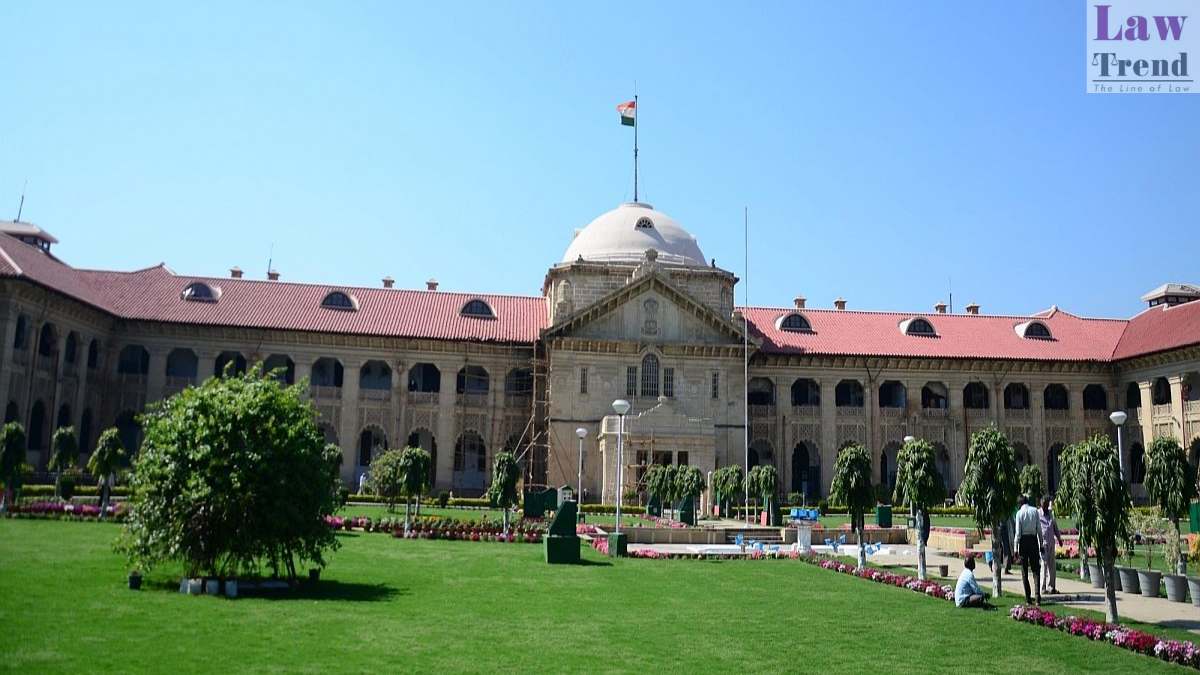
The Lucknow Bench of the High Court of Judicature at Allahabad, comprising Justice Shekhar B. Saraf and Justice Abdhesh Kumar Chaudhary, has ruled that state authorities cannot evade judicial findings and statutory limitations by indirectly enforcing a rent ceiling policy that they have already conceded is inapplicable. Setting aside administrative orders that unilaterally recalled a 2017 rent justification certificate and pegged the monthly rent of private food grain storage godowns at Rs. 350 per 100 bags instead of the recommended Rs. 1,200, the Court held that administrative bodies cannot circumvent the law through colourable exercises of power, act without recording cogent reasons, or treat similarly situated private lessors discriminatorily.
Background of the Dispute
The petitioner, Sudha Agarwal, owns two commercial godowns situated on the Allahabad-Faizabad main road in Sadar Tehsil, Ranjitpur, Chilbila, District Pratapgarh. Godown No. 1 (capacity of 10,736 bags) and Godown No. 2 (capacity of 19,282 bags) were constructed to meet the storage requirements of the Department of Food and Civil Supplies for the Public Distribution System (PDS) in the absence of State-owned facilities in the region.
The tenancy of Godown No. 1 commenced on March 11, 2003, at an initial monthly rent of Rs. 0.80 per 100 bags, while Godown No. 2 was taken on lease on September 8, 2006, at Rs. 1.75 per 100 bags. Following subsequent renewals, the District Magistrate issued a justification certificate on September 19, 2013, fixing the rent for both godowns at Rs. 300 per 100 bags, which was formally approved by the State Government for the period spanning April 1, 2012, to March 31, 2017.
Upon expiry of the term on March 31, 2017, the petitioner sought an enhancement. The Sub-Divisional Magistrate (SDM), acting on a local inquiry by the Tehsildar, submitted a report on November 29, 2017, noting that circle rates had increased up to 4.75 times and recommending a fourfold rent hike. Acting on this report, the District Magistrate issued a justification certificate dated December 27, 2017, recommending a revised rent of Rs. 1,200 per 100 bags for the period from April 1, 2017, to March 31, 2022.
Despite this official certificate, no fresh agreement was executed, and the State continued paying rent at the obsolete rate of Rs. 300 per 100 bags. After representations failed, the petitioner approached the High Court. In an earlier round of litigation (Writ-C No. 2917 of 2023), a coordinate Bench of the High Court noted on April 13, 2023, that Clause 14 of the Government Order dated May 2, 2018—which imposed a maximum 20 percent cap on rent revisions—expressly applied only to godowns rented after July 14, 2015. The court directed the Regional Food Controller to reconsider the applicability of the 2018 policy to pre-2015 tenancies.
However, on June 26, 2023, the District Magistrate, Pratapgarh, issued letters cancelling the 2017 justification certificate and issued fresh certificates recommending an amended rent of Rs. 350 per 100 bags. Consequently, on July 3, 2023, the Regional Food Controller passed an order fixing the rent at Rs. 350 per 100 bags with effect from April 1, 2017. Aggrieved by these orders, the petitioner approached the High Court once again. During the pendency of the petition, the tenancy came to an end, and vacant possession of the godowns was handed back to the petitioner on March 31, 2024, leaving the dispute confined to the revision and arrears of rent between April 1, 2017, and March 31, 2024.
Submissions by the Parties
Learned counsel for the petitioner, Shri Manoj Kumar Mishra, contended that the impugned orders dated July 3, 2023, were arbitrary, colourable, and passed in deliberate defiance of the binding judgment dated April 13, 2023. He argued that the authorities had conceded in their order that Clause 14 of the 2018 Government Order was inapplicable to tenancies initiated in 2003 and 2006, yet they indirectly enforced the 20 percent ceiling by issuing fresh certificates fixing rent at Rs. 350. Counsel further submitted that the 2017 certificate fixing Rs. 1,200 was the outcome of an exhaustive statutory inquiry reflecting a 4.75-fold rise in circle rates, and could not be unilaterally recalled without empirical evidence or reasons. He also placed on record that similarly situated godowns in Babaganj, Belkharnath, Sangipur, and Kalakankar had received rent revisions exceeding 20 percent based on justification certificates, making the State’s action discriminatory under Article 14 of the Constitution.
Opposing the petition, the learned Additional Chief Standing Counsel for the State maintained that the order dated July 3, 2023, was lawful and passed under the Government Order dated May 2, 2018, which superseded all earlier orders. He submitted that Clause 14 restricted enhancement to 20 percent or the rate in the justification certificate, whichever is less. He asserted that the 2017 certificate recommending a fourfold increase to Rs. 1,200 had been issued beyond jurisdiction, far exceeded prevailing local rates, and was rightfully recalled by the District Magistrate on June 26, 2023, upon the intervention of the Divisional Commissioner. Counsel argued that public authorities could not exceed the policy ceilings and prayed for the dismissal of the petition.
The Court’s Analysis and Observations
Delivering the judgment for the Bench, Justice Abdhesh Kumar Chaudhary observed that the core issue was whether the 20 percent enhancement ceiling under Clause 14 of the Government Order dated May 2, 2018, could lawfully be applied to pre-2015 tenancies, and whether the authorities possessed the competence to unilaterally recall the 2017 justification certificate following the High Court’s earlier judgment.
The Court noted that while the Regional Food Controller explicitly acknowledged in paragraph 4 of the impugned order that Clauses 14 and 15 of the 2018 Government Order did not apply to the petitioner’s pre-2015 tenancies, the revised rate of Rs. 350 rested entirely on the fresh certificates issued under those very restrictions. Denouncing this self-contradiction, the Court invoked the settled legal doctrine articulated in State of T.N. v. K. Shyam Sunder (2011) and Jagir Singh v. Ranbir Singh (1979):
“what cannot be done directly cannot be permitted to be done indirectly, for that would amount to an evasion of the very finding the authority itself has recorded. An authority cannot, on the one hand, hold a provision inapplicable to a party and, on the other, achieve the very result that provision would have produced, through a different door.”
The Bench also condemned the summary cancellation of the justification certificate dated December 27, 2017, observing that it had been generated through a structured administrative inquiry based on circle rate hikes and had created a legitimate expectation. Citing the Supreme Court decisions in State of Kerala v. K.G. Madhavan Pillai (1988) and Navjyoti Co-op. Group Housing Society v. Union of India (1992), the Court observed:
“withdrawal of a sanction, benefit or certificate previously granted and acted upon, without adherence to the principles of natural justice or without recording cogent reasons demonstrating jurisdictional or factual infirmity, is impermissible”
The Bench underscored that the respondents had failed to demonstrate any factual or jurisdictional defect in the Tehsildar’s inquiry or the SDM’s report.
Addressing the hurried timeline where the 2017 certificate was cancelled on June 26, 2023, and rent was fixed at Rs. 350 on July 3, 2023, following the High Court’s remand, the Bench observed that the administrative action constituted a colourable exercise of power and legal malice. Citing State of Punjab v. Gurdial Singh (1980), the Court reiterated that legal malice lies in:
“the attainment of ends beyond the sanctioned purposes of power by simulation or pretension of gaining a legitimate goal”
Furthermore, the Court faulted the impugned orders for being completely devoid of reasons, market analyses, or comparative data explaining how Rs. 350—a nominal rise over the 2013 rate of Rs. 300—could constitute fair rent in 2023 on a State highway. Reaffirming the principles in S.N. Mukherjee v. Union of India (1990), Siemens Engineering & Manufacturing Co. of India Ltd. v. Union of India (1976), and Kranti Associates (P) Ltd. v. Masood Ahmed Khan (2010), the Court reiterated:
“reasons are the heartbeat of every conclusion”
Citing Mohinder Singh Gill v. Chief Election Commissioner (1978), the Bench held that:
“an order must stand or fall on the reasons recorded therein, and cannot be supplemented by reasons offered later.”
On the issue of parity, the Court took serious note of the uncontroverted submissions that private godowns at Babaganj, Belkharnath, Sangipur, and Kalakankar had received rent revisions exceeding 20 percent. Referring to the foundational principles of Article 14 laid down in E.P. Royappa v. State of Tamil Nadu (1974), Ramana Dayaram Shetty v. International Airport Authority of India (1979), and Ajay Hasia v. Khalid Mujib Sehravardi (1981), the Court held that the State cannot grant preferential terms to similarly situated lessors without an articulated, rational justification.
Decision of the Court
While recognizing that fixing fair rent is essentially an executive function involving local market data and budgetary factors—precluding the Court from directly fixing the rent at Rs. 1,200—the High Court quashed Office Order No. 671 and Order No. 669 dated July 3, 2023, along with the District Magistrate’s recall letters dated June 26, 2023.
The Bench remitted the matter back to the Regional Food Controller and competent authorities with specific directions:
- Rent must be determined independently without applying Clause 14 of the Government Order dated May 2, 2018.
- Revised rent must be determined afresh under applicable policy, having due regard to the 2017 justification certificate, the SDM’s report on circle rates, and other relevant material through a reasoned, speaking order.
- If the 2017 justification certificate is to be superseded, explicit, cogent reasons demonstrating jurisdictional or factual infirmity must be recorded in writing after affording a fair hearing, rather than merely reiterating the inapplicable 20 percent ceiling.
- The competent authority must examine and return a specific finding on the petitioner’s claim of parity with godowns at Babaganj, Belkharnath, Sangipur, and Kalakankar under Article 14.
- The entire exercise must be completed within 12 weeks from the date a certified copy of the order is produced.
All other claims, including the petitioner’s entitlement to GST and interest on arrears, have been left open to be urged before the competent authority.
Case Details:
Case Title: Sudha Agarwal v. State Of U.P. Thru. Addl. Chief Secy. Food And Civil Supply, U.P. Lucknow And 6 Others
Case No.: WRIT C No. 47 of 2024
Bench: Justice Shekhar B. Saraf and Justice Abdhesh Kumar Chaudhary
Date: September 24, 2026




