

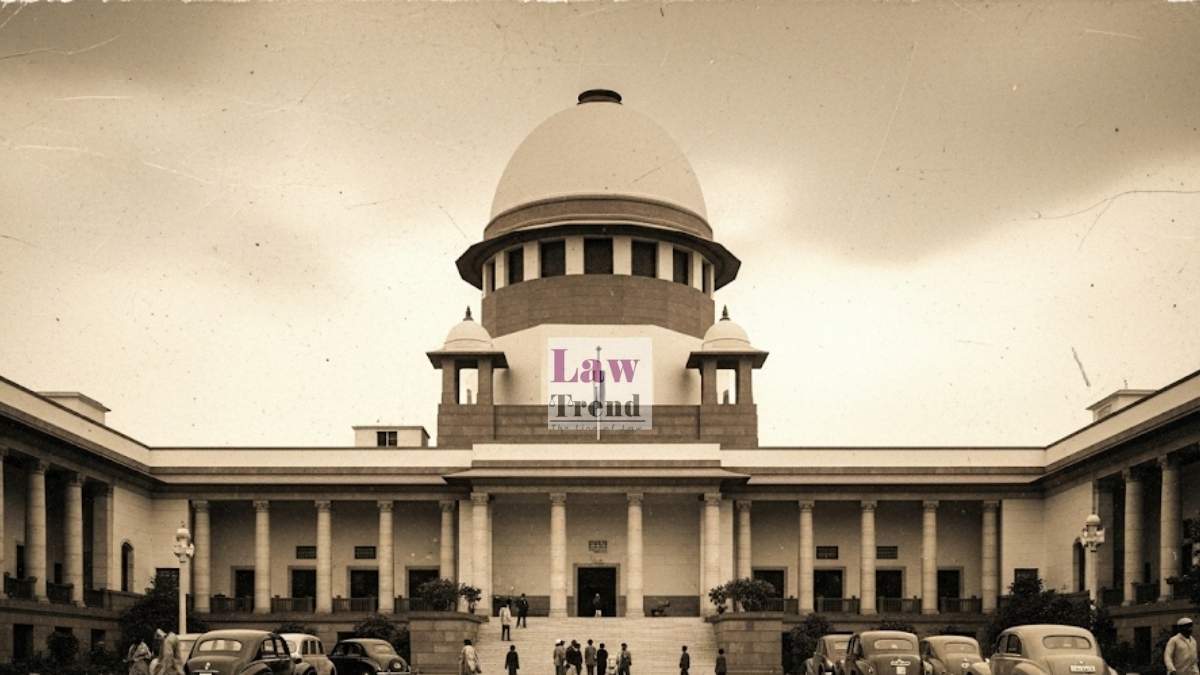
The Supreme Court bench comprising Justice Ujjal Bhuyan and Justice Arun Palli has held that the proof of demand and acceptance of illegal gratification is an indispensable requirement (sine qua non) to establish offences under the Prevention of Corruption Act, 1988, setting aside the conviction and two-year sentence of a deceased revenue official whose legal representatives pursued the appeal.
Background of the Case
The appellant, Jaswinder Singh, who was serving as a Patwari, was accused of demanding an illegal gratification of Rs. 10,000 from the informant, Kulwant Singh, for sanctioning the mutation of land belonging to the informant’s deceased brother in favour of his legal heirs. Following negotiations, the amount was settled at Rs. 9,500.
The informant reported the matter to the Deputy Superintendent of Police (DSP), Vigilance Bureau, who organized a trap on April 19, 2002. Nineteen phenolphthalein-dusted currency notes of Rs. 500 denomination were handed to the informant. During the trap, one Onkar Singh acted as the shadow witness, while official witnesses Harnandan Singh and Balkar Singh were joined. According to the prosecution, the informant handed over the tainted notes to the appellant upon demand, after which the raiding party intercepted him, recovered the money, and conducted a sodium carbonate hand-wash test which turned pink.
On February 25, 2004, the Special Judge, Hoshiarpur, convicted the appellant under Section 7 read with Section 13(2) of the Prevention of Corruption Act, sentencing him to two years of rigorous imprisonment and a fine of Rs. 10,000. On November 28, 2013, the High Court of Punjab and Haryana dismissed his appeal. After the appellant passed away during the pendency of proceedings before the Supreme Court, his legal representatives were substituted to contest the appeal.
Evidence and Arguments
The prosecution examined seven witnesses to establish its case, whereas the appellant examined one defence witness in support of his plea of innocence. Informant Kulwant Singh (PW-1) deposed that the appellant demanded the bribe, accepted the tainted currency notes, and placed them into the pocket of his trousers, from where they were subsequently recovered.
However, the shadow witness, Onkar Singh (PW-2), admitted in his testimony that he had stepped out of the office because the appellant appeared busy and that the money was neither paid nor recovered in his presence. Furthermore, PW-2 noted that he was informed by the vigilance party that the money had been recovered from the appellant’s shirt pocket, directly contradicting PW-1’s account of recovery from the trouser pocket. The official witness, Harnandan Singh (PW-4), similarly admitted during cross-examination that the money was not handed over by the informant to the appellant in his presence.
Court’s Analysis and Precedents
Reviewing the statutory provisions of Sections 7 and 13 of the Prevention of Corruption Act alongside the evidence on record, the Court observed that neither the demand nor the acceptance of the bribe had been corroborated by the prosecution’s witnesses.
The Court relied on several landmark precedents:
- In P. Satyanarayana Murthy Vs. State of A.P., the Court observed: “The proof of demand of illegal gratification, thus, is the gravamen of the offence under Sections 7 and 13(1)(d)(i) and (ii) of the Act and in absence thereof, unmistakably the charge therefor, would fail. Mere acceptance of any amount allegedly by way of illegal gratification or recovery thereof, dehors the proof of demand, ipso facto, would thus not be sufficient to bring home the charge under these two sections of the Act. As a corollary, failure of the prosecution to prove the demand for illegal gratification would be fatal and mere recovery of the amount from the person accused of the offence under Section 7 or 13 of the Act would not entail his conviction thereunder.”
- In the Constitution Bench judgment in Neeraj Dutta Vs. State (Government of NCT of Delhi), it was established that: “Proof of demand and acceptance of illegal gratification by a public servant as a fact in issue by the prosecution is a sine qua non in order to establish the guilt of the accused public servant under Sections 7 and 13(1)(d)(i) and (ii) of the Act.”
- In Aman Bhatia Vs. State, the Bench reiterated: “It is well-settled that mere recovery of tainted money, by itself, is insufficient to establish the charges against an accused under the PC Act. To sustain a conviction under Sections 7 and 13(1)(d) of the Act respectively, it must be proved beyond reasonable doubt that the public servant voluntarily accepted the money, knowing it to be a bribe. The courts have consistently reiterated that the demand for a bribe is sine qua non for establishing an offence under Section 7 of the PC Act.”
Assessing the facts, the Court noted that both the shadow witness (PW-2) and the official witness (PW-4) deposed that the money was neither handed over nor recovered in their presence, leaving the prosecution’s case without substantiation. The Court held: “Under such circumstances, it is evident that neither the demand nor acceptance of the bribe can be said to have been proved. As a matter of fact, no one saw the appellant making the demand for bribe and no one saw PW-1 handing over the bribe money to the appellant nor acceptance of the same by the appellant.”
Decision
Concluding that the charge framed against the deceased appellant could not be sustained in the absence of proof of demand and acceptance, the Supreme Court allowed the appeal and set aside the judgment of the Special Judge, Hoshiarpur, and the affirming order of the High Court of Punjab and Haryana. The Court declared that the charges under Sections 7 and 13(2) of the Prevention of Corruption Act were not proved, clearing Jaswinder Singh of all charges.
Case Title: Jaswinder Singh (Dead through LRs.) Versus State of Punjab
Case No.: Criminal Appeal No. 2137 of 2014
Bench: Justice Ujjal Bhuyan and Justice Arun Palli
Date: September 22, 2026




