

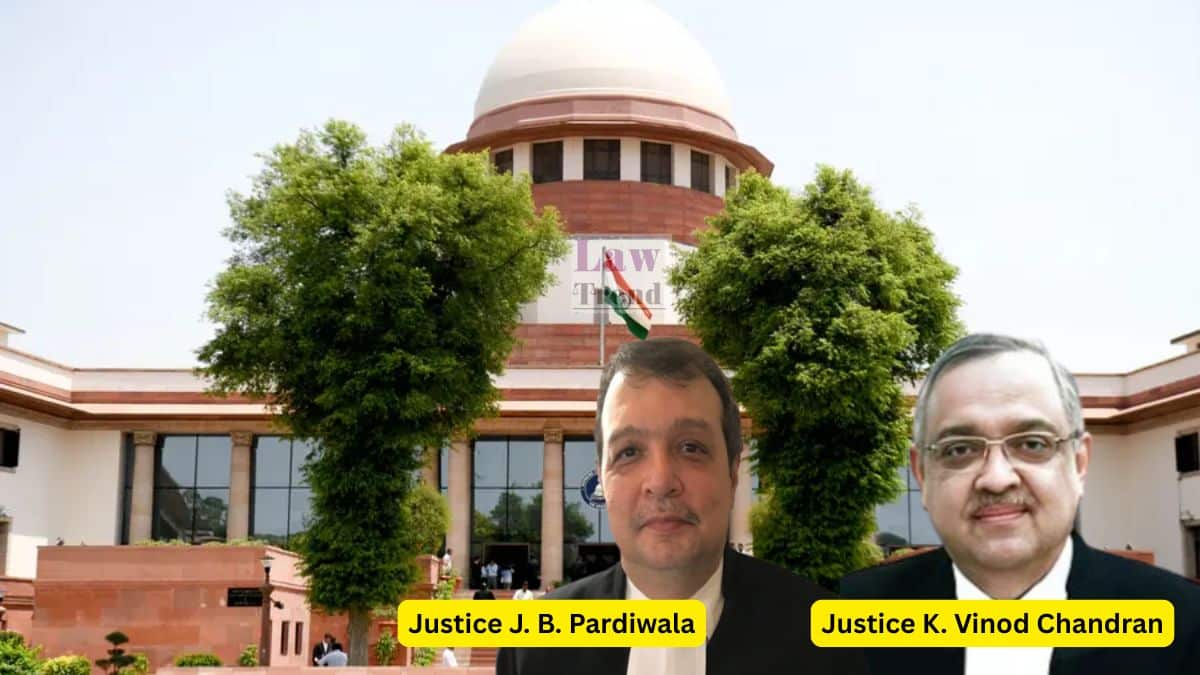
The Supreme Court of India, comprising a Bench of Justice J. B. Pardiwala and Justice K. Vinod Chandran, has ruled that successive appellate orders passed by a High Court in first appeals do not confer a fresh cause of action or extend the statutory three-month period of limitation to claim redetermination of compensation under Section 28A of the Land Acquisition Act, 1894. Allowing an appeal filed by the New Okhla Industrial Development Authority (NOIDA), the Court set aside an order of the High Court and held that the limitation period had expired three months after the High Court’s initial enhancement order concerning the same acquisition and village, leaving subsequent applications based on later orders time-barred.
Background of the Case
The dispute arose out of land acquisition proceedings initiated under Section 4(1) read with Section 17 of the Land Acquisition Act, 1894, for which an award was rendered by the Land Acquisition Officer on February 15, 1977. The predecessors-in-interest of the respondents received the entire compensation awarded and did not seek a reference under Section 18 of the 1894 Act.
However, other landholders whose lands were acquired under the very same notification sought a reference under Section 18. The Additional District Judge, Ghaziabad, rejected their reference by a judgment and decree dated November 25, 1981. Aggrieved by the rejection, those landowners preferred a First Appeal (First Appeal No. 458 of 1982) under Section 54 of the Act before the High Court.
The High Court disposed of First Appeal No. 458 of 1982 on April 18, 2022, enhancing compensation by relying on an earlier decision rendered on July 8, 2019, in First Appeal No. 593 of 1982. Following the April 18, 2022 decision, the respondent landowners filed an application under Section 28A before the Collector on May 23, 2022, claiming parity within three months of that order.
The Collector rejected the application as not maintainable on the ground that it was founded on an appellate decree under Section 54 rather than an award passed by a Reference Court under Section 18. Upon challenge, the High Court directed the application to be entertained, relying on the three-Judge Bench decision in Union of India v. Pradeep Kumari (1995) and the Division Bench ruling in Banwari v. Haryana State Industrial and Infrastructure Development Corporation Limited (2024). NOIDA subsequently challenged this decision before the Supreme Court.
Submissions of the Parties
The appellant authority contended that the respondents’ application under Section 28A was not maintainable and was barred by limitation. It asserted that Section 28A is triggered strictly by Reference Court awards, and even where an appellate order could be relied upon, limitation could not run from subsequent orders that merely followed earlier adjudications.
Conversely, counsel for the respondent landowners argued that under the doctrine established in Union of India v. Pradeep Kumari, successive awards provide independent causes of action, and as a beneficial piece of legislation, successive appellate orders should likewise grant fresh entitlement under Section 28A. The respondents also placed reliance on Andanayya v. Deputy Chief Engineer (2026), citing the doctrine of merger and earlier decisions in Babua Ram v. State of U.P. (1995) and Bharatsing v. State of Maharashtra (2018), to submit that an application predicated on a High Court order in first appeal was maintainable.
The Court’s Analysis and Precedents
In delivering the judgment, Justice K. Vinod Chandran meticulously examined the statutory scheme of Section 28A and the evolution of its jurisprudence through coordinate and larger benches.
The Bench observed that Union of India v. Pradeep Kumari (1995) 2 SCC 736 permitted successive applications within three months of any subsequent Reference Court award under Part III of the Act because landholders who lacked sufficient evidence in earlier references, or who owned lands in different villages covered by the same notification, would otherwise suffer inequity. However, the Court underscored that Pradeep Kumari contemplated awards passed under Section 26 upon references made under Section 18, not orders passed in first appeals by the High Court.
The Court then referred to the three-Judge Bench decision in Jose Antonio Cruz Dos R. Rodriguese v. Land Acquisition Collector (1996) 6 SCC 746, which established that the expression “Court” in Section 28A refers solely to the Reference Court under Section 18, and that limitation runs from the Reference Court’s award, not from an appellate decree. This principle was also affirmed by a two-Judge Bench in Union of India v. Hansoli Devi (2010) 15 SCC 483, following the Constitution Bench decision in Union of India v. Hansoli Devi (2002) 7 SCC 273.
Turning to the strict nature of statutory time frames, the Bench reiterated Popat Bahiru Govardhane v. Special Land Acquisition Officer (2013) 10 SCC 765:
“Here we have to immediately notice the decision in Popat Bahiru Govardhane and Others, which held unequivocally that the date on which limitation commences under Section 28A, is the date of award and not the date of knowledge.”
Addressing Banwari v. HSIIDC (2024), the Bench clarified the narrow exception where an appellate order can trigger Section 28A. Under Banwari, if the Reference Court rejects a Section 18 reference in its entirety without granting any enhancement, no cause of action under Section 28A arises at that stage. It is only when the High Court enhances compensation in first appeal that an entitlement arises for the first time. The Court identified this situation as a legislative gap:
“Hence, the device of an application under Section 28A, from an order in appeal, when the reference is declined by the reference court, is a caussus omissus, ensuring the beneficial legislation not being stultified in the event of a reference under Section 18 being rejected as laid down in Banwari and Ors.; a situation not contemplated by the legislature, obviously.”
Applying these principles to the facts at hand, the Bench observed that the order of April 18, 2022 in First Appeal No. 458 of 1982 did not determine enhanced compensation for the first time; it merely applied the earlier judgment of July 8, 2019 passed in First Appeal No. 593 of 1982, which pertained to the identical village under the very same acquisition notification. The Bench held:
“The party respondent’s claim under Section 28A, limitation of which commenced on 08.07.2019, stood barred on expiry of three months therefrom.”
The Court firmly rejected the proposition that successive High Court orders create recurring causes of action:
“We also have to emphasize that there is no question of successive orders in First Appeal, conferring fresh cause of action under Section 28A, since in First Appeal, the High Court being a Court of Record is bound by an order passed at the first instance, by a Coordinate Bench.”
The Bench also expressed its disagreement with the two-Judge Bench decision in Andanayya v. Deputy Chief Engineer (2026 SCC OnLine SC 482), which had permitted a second Section 28A application following a High Court award under the doctrine of merger. The Court pointed out that Andanayya conflicted directly with the three-Judge Bench rulings in Jose Antonio Cruz and Pradeep Kumari—the latter of which explicitly mandates that only one application under Section 28A can be moved by an applicant.
The Decision
Finding that the respondents’ application was filed long after the expiry of the three-month limitation period calculated from July 8, 2019, the Supreme Court held the claim to be barred by time. The Court accordingly allowed the appeal, set aside the impugned High Court judgment, and rejected the respondents’ application under Section 28A of the Land Acquisition Act, 1894.
Case Details:
Case Title: New Okhla Industrial Development Authority & Anr. v. Rajveer Singh & Ors.
Case No.: Civil Appeal No. ___ of 2026 (Arising out of SLP (C) No. 18801 of 2025)
Bench: Justice J. B. Pardiwala and Justice K. Vinod Chandran




