

Habeas Corpus Not Maintainable Based Solely on Newspaper Reports for Missing or Absconding Persons: Andhra Pradesh High Court
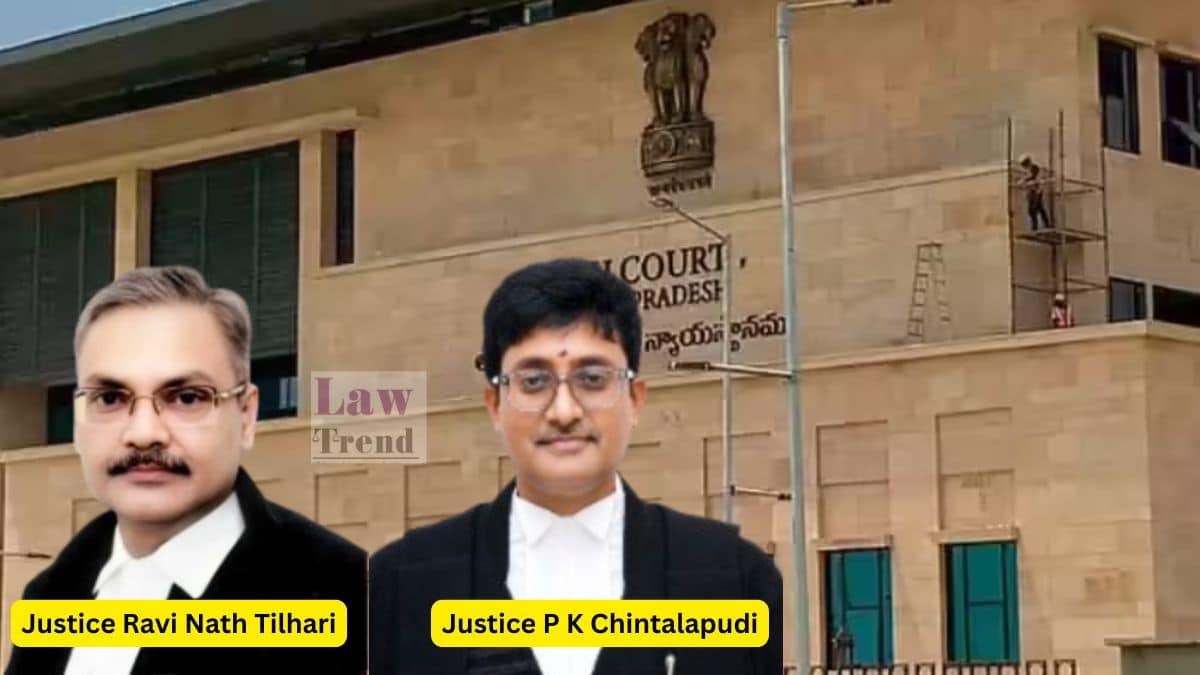

The High Court of Andhra Pradesh at Amaravati has ruled that a writ of habeas corpus cannot be entertained merely on the basis of unverified newspaper reports when the alleged detenu is absconding or missing, and where no substantive material exists to demonstrate unlawful detention. A Division Bench comprising Justice Ravi Nath Tilhari and Justice Purushottam Kumar Chintalapudi dismissed a habeas corpus petition filed by the relatives of two accused individuals seeking the production of an alleged co-accused in a narcotics case, reiterating that unlawful detention is the foundational requirement for invoking habeas corpus jurisdiction.

Background of the Case

The proceedings originated from an enforcement action conducted by the Patamata Police Station, Vijayawada. On June 9, 2026, Sub-Inspector Jami Bharath Kumar received credible intelligence regarding the illicit transit and commercial sale of ganja. Police intercepted two lorries near Model Dairy on National Highway-16, Nidamanuru, and apprehended two drivers, T. Pradeep (A4) and Selvam (A5), along with seizing 140 kg of ganja destined for Coimbatore, Tamil Nadu.

Upon interrogation, the drivers confessed that Mohammed Sohel (A1), Rajesh Kumar Singh (A2), and Anoop Singh (A3) had supplied the contraband. Consequently, Crime No. 231/2026 was registered. The drivers (A4 and A5) were subsequently remanded to judicial custody.

The controversy arose following a media report published on June 16, 2026, in The Times of India, which claimed that Mohammed Sohel, identified as the kingpin of an interstate smuggling ring, had been arrested in Visakhapatnam along with A2 and A3, but had subsequently escaped police custody prior to court production.

Relying on this news report, Sukanti Bilar Sing (mother of A2) and Kuntala Sing (mother of A3) moved the High Court under Article 226 of the Constitution of India. The petitioners alleged that A1 was being held in illegal police custody without production before a Magistrate, violating Articles 14 and 21 of the Constitution. They also claimed that A1 was a crucial witness whose testimony could establish the innocence of their sons.

READ ALSO  S. 439 CrPC | HC Should Confine Itself to Grant or Refusal of Bail, Rules SC

Arguments of the Parties

Appearing for the petitioners, counsel Sri V. Ravindhar submitted that while A2 and A3 were lawfully remanded to judicial custody on June 16, 2026, the police had falsely portrayed A1 as absconding while keeping him in unlawful custody. He argued that the published newspaper report could not be disregarded and that constitutional courts have consistently taken cognizance of press reports in habeas corpus petitions to safeguard fundamental freedoms.

Opposing the petition, Assistant Government Pleader Sri J. Krishna Praneeth, representing the State authorities, firmly denied that A1 was ever arrested or detained. The State submitted that when a surveillance team attempted to apprehend A1 at the M.S.R. Grand Hotel in Vijayawada during the intervening night of June 11 and June 12, 2026, A1 fled and boarded the ERS TATA Express (Train No. 18190) from Vijayawada Railway Station. Accused A2 and A3 were later arrested in Visakhapatnam on June 15, 2026, and remanded on June 16, 2026, whereas A1 remained an absconding accused with multiple prior criminal cases in Kerala and Odisha.

The State argued that newspaper clippings constitute inadmissible hearsay evidence under Section 81 of the Indian Evidence Act, 1872, and relied upon the Supreme Court ruling in Laxmi Raj Shetty and another v. State of Tamil Nadu to contend that a writ cannot lie for an absconding person based solely on media reports.

The Court’s Analysis and Precedents

Delivering the judgment for the Bench, Justice Purushottam Kumar Chintalapudi framed the central question as whether a writ of habeas corpus is maintainable based on a newspaper publication to produce an accused who is alleged to be missing or absconding.

The Bench observed that the petitioners, mothers of co-accused A2 and A3, did not possess personal knowledge or explicit authorization from A1, and were primarily seeking A1’s production to exonerate their sons. The Court underscored that writ jurisdiction cannot be used as an investigative tool to procure evidence for a defence:

“The jurisdiction of habeas corpus is directed towards determining the legality of detention; it cannot be converted into a mechanism for procuring the presence of an alleged missing person merely because his presence may assist an accused in his defence.”

Addressing the maintainability of habeas corpus for missing persons, the Court referred to the Supreme Court’s ruling in Kanu Sanyal vs. District Magistrate, Darjeeling, and the Madhya Pradesh High Court Division Bench decision in Simmi Bai v. Shrimaan Police Mahanirikshak Mahodaya and others (reiterated in coordinate bench decisions of the Andhra Pradesh High Court in Doosari Grasamma and Panchaparvala Rajyalakshmi). Citing Simmi Bai, the Bench highlighted:

“A writ of habeas corpus is not maintainable in respect of a person who is simply missing and not in unlawful detention. Unlawful detention is the sine qua non for issuance of writ of habeas corpus…”

Evaluating the evidentiary value of the newspaper report, the Bench extensively cited the Supreme Court’s landmark judgment in Laxmi Raj Shetty and another v. State of Tamil Nadu, which held:

“A report in a newspaper is only hearsay evidence. A newspaper is not one of the documents referred to in Section 78(2) of the Evidence Act, 1872 by which an allegation of fact can be proved. The presumption of genuineness attached under Section 81 of the Evidence Act to a newspaper report cannot be treated as proved of the facts reported therein.”

The Bench also referred to Prakash C. v. State of Kerala, alongside Supreme Court rulings in Vikas Vashishth v. Allahabad High Court, Rohit Pandey v. Union of India, and Holicow Pictures Pvt. Ltd. v. Prem Chandra Mishra, affirming that petitions based on unverified newspaper reports without personal verification or supporting material cannot be entertained.

Furthermore, referencing the Jharkhand High Court Division Bench ruling in Laeek Khan v. State of Jharkhand, the Court observed that where an individual is evading arrest and absconding rather than being held in state custody, no relief under habeas corpus can be extended.

READ ALSO  Civil Miscellaneous Appeal Against Final Order Under Section 25 Of Hindu Marriage Act Is Maintainable: Andhra Pradesh High Court

The Decision

The High Court concluded that the petitioners had failed to place any independent, contemporaneous, or verifiable material on record to substantiate the allegation that A1 was taken into custody or detained unlawfully.

Holding that the writ petition was not maintainable on the basis of an unconfirmed newspaper report for an accused who is evading arrest, the Bench dismissed the petition.

Case Details

Case Title: Sukanti Bilar Sing and another v. The State of Andhra Pradesh and others
Case No.: Writ Petition No. 16256 of 2026
Bench: Justice Ravi Nath Tilhari and Justice Purushottam Kumar Chintalapudi
Date of Judgment: August 18, 2026

READ ALSO  Question of Limitation Involving Disputed Facts Cannot Be Adjudicated Under Order VII Rule 11 CPC: Andhra Pradesh High Court
Ad 20- WhatsApp Banner

Law Trend
Law Trendhttps://lawtrend.in/
Legal News Website Providing Latest Judgments of Supreme Court and High Court

Related Articles

Latest Articles

