

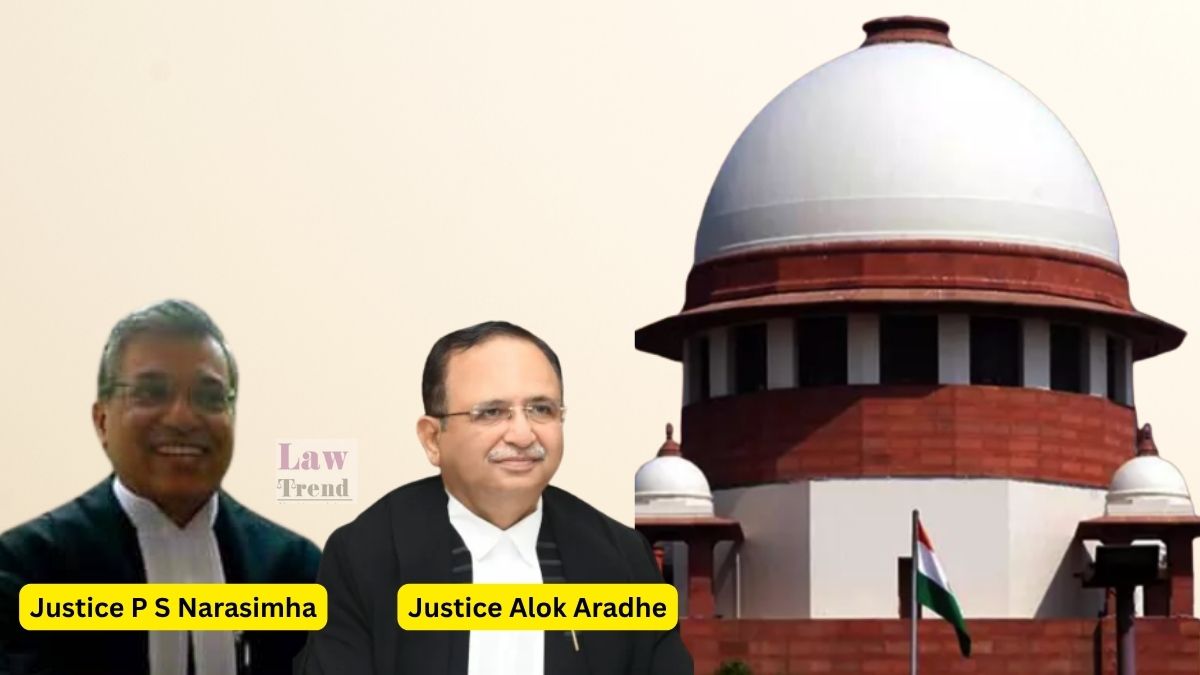
The Supreme Court of India has ruled that fees determined at the commencement of a professional education course cannot ordinarily be varied midstream, holding that competent authorities and fee fixation committees must notify the fee payable for the entire duration of a course before a student takes admission. A bench comprising Justice Pamidighantam Sri Narasimha and Justice Alok Aradhe upheld the ultimate conclusion of a Division Bench of the Calcutta High Court, which quashed a mid-session fee hike imposed on students admitted to undergraduate engineering courses in West Bengal prior to an October 16, 2023 government notification. The top court underscored that fee determination involves balancing the legitimate interests of students and parents in financial certainty against the necessity of self-financing Higher Education Institutions (HEIs) to secure resources for quality infrastructure, while mandating that fee fixation committees must perform their statutory public functions with institutional efficiency.
Background of the Controversy
The dispute arose in the context of admissions to undergraduate engineering programmes for the 2023–24 academic year (2023–27 cohort). Following the West Bengal Joint Entrance Examinations (WBJEE) and JEE (Main) rankings, the West Bengal Joint Entrance Examinations Board conducted centralised counselling between July and August 2023. Students concluded their admission formalities and deposited fees in September 2023 at Dr. B.C. Roy Engineering College, a self-financing private institution affiliated with Maulana Abul Kalam Azad University of Technology (MAKAUT).
The college prospectus specified a semester-wise fee structure across the four-year course, alongside a clause stating that the “fee structure is subject to change from time to time as per Government decision.”
On October 16, 2023—approximately one-and-a-half months after admissions had closed—the Department of Higher Education, Government of West Bengal, issued Notification No. 466-Edn-(T)/10M-04/2004 (Part IV). This notification revised the upper ceiling of fees chargeable by self-financing professional colleges, enhancing it to a maximum of Rs. 1,10,000/- per annum per student, with permission to charge up to 15% as a development fee. It stated that the revised structure was to continue for at least four years for B.Tech and B.Pharm courses effective from the 2023–2024 session.
This revision was issued following recommendations of an Expert Committee constituted on November 15, 2019, which had been adopted by the Fee Structure Committee on June 9, 2023, coming after a seven-year hiatus since the previous revision in the 2016–17 academic year.
Relying on this notification, the college issued a notice on December 15, 2023, hiking tuition fees and imposing a new development fee starting from the second semester in January 2024. The revision represented a 37.5% hike in fees payable by each student. Aggrieved, the admitted students submitted representations seeking a rollback, and subsequently moved the Calcutta High Court.
Legal Journey: Single Judge and Division Bench Decisions
Before the High Court, the students limited their challenge to the applicability of the revised fee structure to those admitted prior to the October 16, 2023 notification, citing Regulation 7 of the All India Council for Technical Education (Norms and Guidelines for Fees and Guidelines for Admission in Professional Colleges) Regulations, 1994 (AICTE Regulations 1994).
A Single Judge of the High Court dismissed the writ petitions on January 15, 2026, holding that the fee structure was not indivisible under the rules, that the college prospectus expressly reserved the right to alter fees per government decisions, and that writ jurisdiction could not be invoked to evade contractual terms.
On appeal, a Division Bench of the Calcutta High Court set aside the Single Judge’s verdict on March 23, 2026. The Division Bench held that Regulation 7(7) of the AICTE Regulations 1994 contemplated an en bloc fixation of fees for the entire course, read down the government notification to apply only to students admitted on or after October 16, 2023, and held that applying the revision to already admitted students gave it impermissible retrospective effect. Invoking principles of equity and promissory estoppel, the Division Bench quashed the revised fee notifications for students admitted before October 16, 2023, and directed the college to refund or adjust the additional amounts collected.
The college and the Association of Professional Academic Institutes, West Bengal, subsequently appealed to the Supreme Court.
Submissions of the Parties
Senior Advocates Mr. Jaideep Gupta, Mr. Harin Raval, and Mr. Rauf Rahim appeared for the appellant colleges, while Senior Advocate Mr. Sanjay R. Hegde represented the respondent students.
The appellants contended that self-financing private colleges require adequate resources to meet operational, recurring, and developmental expenses, relying on the enabling clause in the admission brochure and the state notification. The respondents argued that students entered the courses on the basis of a fixed fee projection, and an unexpected midstream hike caused profound financial prejudice contrary to statutory AICTE norms.
Supreme Court’s Analysis and Principles
Delivering the judgment, the Supreme Court highlighted the tension between competing interests in professional education. Addressing the financial reality of families, the bench cited empirical survey findings from the National Statistical Office (NSO) showing that households spend considerably more on professional education than on general courses, with fees comprising the largest share:
“For the overwhelming majority of households, the fee payable for a professional course constitutes a substantial part of the family’s income and savings; it is not a matter of incidental expenditure. The parents make the provision for payment of fee payable for the professional courses with the aspiration that their children will acquire better qualifications, secure better opportunities, and build a future that may be better than their own.”
The Court emphasized the role of governance in mitigating economic uncertainty:
“It is a matter of good governance for the state and its regulatory bodies to create an ecosystem in which there is certainty about the financial obligation that students and their families need to undertake for acquiring professional qualifications. Adverse variations in financial commitment, and the insecurities that it may create, will impact the student and the family, and, in the long run, have an adverse effect on the quality and character of the professionals that are in the making.”
At the same time, the bench acknowledged the contribution of private enterprise in nation-building, referring to the precedents in TMA Pai Foundation v. State of Karnataka (2002), Islamic Academy of Education v. State of Karnataka (2003), and P.A. Inamdar v. State of Maharashtra (2005). The bench observed:
“Self-financing institutions necessarily require substantial investment in land, buildings, facilities, student services, libraries, equipment, technology, and the like. They must be capable of drawing and retaining competent teaching faculty and other professional staff by providing them suitable, if not attractive, remuneration. After meeting legitimate operational and developmental expenditure, the institutions must also be permitted a reasonable return for sustenance and further development.”
Examining the regulatory framework under the AICTE Regulations 1994, the National Education Policy 2020 (NEP-2020), and the ruling in Lifecare Innovations Pvt. Ltd. v. Union of India (2025), the Court observed that institutional efficiency in fee determination is paramount. Under Regulation 7 of the AICTE Regulations 1994, fees must be determined based on estimated recurring expenditure over three years and audited figures, with intimation given in advance for the entire course. The bench stated:
“A student entering a four-or five-year professional programme should ordinarily know, at the very threshold, the financial liability that they or their family is undertaking. Such advance determination promotes transparency, enables informed choice, and facilitates financial planning. This does not mean that the fee structure must remain incapable of adjustment in every conceivable circumstance. Costs may increase unexpectedly because of extraordinary economic conditions, statutory changes or other circumstances which could not reasonably have been anticipated. A narrowly defined mechanism may therefore be provided to accommodate such exceptional circumstances. But such adjustment must remain an exception and cannot become a substitute for timely assessment and proper institutional planning.”
The Court criticized the regulatory delay in West Bengal, observing:
“The fee fixation committee and the State Government acted inefficiently inasmuch as they failed to ensure the completion of revision exercise in time for 2023-27 courses. A fresh revision of fee was undertaken after seven years vide notification dated 16.10.2023. The Appellant-College adopted the revised fee on 15.12.2023. The Appellant-College cannot be blamed for its anxiety in implementing the revised fee structure after conclusion of the first semester. The problem arising out of mid-stream implementation of revised fee schedule could have been avoided, if the State Government had issued the notification dated 16.10.2023 before the commencement of academic session 2023-2024.”
Disagreement with High Court Reasoning and Final Decision
While affirming the operational directions issued by the High Court’s Division Bench, the Supreme Court expressly disagreed with parts of its legal reasoning:
“While we uphold the conclusions drawn by the Division Bench of the High Court for the independent reasons that we have given, we are not in agreement with the reasoning of the Division Bench that the implementation of the revised fee structure for the 2023-27 course will have the effect of giving retrospective obligation to the Notification dated 16.10.2023. We are also of the opinion that the approach adopted by the High Court in applying principles of equity and estoppel against the Appellant-College on the basis of its admission brochure is not sustainable in law. To that extent, the judgment of the High Court is set aside.”
Partly allowing the appeals, the Supreme Court laid down three binding directions:
- Fee fixation committees possess a statutory foundation and serve an important public purpose. High Courts must exercise due judicial review to ensure these committees function with institutional efficiency, expertise, and integrity.
- The regulatory framework, AICTE Regulations, NEP-2020, and the principle of certainty require relevant authorities to notify the fees payable for the entire course prior to a student taking admission. Fee variations during the subsistence of a course are permissible only in exceptional instances of unforeseen expenditure increases.
- The final directions of the High Court Division Bench—mandating that the fee hike shall not apply to students whose admissions concluded prior to October 16, 2023, and requiring refunds or adjustments of excess amounts collected—stand affirmed. The appellant college was directed to take necessary steps to comply with those directions.
Case Details:
Case Title: Dr. B.C. Roy Engineering College & Anr. v. The State of West Bengal & Ors.
Case No.: Civil Appeal No. [Arising out of SLP (C) No. 13237 of 2026] with connected appeals
Bench: Justice Pamidighantam Sri Narasimha and Justice Alok Aradhe
Date: October 14, 2026




