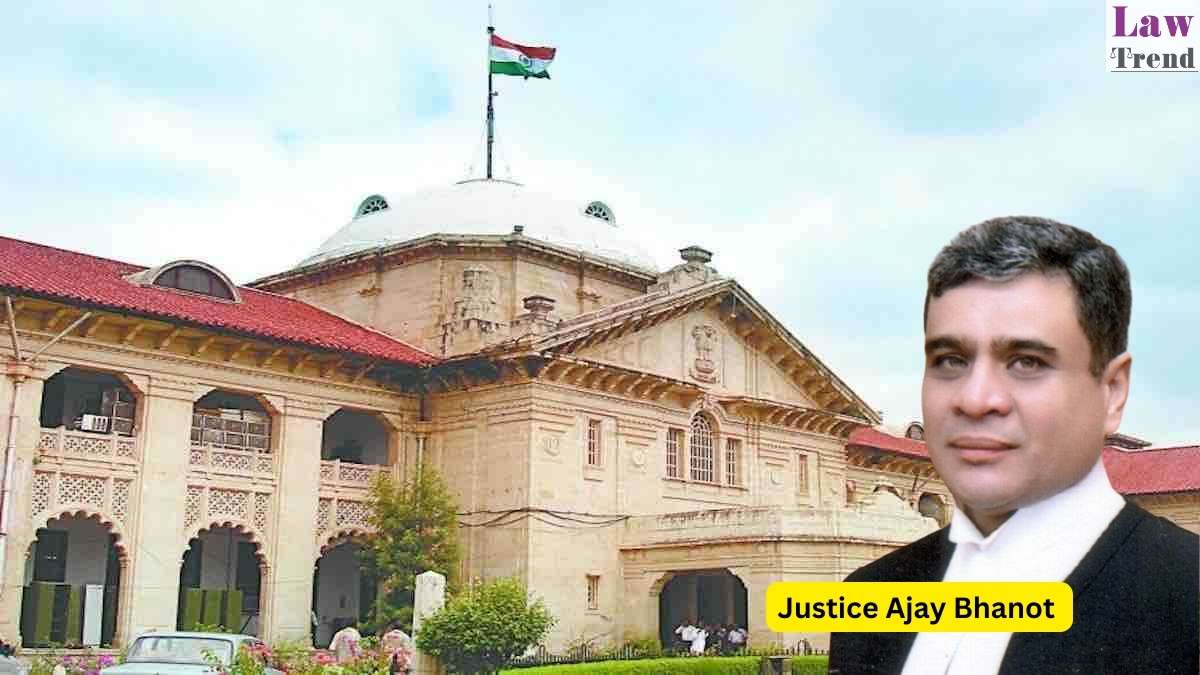
In a significant ruling advancing restorative child jurisprudence, the High Court of Judicature at Allahabad, presided over by Justice Ajay Bhanot, has ruled that juvenile bail proceedings cannot remain purely adjudicatory exercises stripped of reformative intent, holding that Juvenile Justice Boards and Children’s Courts are legally obligated under the Juvenile Justice (Care and Protection of Children) Act, 2015 to examine the need for Rehabilitation and Reintegration (R & R) programmes, formulate individual child care plans, and ensure school education when releasing a child in conflict with law on bail.
Setting aside a bail rejection order passed by the Kasganj Children’s Court and allowing the connected appeals, the Court held that the beneficent object of juvenile justice is defeated if a child is abandoned without supportive structures post-release. Addressing the acute shortage of child care infrastructure in Uttar Pradesh, the Court held that regular government-run day schools and teachers can provisionally be recognized as “fit institutions” and “fit persons” to implement the educational components of individual care plans.
Background of the Case
The judgment arose from two connected appeals filed under Section 101(5) of the Juvenile Justice (Care and Protection of Children) Act, 2015 (JJ Act, 2015).
The primary appeal, Criminal Appeal No. 1470 of 2024 (X Juvenile-Rehabilitation and Reintegration Vs. State of U.P.), challenged an order dated January 3, 2024, passed by the Children’s Court/Special Judge (POCSO Act), Kasganj, which had rejected the bail plea of a minor in Sessions Case No. 1133 of 2023 arising out of Case Crime No. 203 of 2023 under Sections 328, 363, 366, 376D, and 506 of the Indian Penal Code (IPC), Sections 5/6 of the POCSO Act, and Section 67A of the Information Technology Act, registered at Police Station Patiyali, District Kasganj.
The connected matter, Criminal Appeal No. 2446 of 2026, arose from a bail rejection order dated November 25, 2024, passed by the Additional District and Sessions Judge/Special Judge (POCSO Act), Jalaun at Orai, in Case Crime No. 223 of 2023 under Section 376(3) IPC and Section 3/4(2) of the POCSO Act.
Arguments of the Parties
Appearing for the appellants, learned counsel Shri Yashaswin Venugopal Bajpai, Ms. Vishakha Pande Bajpai, Shri Manu Srivastava, and Shri Tarun Jha, assisted by learned Amicus Curiae Ms. Vijeta Singh, submitted that the appellants are juveniles entitled to statutory protections and the benefits of an R & R programme under the JJ Act, 2015 read with the Juvenile Justice (Care and Protection of Children) Rules, 2016 (JJ Rules, 2016). They argued that R & R plans and school education constitute the core of rehabilitative justice and must be framed while deciding bail applications.
On the merits of the Kasganj appeal, the appellant’s counsel contended that the victim was falsely portrayed as a 15-year-old minor despite material contradictions regarding her age across prosecution records; that the parties were in a consensual neighbourhood relationship opposed by the victim’s family; that there was an unexplained two-month delay in lodging the FIR; that the victim was never confined, raised no alarm, and participated in a videographed temple wedding; that no medical or toxicological evidence supported the administration of sedatives or sexual assault; that no objectionable videos were recovered; and that the appellant had no criminal antecedents and had cooperated with the investigation.
Shri Anoop Trivedi, learned Additional Advocate General, assisted by Shri Paritosh Kumar Malviya, learned AGA-I, submitted on behalf of the State of Uttar Pradesh that the State does not view the implementation of R & R programmes and educational measures as adversarial litigation. The State affirmed its role as the guardian of all children and expressed its commitment to fulfilling statutory mandates.
However, an affidavit submitted by the Additional Chief Secretary, Department of Women and Child Development, Government of Uttar Pradesh, revealed that in the entire State, only three “fit persons”, three “fit facilities”, and 14 foster care families were currently identified, with zero fit institutions or persons identified in Kasganj and Mainpuri districts. The State also contended that “fit facilities” and “fit persons” could only be granted to residential setups providing 24×7 institutional care, citing a lack of financial budget allocations for non-residential fit entities.
The Court’s Analysis
Justice Ajay Bhanot framed three core questions of law regarding the statutory duty of the High Court, Juvenile Justice Boards, and Children’s Courts to initiate R & R plans, formulate Form 7 Individual Care Plans, and guarantee school admissions during bail proceedings, as well as the identification of competent institutions to implement them.
1. Constitutional and International Foundations
The Court observed that child welfare is anchored in Articles 15(3), 21, 21-A, 24, 39(e), 39(f), 45, and 47 of the Constitution of India, as well as international instruments including the UN Convention on the Rights of the Child (UNCRC) and the Beijing Rules, 1985. Referring to the Supreme Court ruling in Pratap Singh vs. State of Jharkhand, the Bench noted that municipal juvenile laws must be interpreted consistently with international covenants.
Citing Jitendra Singh v. State of U.P., the Court highlighted that “the traditional objectives of criminal justice, that is retribution and repression, must give way to rehabilitative and restorative objectives of juvenile justice”. It also referenced Bachpan Bachao Andolan vs. Union of India, which underscored that rehabilitation is the true measure of success under juvenile laws.
2. Adjudicatory Powers Paired With Restorative Duties at Bail Stage
The Bench observed that when exercising bail jurisdiction under Section 12 or appellate powers under Section 101(5) of the JJ Act, 2015, courts act as parens patriae. The Court ruled:
“Absence of school education and/or R & R programme/individual child care plan even where the need of same exists will render the bail proceeding into a purely adjudicatory process which is devoid of rehabilitative content. A reductionist judicial approach in the bail process will defeat the beneficent intent of the JJ Act, 2015 read with JJ Rules, 2016.”
The judgment emphasized that granting bail does not obviate the need for an R & R plan or education, noting that children in conflict with law frequently face vulnerabilities arising from adverse socio-economic marginalization, trauma, or youth aberrational conduct.
3. Interplay of Sister Enactments
The Court integrated the provisions of the JJ Act, 2015, the Right of Children to Free and Compulsory Education Act, 2009 (RTE Act, 2009), the Rights of Persons with Disabilities Act, 2016 (PwD Act, 2016), and the Mental Healthcare Act, 2017 (MH Act, 2017).
Drawing upon its earlier ruling in Junaid Vs. State of UP, the Court reiterated:
“The task of the Court is to achieve the overarching and underlying legislative intent by integrating the various statutes into an unified legal framework. This requires corralling up the assortment of statutory bodies under a single legal umbrella, establishing synergy in aims, and ensuring concert in action of said authorities.”
Highlighting the constitutional mandate of inclusive learning, the Court cited Society For Unaided Private Schools of Rajasthan Vs. Union of India, Avinash Mehrotra Vs. Union of India, and Maharishi Mahesh Yogi Vedic Vishwavidyalaya Vs. State of M.P., observing:
“An education system that segregates the disadvantaged cannot coexist with a Constitution that espouses equality. An education system that shuns those who need care and protection is not compatible with a Constitution that promotes fraternity. One has to yield to the other.”
4. Rejection of State’s Stand on Residential Exclusivity & Budgetary Constraints
The High Court rejected the State Government’s contention that “fit facilities” must be strictly residential 24×7 institutions. The Bench clarified that post-release R & R is family- and community-centric. It held that budgetary constraints cannot defeat statutory and constitutional rights under Article 21-A and the JJ Act.
Addressing the absence of formal rules under Section 110 of the JJ Act for recognizing fit institutions, the Court held:
“Rights of children under the constituent elements of education of the R & R programme/individual child care plan cannot remain still born in the absence of Rules. In case implementation of the educational component of R & R programme/individual child care plan is stalled on the footing of non existence of rules, a generation of children will be denied their basic right to education which is fundamental to their reintegration into the society. Executive inertia cannot frustrate legislative purpose or cause a constitutional stasis.”
The Decision and Systemic Directives
The High Court allowed Criminal Appeal No. 1470 of 2024, set aside the Kasganj Children’s Court order dated January 3, 2024, and ordered the release of the minor appellant on bail on the personal bond and sureties furnished earlier during interim bail, subject to standard conditions and in light of Arvind Singh v. State of U.P. regarding non-onerous surety terms.
Having evaluated reports from District Probation Officers, the Court formalized a comprehensive 12-point R & R programme to be implemented by the school where the minor had been admitted:
- Academics
- Yoga
- Sports
- Music
- Arts
- Crafts
- Theatre and story telling
- Nurturing of trees and plants to develop environmental respect
- Group activities with other students
- Moral values and life skills mentoring by teachers
- Periodic counselling
- Nutritious food through mid-day meals
The Court issued systemic directions applicable across Uttar Pradesh:
- Mandatory Assessment: JJBs and Children’s Courts must assess the need for an R & R plan and school admission whenever releasing a child on bail and upon conclusion of inquiry.
- Day Schools as Fit Facilities: Government-run day schools under the Basic and Secondary Education Departments and their teachers can be recognized as “fit institutions” and “fit persons” to implement educational components.
- Protection of Identity: Strict anonymity of the child must be maintained by school authorities and courts throughout the process.
- Rule-Making Directive: The State Government must frame comprehensive rules under the JJ Act, 2015 for identifying and activating the statutory ecosystem of fit institutions, fit persons, and foster care.
Case Title: X- Juvenile- Rehabilitation and Reintegration Versus State of UP and 3 others (with connected appeal)
Case No.: Criminal Appeal No. 1470 of 2024 with Criminal Appeal No. 2446 of 2026
Bench: Justice Ajay Bhanot
Date: August 31, 2026