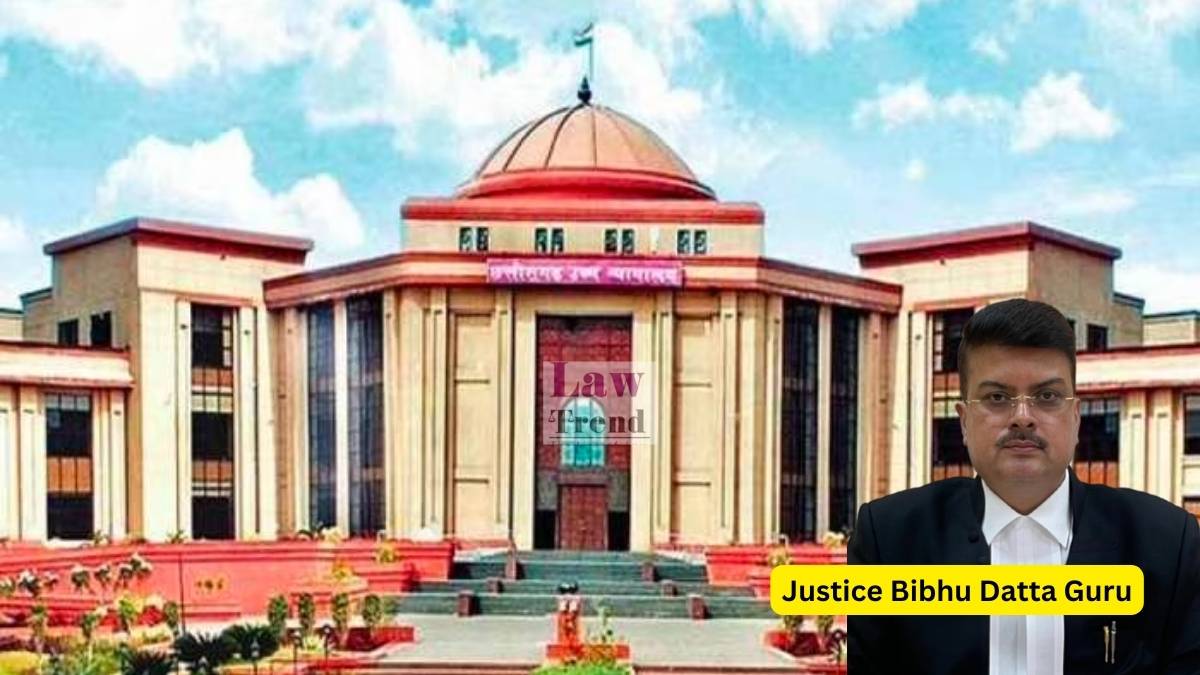
The High Court of Chhattisgarh has quashed a dismissal order passed against a school teacher, holding that an authority cannot dispense with a departmental inquiry under Article 311(2)(b) of the Constitution of India based on mere satisfaction without recording reasons in writing. Justice Bibhu Datta Guru set aside the dismissal order, declaring the decision to bypass the inquiry contrary to constitutional provisions, and granted the state authorities the liberty to initiate fresh steps in accordance with the law.
Background of the Case
The petitioner, Kamlesh Kumar Sahu, served as a teacher at the Government Middle School, Godaiya, Block Bilha, in the Bilaspur District of Chhattisgarh. He challenged a dismissal order dated February 7, 2025, issued under Rule 10 of the Chhattisgarh Civil Services (Classification, Control & Appeal) Rules, 1966.
The dismissal was initiated on allegations that the petitioner sent an objectionable WhatsApp message and made a video call to a girl student. Seeking his reinstatement with all consequential benefits, the petitioner approached the High Court to quash the dismissal order and requested a direction for the authorities to decide his pending representation dated February 25, 2025.
Arguments of the Parties
Advocate Ashutosh Trivedi, appearing for the petitioner, contended that the dismissal order was arbitrary, illegal, and in gross violation of the principles of natural justice. He submitted that the impugned order was passed without issuing any show cause notice, conducting a departmental enquiry, or affording the petitioner any opportunity of being heard. Trivedi argued that because the allegations were not legally established, the stigmatic nature of the dismissal seriously prejudiced the petitioner’s career and future prospects.
Conversely, Panel Lawyer Apurva Nigam, representing the State of Chhattisgarh, opposed the petition. She argued that the dismissal was justified given the highly serious nature of the allegations. Nigam submitted that the competent authority had reviewed the materials on record and exercised its powers legally under Rule 10 of the Rules of 1966, maintaining that the order suffered from no arbitrariness or illegality.
The Court’s Analysis
Upon perusing the record, the Court found that the competent authority had passed the dismissal order without due application of mind and without following the prescribed procedure for invoking major penalties.
The Court noted that before imposing a major penalty under Rule 10 of the Rules of 1966, a proper departmental inquiry must be conducted in accordance with Rule 14. In this case, the inquiry was entirely dispensed with.
The Court then examined the applicability of Article 311(2)(b) of the Constitution of India, which allows an inquiry to be bypassed if the disciplinary authority is satisfied that it is “not reasonably practicable” to hold one. The Court emphasized that mere satisfaction, without recording the underlying reasons in writing, is insufficient. Any reasons recorded must also be strong, cogent, and subject to judicial review.
To reinforce this standard, the Court relied on several landmark rulings of the Supreme Court of India:
- Mohinder Singh Gill and Another v. The Chief Election Commissioner, New Delhi and Others (AIR 1978 SC 851): The Court highlighted the Constitution Bench’s finding: “when a statutory functionary makes an order based on certain grounds, its validity must be judged by the reasons so mentioned and cannot be supplemented by fresh reasons in the shape of affidavit or otherwise. Otherwise, an order bad in the beginning may, by the time it comes to court on account of a challenge, get validated by additional grounds later brought out…”
- Union of India and Another v. Tulsiram Patel ((1985) 3 SCC 398): Referring to another Constitution Bench judgment, the Court quoted: “A disciplinary authority is not expected to dispense with a disciplinary inquiry lightly or arbitrarily or out of ulterior motives or merely in order to avoid the holding of an inquiry or because the department’s case against the government servant is weak and must fail….” The judgment further noted: “The second condition necessary for the valid application of clause (b) of the second proviso is that the disciplinary authority should record in writing its reason for its satisfaction that it was not reasonably practicable to hold the inquiry contemplated by Article 311(2). This is a constitutional obligation and if such reason is not recorded in writing, the order dispensing with the inquiry and the order of penalty following thereupon would both be void and unconstitutional.”
- Jaswant Singh v. State of Punjab and Others ((1991) 1 SCC 362): On the subjective satisfaction of authorities, the Supreme Court’s observation was cited: “The decision to dispense with the departmental enquiry cannot, therefore, be rested solely on the ipse dixit of the concerned authority. When the satisfaction of the concerned authority is questioned in a court of law, it is incumbent on those who support the order to show that the satisfaction is based on certain objective facts and is not the outcome of the whim or caprice of the concerned officer.”
- Tarsem Singh v. State of Punjab & Others ((2006) 13 SCC 581): The Court pointed to the Supreme Court’s ruling that: “The purported reason for dispensing with the departmental proceedings is not supported by any document.”
The Court also noted that the principles established in Tulsiram Patel were subsequently approved in Southern Railway Officers Association and Another v. Union of India and Others.
Decision of the Court
The High Court observed that the impugned dismissal order did not record any reasons for bypassing the mandatory inquiry under Rule 14 of the Rules of 1966. Because the authorities failed to provide any written grounds for applying the constitutional exception, the Court ruled that the decision directly contravened Article 311(2) of the Constitution of India.
While the Court declined to express an opinion on the merits of the allegations since no formal inquiry had been conducted, it quashed the dismissal order dated February 7, 2025. However, at the request of the State’s counsel, the Court reserved liberty for the competent authority to take appropriate steps in accordance with constitutional provisions and statutory rules, if so advised.
The writ petition was accordingly allowed to this extent.
Case Details
Case Title: Kamlesh Kumar Sahu v. State Of Chhattisgarh & Others
Case No.: WPS No. 3073 of 2025
Bench: Justice Bibhu Datta Guru
Date: 09/07/2026