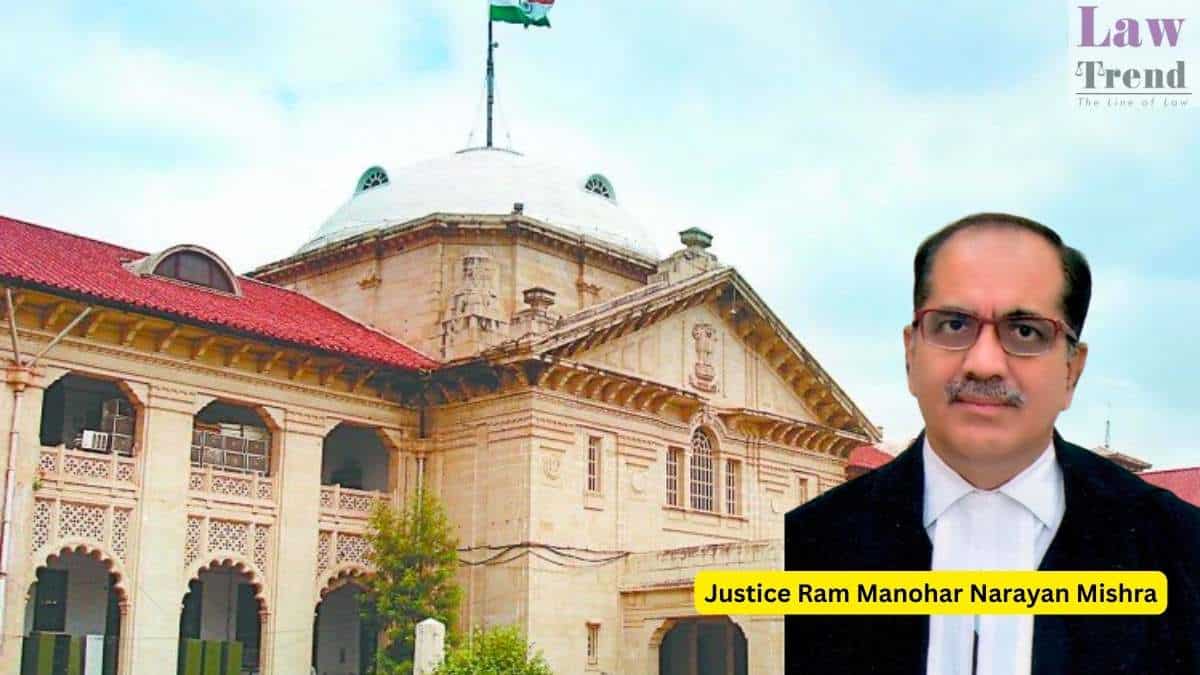
In a judgement resolving a decades-long intra-family property dispute, the High Court of Judicature at Allahabad, Lucknow Bench, has dismissed a second appeal and affirmed that under Section 4 of the Prohibition of Benami Property Transactions Act, 1988, any defence based on a benami transaction is legally barred in suits instituted after the commencement of the Act, even if the underlying transaction took place prior to 1988.
The decision was pronounced on May 18, 2026, by Justice Ram Manohar Narayan Mishra in SECOND APPEAL No.308 of 2018 (Dr. Brij Bhushan And Ors. v. Satya Bhudhsn Verma [Neutral Citation: 2026:AHC-LKO:35522]), which was heard and reserved on February 3, 2026. The High Court affirmed the concurrent findings of the trial court and the first appellate court, ruling that the occupation of the eldest brother, Dr. Brij Bhushan, in the western portion of House No. 531/16Ga, Bhindiya Tola, Bara Chaandganj, Lucknow, was that of a licensee and not a co-owner. Consequently, the Court upheld the decree of eviction and restoration of possession in favour of the respondent, Satya Bhudhsn Verma.
Background of the Case
The subject matter of the dispute is House No. 531/16Ga, located at Bhindiya Tola, Bara Chaandganj, Lucknow. The land was originally purchased through a registered sale deed executed on February 10, 1977 (registered on June 18, 1977), by Smt. Prabhavati, widow of Ganga Prasad, in the joint names of Satya Bhudhsn Verma (plaintiff no. 2 / respondent) and Sabitur Bhushan Verma (defendant no. 2 / appellant no. 2).
The litigation commenced on November 29, 2000, when Sukhnandan (the father, plaintiff no. 1, who died during the pendency of the suit) alongside his son, Satya Bhudhsn Verma, instituted Regular Suit No. 331/2000 (initially registered as Original Suit No. 391 of 2000) before the Additional Civil Judge (Senior Division), Court No. 22, Lucknow.
According to the plaint:
- The land was purchased in 1977 by the father, Sukhnandan, using his personal funds, to settle his two sons (Satya Bhudhsn and Sabitur Bhushan), who were school and college-going students at the time with no independent sources of income.
- Sukhnandan provided the necessary funds to construct a residential house and four shops on the plot.
- By mutual understanding, a private partition was executed under which the eastern $\frac{1}{2}$ portion of the house (along with two shops) was allocated to Sabitur Bhushan, while the western $\frac{1}{2}$ portion (along with two shops) was given to Satya Bhudhsn Verma.
- In 1980, the eldest son, Dr. Brij Bhushan (a government medical officer), was transferred to Lucknow. On his request and under the father’s instructions, he was permitted to occupy the ground floor of the western portion (consisting of a room, veranda, kitchen, latrine, bathroom, gallery, and staircase) as a licensee due to his temporary accommodation needs.
- Although a licence fee of Rs. 500 per month was requested, Dr. Brij Bhushan failed to pay any amount. Satya Bhudhsn subsequently revoked the licence via a legal notice dated October 11, 2000, demanding vacant possession.
- During the pendency of the suit, in the first week of September 2004, Dr. Brij Bhushan allegedly raised unauthorised construction consisting of a room and veranda on the first floor of the western portion, in violation of a court-ordered temporary injunction (status quo order) dated December 8, 2000, for which an application under Order 39 Rule 2A CPC was moved.
On January 17, 2006, the trial court decreed the suit, issuing a mandatory injunction directing Dr. Brij Bhushan to vacate the western portion and hand over possession (including the first-floor construction) to Satya Bhudhsn Verma. The judgement was challenged in Regular Civil Appeal No. 6500026 of 2006, which was dismissed by the Additional District Judge/Special Judge EC Act, Lucknow, on July 27, 2018, leading the defendants to prefer a second appeal before the High Court.
Arguments of the Parties
Appellants (Defendants)
The appellants—represented by Senior Advocate Dr. Ramsurat Pande, assisted by Sri Ankit Pande, Sri Shashank Bhushan Singh, and Sri Virendra Bhatt—argued:
- Source of Purchase Funds: The land was purchased in 1977 and constructed using funds entirely provided by Dr. Brij Bhushan from his medical service salary, which he joined in 1975. The named buyers, Satya and Sabitur, were non-earning students.
- Joint Family Property & Family Settlement: They asserted the property was acquired by a Joint Hindu Family of which Sukhnandan was the Karta. They claimed a family settlement in 1986 allocated two shops to Satya, two shops to Sabitur, and the entire residential area to Dr. Brij Bhushan.
- Municipal Mutation: In 1986, the municipal records of Nagar Nigam, Lucknow, were mutated to reflect Dr. Brij Bhushan’s name over the residential portion based on an affidavit filed by Satya Bhudhsn Verma on January 28, 1982, which they argued estopped the plaintiff from claiming sole ownership.
- Irrevocable Licence: Alternatively, they claimed protection under Section 60 of the Indian Easements Act, 1882, arguing the licence was irrevocable because Dr. Brij Bhushan had executed works of a permanent character (the first-floor construction) and incurred expenses.
- Application of the Benami Act: The appellants contended that the lower courts erred in holding that the Prohibition of Benami Property Transactions Act, 1988, had retrospective operation to bar their plea of a benami transaction under Section 4.
Respondent (Plaintiff)
The respondent—represented by Sri Yogendra Singh and Sri Ashok Kumar Srivastava—submitted:
- Financial Strength of the Father: Sukhnandan was a freedom fighter receiving a monthly pension of Rs. 5,800 to Rs. 6,000 and owned 40 to 45 pakka bighas of agricultural land in Barabanki, providing him ample independent means. Conversely, Dr. Brij Bhushan had only completed two years of service by 1977 on a basic pay scale of Rs. 500–1200 and could not have funded the purchase.
- Statutory Bar on Benami Pleadings: Since the suit was instituted in 2000 (long after the 1988 Act came into force), Section 4 strictly barred Dr. Brij Bhushan from raising any defence claiming to be the real owner of property held in his brothers’ names.
- Illegal and Unauthorised Construction: The first-floor construction was raised illegally in 2004 during the pendency of the suit in direct violation of the court’s status quo order, thereby disentitling him to the protection of Section 60 of the Easements Act.
The Court’s Analysis
At the stage of admission, the High Court framed two substantial questions of law:
- (E) Whether the findings of the courts below are tenable in holding that the Prohibition of Benami Property Transactions Act, 1988, has retrospective operation and bars the plea of a benami transaction under Section 4, without considering the definitions in Sections 2(8) and 2(9).
- (F) Whether the judgement and decree passed by the courts below are perverse in law and facts.
1. Retroactivity of the Benami Transactions Act and the Bar on Defences (Question E)
To address the applicability of the Act, the High Court evaluated key Supreme Court precedents:
- R. Rajagopal Reddy v. Padmini Chandrasekharan (1995) 2 SCC 630: The Supreme Court established that while Section 4(1) (barring suits by real owners) is prospective, Section 4(2) (barring benami defences) operates such that once Section 4(2) applies, no defence claiming real ownership shall be allowed in any suit filed after the Act came into force, even if the underlying transaction occurred prior to the Act.
- Marcel Martins v. M. Printer (2012) AIR SC 1987: The Apex Court affirmed that where a sale deed was executed before 1988 but the suit was filed after 1988, the prohibition in Section 4 applies.
Justice Ram Manohar Narayan Mishra applied these principles to the facts, observing:
“Although the sale deed in question was executed in the name of plaintiff no. 2 and defendant no. 2 was executed way back in the year 1997 [sic: 1977], long before coming into force of the Act of 1988, i.e. 19.05.1988, but as the suit in which the appellant has taken defence of Benami transaction was filed in the year 2000 and written statement therein was filed by the defendant no. 1 on 06/01/2001, he will not be permitted to take a plea of Benami transaction showing himself as a real owner regarding property in question, safe to the extent the pleas covered under Section 4(3) of the Act which has been deleted by amending Act of 2016 w.e.f 01/11/2016.”
The Court found that Dr. Brij Bhushan failed to satisfy the exceptions under Section 4(3) (as it stood prior to the 2016 amendment) because he could not prove that the property was held in a fiduciary capacity or for the benefit of coparceners of a Hindu Undivided Family.
The Court also addressed the legal nature of the purchase by the father:
“Under facts of law if a father purchases some property in the name of his two sons to the exclusion of other sons for their welfare and pays the sale consideration himself, the transaction is held to be a gift deed in favour of the sons whose names are shown as purchasers unless it was purchased with joint family fund.”
The Court observed that there was no proof that joint family funds were used. Highlighting that under the Zamindari Abolition and Land Reforms (ZA&LR) Act, 1950, a bhumidhar with transferable rights is the absolute owner and the Mitakshara law of coparcenary rights does not apply to agricultural land, the Court ruled that no presumption of joint family property could be raised. Consequently, the 1977 transaction was in essence a gift, making the property the self-acquired property of Satya and Sabitur.
Furthermore, the Court took note of the Supreme Court’s ruling in Union of India v. M/s Ganpati Dealcom Pvt. Ltd. (Review Petition No. 359 of 2023 in Civil Appeal No. 5783 of 2022), which recalled its prior judgement concerning the retroactivity of the 2016 amendments, restoring the matter for fresh adjudication.
2. Status of the Appellant as a Licensee & the Claim of Irrevocability (Question F)
The Court appraised the testimony of Sukhnandan (PW-1), the patriarch of the family, who was 95 years old when he testified in 2002 (and subsequently passed away). Sukhnandan explicitly declared that he purchased the property with his own earnings and constructed the house for his sons Satya and Sabitur. He stated:
“…he permitted his son, Brij Bhushan, to reside in a portion of the house due to his necessity for Rs.500 per month rent, but Brij Bhushan never paid the rent.”
The High Court confirmed that Dr. Brij Bhushan’s entry into the property in 1980 was strictly that of a licensee under Section 54 of the Indian Easements Act, 1882, and that the close relationship explained why no strict written licence fee agreement was enforced.
Addressing the appellant’s defence under Section 60 of the Indian Easements Act, 1882, which limits the revocability of a licence if the licensee has executed works of a permanent character, the Court observed that Dr. Brij Bhushan had raised the first-floor construction unauthorisedly during the pendency of the suit and in direct violation of the status quo order of December 8, 2000. Citing Iftkharul Haq v. Lala Data Ram, AIR 1975 All 670, the Court held that the protection of Section 60 cannot be extended to illegal or unauthorised constructions raised in defiance of court injunctions.
The Court further rejected the defence based on municipal mutation records, emphasising that mutation is only for fiscal/tax purposes and does not determine or extinguish proprietary title.
3. Standards of Interference in Second Appeals
The High Court cited the Supreme Court’s rulings in K.N. Nagarajappa v. H. Narasimha Reddy (Civil Appeal No. 5033-5034 of 2009, decided on September 9, 2021) and Narendra Gopal Vidyarthi v. Rajat Vidyarthi (2010), reiterating that under Section 100 of the Code of Civil Procedure (CPC), the High Court’s jurisdiction is strictly confined to substantial questions of law. Concurrent findings of fact are final and cannot be disturbed unless they are shown to be palpably perverse, outrageous to the conscience of the court, or based on no evidence. Finding no such perversity, the Court upheld the judgements of the lower courts.
The Decision
Concluding the judgement, Justice Ram Manohar Narayan Mishra stated:
“With the above findings, I find no factual or legal error or perversity in concurrent findings of both courts below and no interference is warranted in second appeal by this Court. Consequently, the second appeal is dismissed.”
Accordingly, the High Court of Judicature at Allahabad, Lucknow Bench:
- Decided substantial questions of law (E) and (F) against the appellants.
- Dismissed Second Appeal No. 308 of 2018.
- Upheld the concurrent decrees of the trial court and first appellate court ordering the eviction of Dr. Brij Bhushan and the restoration of the possession of the western portion of House No. 531/16Ga (including the ground floor and the first-floor construction) to Satya Bhudhsn Verma.
The judgement was signed and authorised by Justice Ram Manohar Narayan Mishra on May 18, 2026.
Case Details
- Case Title: Dr. Brij Bhushan and Ors. v. Satya Bhudhsn Verma
- Case Number: Second Appeal No. 308 of 2018 (Arising out of Original Suit No. 391 of 2000 / Regular Suit No. 331 of 2000)
- Bench: Justice Ram Manohar Narayan Mishra
- Date of Judgement: May 18, 2026
- Counsel for Appellants: Dr. Ramsurat Pande (Senior Advocate), Sri Ankit Pande, Sri Shashank Bhushan Singh, Sri Virendra Bhatt
- Counsel for Respondents: Sri Yogendra Singh, Sri Ashok Kumar Srivastava