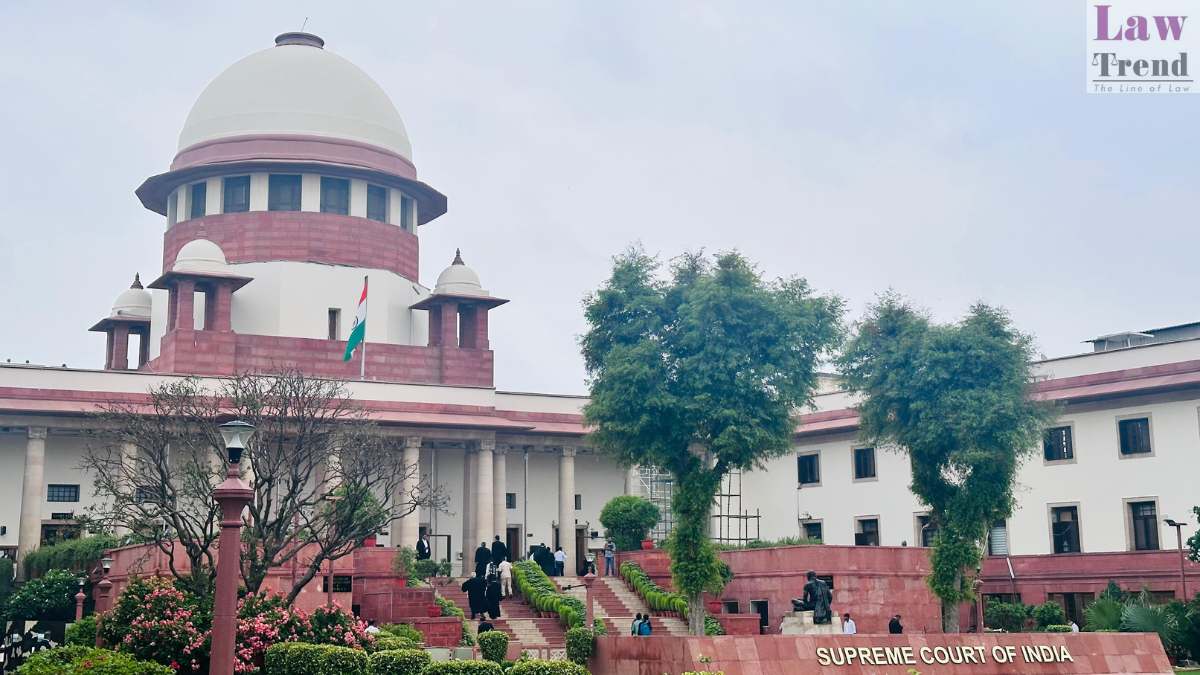
In a significant ruling reinforcing the constitutional right to property under Article 300A, the Supreme Court of India has dismissed an appeal filed by the Brihanmumbai Municipal Corporation (BMC) and directed it to grant additional amenity Transferable Development Rights (TDR) to a landowner. The division bench, comprising Justice J.K. Maheshwari and Justice Atul S. Chandurkar, held that the statutory right to fair compensation under Section 126(1)(b) of the Maharashtra Regional and Town Planning Act, 1966 (MRTP Act) cannot be negotiated away, waived by executive contracts, or defeated by arguments of delay and laches.
The apex court upheld the Bombay High Court’s judgment dated April 3, 2024, which had quashed the BMC’s rejection letter and ordered the civic body to grant additional amenity TDR to the landowner, Vijay Nagar Apartments, for developing a garden on a designated plot in Bhakti Park, Chembur.
Background of the Case
The case traces back to March 4, 1994, when the Urban Development Department of the Government of Maharashtra issued a Notification under the MRTP Act reserving lands bearing CTS Nos. 1A/4, 1A/10, 1A/14 (pt.), and 1A/15, admeasuring 98,369.1 square meters in Chembur, Mumbai (the “subject land”) for the purpose of a “garden.” The notification stipulated that the respective landowners must develop the garden and hand it over to the Corporation.
In July 2001, the landowner applied to the Corporation for the grant of TDR in lieu of surrendering the land. On December 13, 2001, the BMC issued a Letter of Intent (LOI) stating that the landowner’s request for a Development Rights Certificate (DRC) would be considered subject to certain requirements. Paragraph 3 of the LOI mandated that the landowner develop the garden plots at their own cost, maintain them for 20 years, and execute a registered undertaking agreeing “not to claim any amenity TDR towards the development of the garden.”
Following these terms, the landowner developed the garden to municipal specifications. A completion certificate was issued on December 21, 2001, and an undertaking was signed by the landowner on January 10, 2002, agreeing to the 20-year maintenance period without claiming amenity TDR. Physical possession of the land was handed over to the BMC in stages between January and October 2002. In return, the basic TDR for the bare land surrendered was released to the landowner.
On November 27, 2002, both parties entered into a Maintenance Agreement permitting the landowner to maintain the garden on an “adoption basis” for 20 years (from 2002 to 2022) without claiming amenity TDR or Floor Space Index (FSI).
This arrangement continued until 2016 when the Lokayukta of Maharashtra initiated suo motu proceedings based on a news report alleging that the garden was being commercially exploited, run as an elite sports academy, and kept inaccessible to the general public. Acting on the Lokayukta’s directions, the BMC demanded actual possession of the garden. The landowner handed over physical possession on June 2, 2016, without immediate demur.
Subsequently, in April 2019, the landowner formally claimed additional amenity TDR for developing the garden. The BMC rejected this claim on November 5, 2019, citing:
- A delay of 17 years in making the claim.
- The supersession of the Development Control Regulations, 1991 (DCR 1991) by the Development Control and Promotion Regulations, 2034 (DCPR 2034), which had no provision for additional TDR for this category.
- The restrictive terms of the LOI, Undertaking, and Maintenance Agreement signed by the landowner.
The landowner challenged this rejection in a writ petition before the Bombay High Court, which was allowed, prompting the BMC to appeal to the Supreme Court.
Arguments of the Parties
For the Appellant (Brihanmumbai Municipal Corporation)
Senior Advocate Dhruv Mehta, representing the BMC, argued that the High Court had erroneously engaged in “rewriting” a commercial contract. He maintained that:
- The terms of the LOI, Undertaking, and Maintenance Agreement were clear, mutually agreed upon, and must be construed strictly without external aid, relying on Rajasthan State Industrial Development & Investment Corpn. v. Diamond & Gem Development Corpn. Ltd.
- The garden was commercially exploited for personal benefit and did not serve the public as an “amenity.”
- The claim was made under the DCR 1991, which was superseded by the DCPR 2034 by the time the application was filed in 2019. Relying on T. Vijayalakshmi v. Town Planning Member, he argued that the regulations active on the date of the application must apply.
- The claim was barred by an unexplained delay of 17 years, citing Shri Vallabh Glass Works Ltd. v. Union of India and Municipal Corpn., Greater Mumbai v. Century Textiles & Industries Ltd.
- Private individuals can waive mandatory legal provisions enacted for their protection if no public interest is involved, placing reliance on Lachoo Mal v. Radhey Shyam, Sita Ram Gupta v. Punjab National Bank, and Bank of India v. O.P. Swarnakar.
For the Respondents (Landowner)
Senior Advocates Mukul Rohatgi and Pravin Samdani defended the High Court’s judgment, arguing that:
- Under Section 126(1)(b) of the MRTP Act, compensation comprises two distinct components: TDR equal to the land surrendered, and additional TDR equal to the area of the developed amenity.
- Denying the second part violates the statute, DCR 1991, and Article 300A of the Constitution.
- Parties cannot “contract out of the statute,” and no estoppel can operate against statutory mandates.
- The right to receive rightful compensation is a continuing cause of action, meaning the claim is not hit by delay and laches, as established in Kukreja Construction Company v. State of Maharashtra.
- The right crystallized in 2002 when DCR 1991 was in force, meaning the introduction of DCPR 2034 has no retrospective effect on vested rights.
The Court’s Analysis and Observations
The Supreme Court examined the legal issues through the twin lenses of waiver of rights and delay/laches.
1. The Statutory Right to Compensation and Article 300A
The Court underscored that compulsory land acquisition under Section 126(1)(b) of the MRTP Act directly implicates Article 300A of the Constitution, which is a sacrosanct constitutional and human right. Referring to Kolkata Municipal Corpn. v. Bimal Kumar Shah, which identified seven sub-rights under Article 300A—including the right to fair compensation—the Court held that “statutes which are expropriatory must be strictly constructed.”
The Bench observed:
“In matters which relate to payment of fair compensation against acquisition of land, the State is obligated to fairly compensate the owner of the land since it is a curtailment of his legal right to enjoyment of such land. It is an intrinsic aspect of Article 300A. Upon such acquisition, a duty is cast on the State to make good the compensation as determined under the relevant statute…”
2. Rejecting the Plea of Waiver and “Contracting Out” of the Statute
The Court rejected the BMC’s argument that the landowner had voluntarily waived its right to amenity TDR through the LOI and the 2002 undertaking. Pointing out the stark power imbalance between public authorities and citizens, the Bench held:
“There is invariably an inequal bargaining power between the authority, i.e. the Corporation on one hand and the landowner on the other. We are aware that the Landowner in the instant case is a corporation, a developer, but that would make no difference. Once the land has been demarcated for a public purpose under the MRTP Act, there is inherent imbalance of bargaining power between the authority carrying out the acquisition and the landowner and Courts must be wary of any possible economic duress which might affect parties’ decision-making.”
The Court ruled that the BMC could not project a disclaimer of amenity TDR as a pre-condition for releasing the primary TDR for the bare land, stating that “what cannot be done directly, also cannot be done indirectly.” Citing Godrej & Boyce Manufacturing Co. Ltd. v. State of Maharashtra (“Godrej & Boyce I”), the Bench reiterated that “surrender of the land in terms of clause (b) of Section 126(1) of the Act cannot be subjected to any further conditions than those already provided for in the statutory provisions.”
The Court further clarified that the Maintenance Agreement was completely independent of the statutory right to compensation. It noted that the right to maintain a garden on an adoption basis was not a substitute for statutory TDR, stating: “The maintenance of a garden on adoption basis has nothing to do with the statutory rights of the Landowner for compensation accruing under Section 126(1)(b) of the MRTP Act.”
3. Delay and Laches Cannot Defeat Compensation Claims
Addressing the BMC’s objection to the 17-year delay, the Supreme Court relied heavily on its recent decision in Kukreja Construction Company, where it was established that delay and laches cannot defeat claims for statutory compensation like FSI/TDR.
The Court noted:
“…once the compensation is determined in the form of FSI/TDR, the same is payable even in the absence of there being any representation or request being made. In fact, a duty is cast on the State to pay compensation to the land losers as otherwise there would be a breach of Article 300-A of the Constitution.”
The Bench distinguished Century Textiles & Industries Ltd., noting that the delay in that case occurred when challenging the acquisition process itself, whereas the present case merely sought the payment of fair statutory compensation. Relying on Sukh Dutt Ratra, the Court affirmed that the plea of delay does not succeed when there is a continuing cause of action regarding unpaid compensation.
4. Categorization of the Amenity
Lastly, the Court rejected the BMC’s eleventh-hour argument that the garden was not an “amenity” under Section 2(2) of the MRTP Act or that it was developed before the land was handed over. The Bench pointed out that the BMC itself had certified the development of the garden and had made its development a prerequisite for granting the bare land TDR.
The Court added that any alleged misuse of the garden or breach of the Maintenance Agreement must be addressed through separate legal remedies under that contract, and could not be used to deprive the landowner of statutory compensation.
The Decision
Finding no merit in the appeal, the Supreme Court dismissed the BMC’s challenges and upheld the High Court’s directions. The Court ordered:
“The Corporation shall now comply with the directions issued by the High Court within a time period of two months.”
All associated interlocutory applications were disposed of accordingly.
Case Details
- Case Title: Brihanmumbai Municipal Corporation and Ors. v. Vijay Nagar Apartments and Ors.
- Case No.: Civil Appeal No(s). of 2026 (Arising out of SLP (C) No. 11541 of 2024)
- Bench: Justice J.K. Maheshwari and Justice Atul S. Chandurkar
- Date of Judgment: May 20, 2026