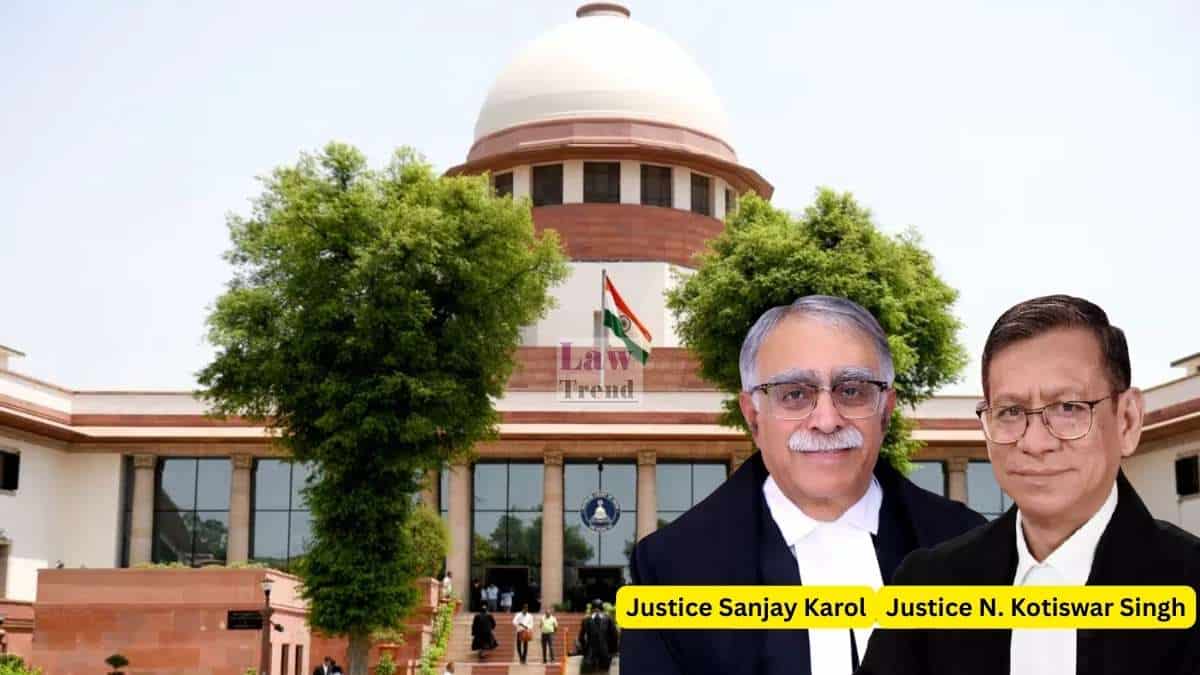
The Supreme Court of India has set aside an order of the Allahabad High Court and cancelled the bail granted to an accused, Jeeshan, in a case involving charges of attempt to murder and violations of the Arms Act. The Court ruled that the High Court committed a manifest error of law by failing to consider its previous bail cancellation order, ignoring the accused’s subsequent contumacious conduct of evading arrest, and misapplying the principle of parity with a co-accused.
A Bench comprising Justice Sanjay Karol and Justice Nongmeikapam Kotiswar Singh allowed the appeal filed by the informant, Mohseen, and directed the accused to surrender before the trial court forthwith.
Background of the Case
The dispute arises from a sequence of events linked to the murder of the Appellant’s brother, Aamir, in connection with which FIR No. 143/2023 was registered under various sections of the Indian Penal Code (IPC), including Section 302 (murder). The co-accused in that murder case, Aabaad and Aurangzeb, were subsequently convicted on November 12, 2025, and sentenced to life imprisonment on November 14, 2025.
On February 27, 2024, while the Appellant was attending the trial court proceedings of the murder case in Meerut, he was threatened within the court premises by Aabaad and Aurangzeb for refusing to compromise, leading to a separate FIR (No. 67/2024) under Section 506 of the IPC.
The current proceedings stem from an incident on May 12, 2024. The Appellant’s uncle Rihan and cousin Afsar were intercepted on the road by Aurangzeb, Aabaad, Jeeshan (Respondent No. 2), Arbaz, and Shahnawaz, who demanded the withdrawal of the murder case. The victims were allegedly assaulted with lathis, dandas, knives, and a country-made pistol (tamancha). When the victims ran to their houses, the accused forcibly entered the premises and continued the assault.
CCTV footage from the area showed Jeeshan retrieving a country-made pistol from his house, brandishing it on the road, and going to the roof of an adjacent house, following which the sound of multiple gunshots was recorded. Eyewitnesses deposed that Jeeshan fired at them with an intent to kill, though no firearm injuries were sustained. Jeeshan subsequently admitted to the Investigating Officer that he had fired several rounds and concealed the weapon. A .315 bore working pistol and a live cartridge were later recovered at his instance.
Following his arrest, Jeeshan was granted regular bail by the High Court of Judicature at Allahabad on October 23, 2024, which characterized his role as “vague and general.” However, the Supreme Court, vide an order dated January 27, 2025, set aside the bail, stating:
“We are of the considered view that the High Court committed grave error in allowing the application filed by the Respondent No. 2 herein. The High court ignored the specific role assigned to the accused-Respondent No. 2 in the FIR. the Court erred in recording that a vague and general role has been assigned to the accused Respondent No. 2…”
Despite the Supreme Court’s direction to surrender forthwith, Jeeshan did not surrender, prompting the Trial Court to issue a Non-Bailable Warrant (NBW) on February 10, 2025, and initiate proclamation proceedings under Section 82 of the Code of Criminal Procedure (CrPC) on February 28, 2025. Jeeshan ultimately surrendered on March 10, 2025, approximately 42 days after the Supreme Court’s cancellation order.
After the Trial Court rejected his second regular bail application, Jeeshan approached the High Court, which granted him bail on September 22, 2025, citing a seven-hour delay in lodging the FIR, lack of firearm injuries, and parity with the co-accused Aurangzeb. The Appellant challenged this decision before the Supreme Court.
Arguments of the Parties
Appellant’s Submissions:
- The High Court failed to engage with the Supreme Court’s previous cancellation order dated January 27, 2025.
- The accused’s conduct after the previous cancellation was contumacious as he failed to surrender, evading arrest until NBW and Section 82 CrPC proceedings were initiated.
- The CCTV footage and the recovery of the working pistol and cartridge directly establish his active involvement.
- The motive behind the crime was to intimidate eyewitnesses in a murder case, magnifying the potential threat if the accused remained at large.
State of Uttar Pradesh’s Submissions:
- The investigation conclusively proved Jeeshan’s active role. Eyewitness statements and CCTV footage corroborated his presence and the act of firing.
- Charges have been framed, and the trial is at its commencement stage with 12 prosecution witnesses.
- Relying on Ajwar v. Waseem & Anr. (2024), the State argued that an unreasoned or perverse bail order is always open to interference.
Respondent No. 2 (Accused Jeeshan’s) Submissions:
- He was never formally declared a “proclaimed offender” since he surrendered within 12 days of the Section 82 CrPC order.
- The delay in surrender was due to the pendency of a Review Petition before the Supreme Court, showing a bona fide intention to engage with the law.
- The CCTV footage did not depict him firing at any person, and he appeared 11 minutes after the altercation began.
- The victims sustained only simple injuries, which did not support a charge under Section 307 IPC.
- A cross-FIR was registered against the Appellant’s family members, who were the actual aggressors.
- Parity operated in his favour as the challenge to the bail of co-accused Aurangzeb had been withdrawn. Jeeshan had spent 7.5 months in custody.
The Court’s Analysis
The Supreme Court found that the High Court’s order granting bail suffered from a “manifest error of law” and failed to apply the established principles of bail and its cancellation.
1. Disregard of Prior Supreme Court Cancellation Order
The Bench noted that the High Court completely failed to engage with the Supreme Court’s previous order dated January 27, 2025, which cancelled Jeeshan’s first bail. The Court observed:
“While there is no absolute bar against a High Court granting bail to an accused whose bail was previously cancelled by this Court, the grant of bail must be supported by reasons demonstrating either a change in circumstances or the existence of fresh grounds not considered by this Court at the time of cancellation.”
2. Contumacious Conduct and Delay in Surrender
The Bench rejected the accused’s argument that the delay in surrendering was justified due to a pending Review Petition. It observed that the filing of a Review Petition does not automatically stay an order. Citing Ajwar v. Waseem & Anr. (2024) 10 SCC 768, the Court noted:
“The considerations that weigh with the appellate Court for setting aside the bail order on an application being moved by the aggrieved party include any supervening circumstances that may have occurred after granting relief to the accused, the conduct of the accused while on bail…”
The Court remarked that Jeeshan actively evaded the process of law for 42 days, forcing the Trial Court to issue an NBW and initiate Section 82 CrPC proceedings.
3. Irrelevance of Lack of Firearm Injuries for Section 307 IPC
The Supreme Court clarified that the absence of physical firearm injuries does not defeat a charge under Section 307 IPC:
“This Court has consistently held that what Section 307 IPC requires is the doing of an act with intent or knowledge that it can cause death. If an accused fires a weapon at victim with the intent to kill and or the knowledge that it can kill, but the victims escape by chance, the commission of the offence under Section 307 IPC is made out.”
4. Misapplication of Parity
The High Court’s reliance on parity with co-accused Aurangzeb was deemed “manifestly erroneous.” Aurangzeb was accused of assault with a knife, whereas Jeeshan was accused of the specific act of firing a country-made pistol. Furthermore, Jeeshan faced charges under the Arms Act, which did not apply to Aurangzeb. Citing Neeru Yadav v. State of U.P. (2014) 16 SCC 508, the Bench reiterated that the principle of parity is not an inflexible rule and cannot be mechanically applied when roles are materially different.
5. Witness Threat and Non-Reasoned Orders
Highlighting the broader context of witness intimidation, the Supreme Court emphasized the need to protect victims and witnesses from threats, quoting Sudha Singh v. State of Uttar Pradesh & Anr. (2021) 4 SCC 781:
“There is no doubt that liberty is important, even that of a person charged with crime but it is important for the courts to recognise the potential threat to the life and liberty of victims/witnesses, if such accused is released on bail.”
The Court concluded that the High Court failed to provide a reasoned order as required under the principles established in Mahipal v. Rajesh Kumar (2020) 2 SCC 118 and Prasanta Kumar Sarkar v. Ashis Chatterjee (2010) 14 SCC 496. It failed to examine the gravity of the offense, the prima facie evidence, and the potential threat of justice being thwarted.
Decision of the Court
Holding the High Court’s order to be perverse, the Supreme Court allowed the appeal and set aside the impugned order dated September 22, 2025.
The bail granted to Jeeshan was cancelled, and he was directed to surrender before the Trial Court immediately, failing which the Trial Court was directed to issue an NBW to secure his custody.
Case Details
- Case Title: Mohseen v. The State of Uttar Pradesh & Anr.
- Case No.: Criminal Appeal No(s). ______ of 2026 (Arising out of SLP (Crl.) No. 16696 of 2025)
- Bench: Justice Sanjay Karol and Justice Nongmeikapam Kotiswar Singh
- Date: May 22, 2026