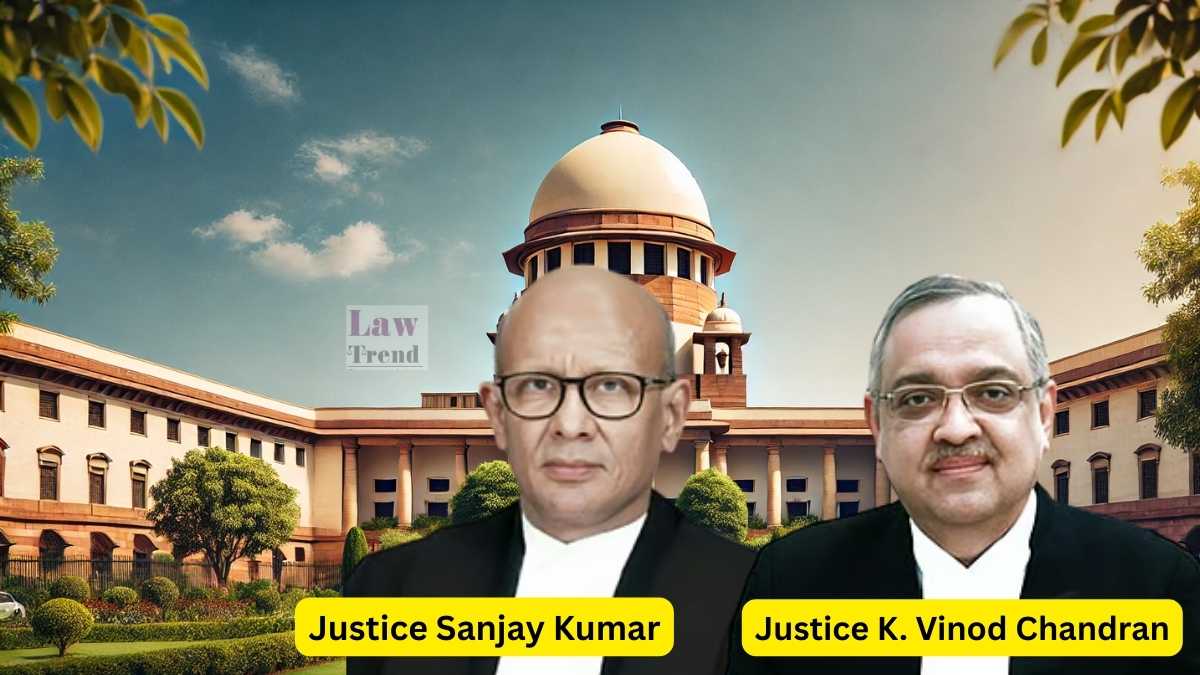
The Supreme Court of India has set aside a High Court judgment that disqualified a bidder for submitting its Earnest Money Deposit (EMD) via a Fixed Deposit (FD) instead of a Demand Draft (DD). The Court held that the specific terms of the tender document framed the submission of a DD for out-of-state bidders as an option rather than a mandatory requirement.
The Division Bench of Justice Sanjay Kumar and Justice K. Vinod Chandran ruled that the word “may” used in the relevant clauses of the tender document indicated an option. Consequently, the appellant’s technical bid under “Envelope A” was declared valid, and the appellant was granted 48 hours to represent against a subsequent disqualification under “Envelope B” which it had previously been unable to contest due to the High Court’s disqualification order.
Background of the Case
The dispute arose from a Notice Inviting Tender (NIT) issued by the Water Resources Department of Chhattisgarh for the “Construction of Head Work of Lamti Feeder Minor Tank Scheme,” carrying an estimated project value of Rs. 13,72,98,000/-.
The bidding process required submissions in three separate envelopes:
- Envelope A: Technical qualification containing the EMD.
- Envelope B: Pre-bid technical qualification certificate.
- Envelope C: Financial bids.
The appellant, RR Constructions and Infrastructure India Pvt. Ltd. (an out-of-state bidder), submitted its financial bid at Rs. 120 Crores, while the 6th Respondent, Gayatri Ventures, submitted a bid of Rs. 149 Crores. Under Envelope A, the appellant submitted its EMD in the form of a Fixed Deposit Receipt (FDR) from the Punjab National Bank, Banjara Hills Branch, Hyderabad, drawn in favor of the Executive Engineer, Water Resources Division, Chhuikhadan (CG).
Initially, the Tendering Authority cleared the appellant’s Envelope A technical bid on representation. However, the 6th Respondent challenged this decision before the High Court. On December 11, 2025, the High Court allowed the writ petition, disqualifying the appellant on the ground that it was mandatory for out-of-state bidders to submit EMD strictly in the form of a Demand Draft. The appellant subsequently filed a Special Leave Petition (SLP) before the Supreme Court on December 17, 2025.
Arguments of the Parties
For the Appellant: Sri Amit Anand Tiwari, learned Senior Counsel appearing for the appellant, argued that furnishing the EMD by a Demand Draft was merely optional. The appellant had furnished a Fixed Deposit directly in the name of the Tendering Authority. He maintained that the tender document did not make the DD mandatory and pointed out that the tender scrutiny committee had initially qualified the appellant.
Regarding a subsequent disqualification under Envelope B issued on December 26, 2025, the appellant explained that they could not respond to the 48-hour notice because they had already been disqualified by the High Court’s order.
For the 6th Respondent: Sri Gagan Gupta, learned Senior Counsel representing the 6th respondent, raised a preliminary objection that the appellant was guilty of suppression because the subsequent Envelope B disqualification was not disclosed to the Supreme Court when a status quo order was passed. He argued that since the financial bid had been opened and the 6th respondent’s bid accepted, the appeal had become infructuous.
For the State: Sri Dama Sesadhri Naidu, learned Senior Counsel appearing for the State, supported the 6th respondent on the subsequent Envelope B disqualification. However, he admitted that as per the accepted practice, the State had been accepting FDRs from out-of-state bidders and agreed that the submission of an FDR could not lead to disqualification.
The Court’s Analysis
The Supreme Court examined the specific clauses of the tender document, primarily focusing on Clauses 2.13, 2.15, and 2.16.
Clause 2.13(a) lists the approved forms of EMD, which includes:
- Sub-clause (a)(iv): Approved Interest Bearing Security.
- Sub-clause (a)(xiii): Bank Draft of State Bank of India or scheduled Banks in case of tenderers of other States.
Clause 2.13(b) relaxes the condition for out-of-state bidders, stating they “may submit” the EMD in the form of a bank draft. Furthermore, Clause 2.15 uses similar optional phrasing.
Analyzing these terms, the Court observed:
“We cannot but notice that though Clause 2.13 (a) (xiii) specifies bank draft of State Bank of India or scheduled Banks in case of tenderers of other States it is in the nature of an option as reiterated in Clause 2.13 (b), which employs the words ‘may submit’. The word ‘may’ is also employed in Clause 2.15 and hence it is only in the nature of an option and not a mandatory condition.”
Regarding the State’s contention that “Approved Interest Bearing Security” required explicit approval from the government, the Court clarified:
“The word approved used is not to indicate any specific approval by the State Government, as is submitted by the learned Senior Counsel for the State, but loosely indicates Interest Bearing Security, which character a FD definitely has.”
On the issue of the subsequent disqualification under Envelope B, the Bench observed that the appellant could not have effectively challenged it while the High Court’s disqualification order was active:
“We cannot but observe that even if a challenge was made against the subsequent disqualification, it would have been declined by reason of the disqualification ordered by the High Court. The appellant cannot be faulted for not having responded to the same…”
Decision of the Court
The Supreme Court set aside the impugned judgment of the High Court and affirmed the appellant’s qualification under Envelope A.
While the Court did not express any opinion on the merits of the Envelope B qualification, it ruled that the appellant is permitted to approach the Tendering Authority within 48 hours of the judgment being uploaded with a representation against the subsequent disqualification or rely on representations submitted after the initial 48-hour window. The appeal was allowed, and all pending applications were disposed of.
Case Details
- Case Title: RR Constructions and Infrastructure India Pvt. Ltd. v. Gayatri Ventures and Ors.
- Case No.: Civil Appeal No. of 2026 (Arising out of SLP (C) No. 37099 of 2025)
- Bench: Justice Sanjay Kumar and Justice K. Vinod Chandran
- Date: May 20, 2026