

Heinousness of Crime Alone Cannot Justify Denial of Remission; Punishment Must Serve Reformative Purpose: Supreme Court
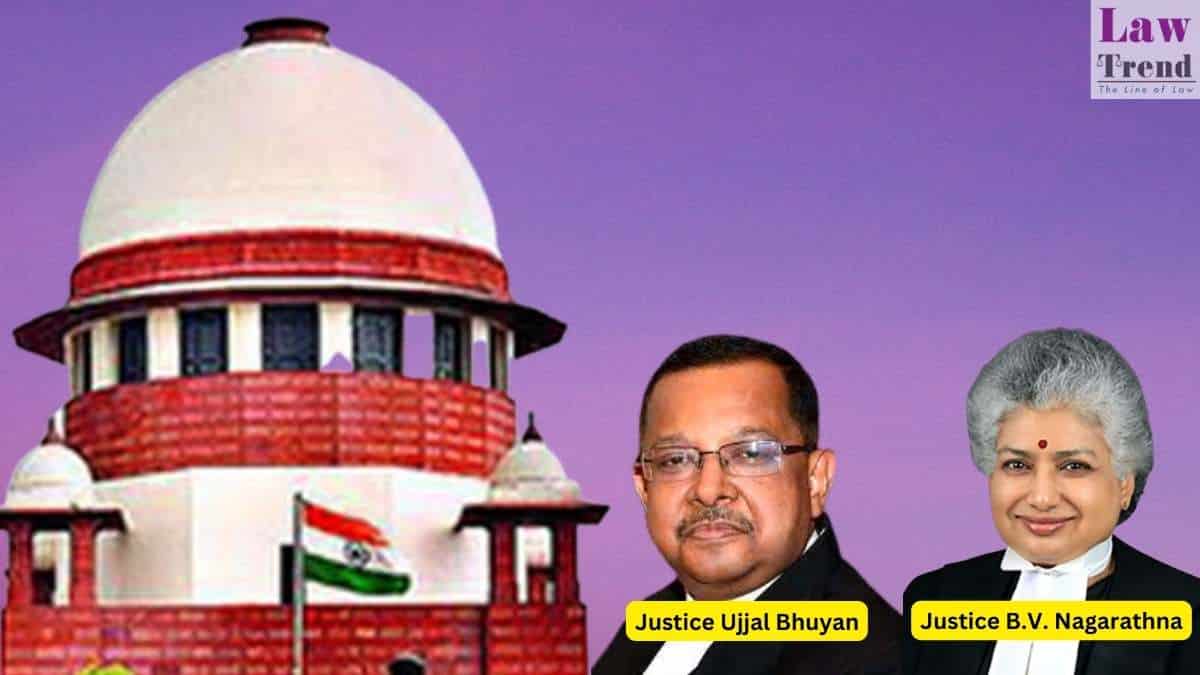

The Supreme Court of India has quashed a Ministry of Home Affairs (MHA) order that rejected the premature release of a convict who had served 22 years in prison. A Bench comprising Justice B.V. Nagarathna and Justice Ujjal Bhuyan ruled that the executive cannot deny remission based solely on the “heinousness of the crime,” emphasizing that punishment must serve a future-oriented reformative purpose rather than being an instrument of emotive retribution.

The Court held that the MHA’s rejection was “arbitrary, non-speaking, and unsustainable,” particularly as it disregarded the State of Uttarakhand’s positive recommendation without providing any rational basis for its disagreement.

Background of the Case

The case arose from a murder registered in 2003 at Mahanagar Police Station, Lucknow. Initially investigated by the Uttar Pradesh Police and CB-CID, the case was later transferred to the Central Bureau of Investigation (CBI). Although the crime occurred in Uttar Pradesh, the Supreme Court transferred the trial to Dehradun, Uttarakhand, in 2007 for exceptional reasons. The petitioner, Rohit Chaturvedi, was convicted under Sections 120B and 302 of the IPC and sentenced to life imprisonment.

After approximately 22 years of incarceration, Chaturvedi sought premature release. The State of Uttarakhand recommended his release; however, because the CBI had investigated the case, the concurrence of the Central Government was required under Section 477 of the Bharatiya Nagarik Suraksha Sanhita, 2023 (BNSS). On July 9, 2025, the MHA issued a letter disallowing the State’s recommendation, which the petitioner challenged via a writ of certiorari.

Arguments of the Parties

Petitioner’s Submissions: The petitioner contended that the MHA’s letter was a “non-speaking” order that failed to provide reasons for overriding the State’s recommendation. He sought parity with a co-accused, Amarmani Tripathi, who was granted premature release by the Uttar Pradesh government in 2023 after serving approximately 17 years of actual sentence. The petitioner emphasized his 22-year stay and consistently good conduct.

READ ALSO  Prosecution Cannot Delay Trial by Insisting on Summoning New Accused First: Supreme Court Upholds Acquittal

State of Uttarakhand: The Standing Counsel for the State confirmed that the State Government had recommended premature release after assessing the petitioner’s conduct and reformation, and effectively left the matter to the Court’s discretion.

Union of India (MHA/CBI): The Additional Solicitor General (ASG) defended the MHA’s decision, arguing that the petitioner played a “significant role” in a “heinous” crime. The Union maintained that the gravity of the offence justified the denial and that parity with a co-accused was not an absolute right.

The Court’s Analysis

The Court’s analysis focused on the constitutional limits of executive discretion and the underlying philosophy of the criminal justice system.

1. Requirement of a Reasoned Order: The Bench found the MHA’s letter to be “ex facie non-speaking,” noting it merely stated that the Competent Authority “does not concur” without disclosing any basis.

READ ALSO  Suit for Injunction Simpliciter Valid if Title of Plaintiff is Undisputed, Even Without Declaration Relief: Supreme Court

“Recording of reasons is not an empty formality, it is a safeguard against arbitrariness and ensures transparency, fairness, and accountability in decision-making. The absence of reasons renders it bald and makes it impossible to ascertain whether relevant factors were duly considered or not.”

2. Heinousness vs. Reformation: The Court clarified that the nature of the offence cannot be the sole ground for denying remission, as the gravity of the crime is already “exhausted at the stage of sentencing.”

“To predicate its denial only on the heinous nature of the offence is to collapse this distinction and to reconvert remission into a retrospective reaffirmation of guilt… Justice does not permit permanent incarceration of an individual in the shadow of their worst act.”

3. The Curative Theory of Punishment: Invoking the philosopher Plato, the Court observed that punishment should be likened to medicine.

“If the offender’s conduct and record in custody indicate that this ‘instinctive aversion to injustice’ has taken root, then continued incarceration becomes unnecessary and arguably contrary to its own objective. The deprivation of liberty no longer serves correction but becomes retribution.”

4. Parity and Reformation: The Court highlighted that the State of Uttarakhand, which directly manages prison administration, found the petitioner fit for release. It also noted the release of a co-accused, stating that differential treatment requires “cogent, rational, and clearly discernible distinguishing circumstances,” which were absent here.

READ ALSO  आंध्र प्रदेश हाईकोर्ट की घटना पर सुप्रीम कोर्ट ने बंद की कार्यवाही; ग्रीवांस रिड्रेसल कमेटी बनाने का निर्देश

The Decision

The Supreme Court quashed the MHA letter dated July 9, 2025. Finding that the petitioner had undergone 22 years of imprisonment with good conduct, the Bench determined that remanding the matter would be an “empty formality.”

The Bench exercised its power of judicial review to grant the relief directly, ordering that the petitioner be treated as prematurely released. “His surrender shall not be required,” the Court directed, allowing the writ petition.

Case Details:

Case Title: Rohit Chaturvedi v. State of Uttarakhand & Others

Case No.: Writ Petition (Criminal) No. 446 of 2023

Bench: Justice B.V. Nagarathna and Justice Ujjal Bhuyan

Date: May 15, 2026

Law Trend
Law Trendhttps://lawtrend.in/
Legal News Website Providing Latest Judgments of Supreme Court and High Court

Related Articles

Latest Articles

