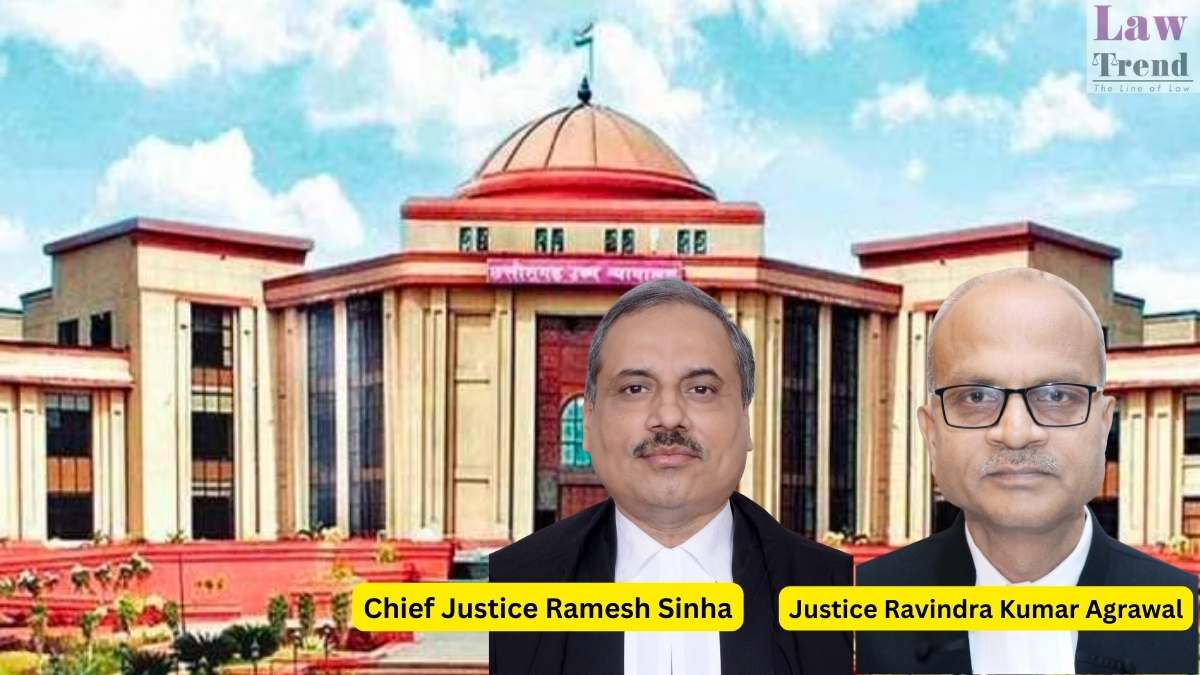
The High Court of Chhattisgarh has ruled that investigating police officers cannot independently debit freeze bank accounts or place a hold on funds under Section 106 of the Bharatiya Nagarik Suraksha Sanhita (BNSS), 2023. Instead, the court held that any action to freeze, attach, or hold funds believed to be the “proceeds of crime” must strictly proceed through the jurisdictional Magistrate under Section 107 of the BNSS.
Concurring with the Nagpur Bench of the Bombay High Court, the division bench of Chief Justice Ramesh Sinha and Justice Ravindra Kumar Agrawal quashed the police directives issued to Kotak Mahindra Bank to freeze and put a hold on the bank account of Non-Banking Financial Company (NBFC) Oxyzo Financial Services Ltd.
Background of the Case
The petitioner, Oxyzo Financial Services Ltd., is a registered Non-Banking Financial Company (NBFC) under the Reserve Bank of India and the Companies Act, 2013, engaged in providing credit solutions and customized loans to SMEs. The petitioner operates bank account number 991xxxxx with Kotak Mahindra Bank (Respondent No. 8) which regularly receives daily loan repayments (EMIs) of ₹12 to ₹15 Crores.
In January 2023, the petitioner entered into a commercial transaction with Respondent No. 9, Shreejikrupa Project Ltd. (SKPL). On January 30, 2026, they executed a Purchase Financing Facility of ₹10,00,00,000 for 12 months at an interest rate of 14.25% per annum, followed by a Master Facility Agreement on February 2, 2026. Under this facility, SKPL financed its purchase of raw materials from several suppliers, primarily OFB Tech Ltd. (OFB). Oxyzo maintained that it had no nexus with the internal commercial transactions between OFB and SKPL.
On March 20, 2026, SKPL lodged an FIR (Crime No. 148 of 2026) under Sections 318(4) and 3(5) of the Bharatiya Nyaya Sanhita (BNS), 2023, at Police Station Mandir Hasaud, Raipur. The complainant alleged that consignments of TMT Iron Bars supplied by OFB were underweight. Upon inspection of three transport trucks, secret boxes containing 5 MT of pig iron were discovered. These boxes had been used to falsely show the correct weight on weighing scales, resulting in a shortage of about 15 MT of iron bars. The initial loss of consignment was estimated at ₹6.9 Lakhs.
The Account Freeze and Subsequent Orders
During the investigation, on April 10, 2026, the Station House Officer (SHO) of PS Mandir Hasaud directed Kotak Mahindra Bank to completely freeze Oxyzo’s bank account. This sudden freezing paralyzed the petitioner’s daily financial operations. In response, Oxyzo issued a loan recall notice to SKPL, which prompted SKPL to repay ₹4,45,13,465 via RTGS on April 13, 2026, to clear its outstanding loan liability.
Oxyzo challenged the April 10 freeze order before the Delhi High Court in WP(Cr) No. 1189 of 2026 (also referenced in the order as WP(Cr) No. 1184 of 2026). On April 13, 2026, the Delhi High Court stayed the operation of the freeze order but directed Oxyzo to delete the police authorities (Respondents 3 to 8) from the array of parties and confine its petition to the action of Kotak Mahindra Bank.
Subsequent to this stay, on April 13, 2026, the SHO of PS Mandir Hasaud issued a fresh communication to Kotak Mahindra Bank, directing it to defreeze the account to comply with the court’s order but to “hold/lien” an amount of ₹53,47,17,835.
During the hearing before the Chhattisgarh High Court, the State filed an affidavit by the Deputy Superintendent of Police (Rural), Mana, Raipur, stating that the complete hold of ₹53.47 Crore was unnecessary. It was modified via a letter dated April 27, 2026, to put a hold only on an amount of ₹43,38,375, which represented the recalculated approximate loss of the alleged offence based on an observed 12.5% weight shortage in the supplied consignments (amounting to 62.87 MT of iron bars). Oxyzo filed the present writ petition to quash these orders.
Arguments of the Parties
For the Petitioner
Senior Advocate Abhishek Sinha, appearing alongside Advocate Vivek Chopda, submitted that:
- The petitioner is not an accused in the FIR and has no connection with the cheating offence allegedly committed by the suppliers or truck drivers.
- Under the statutory scheme, the investigating officer has no authority to independently freeze or hold funds without obtaining mandatory prior permission from the Superintendent of Police and the concerned Magistrate under Section 107 of the BNSS.
- The sudden freeze on April 10, 2026, was executed without any prior notice or opportunity of hearing, violating the principles of natural justice and unlawfully depriving the petitioner of its property under Article 300-A and its right to carry on business under Article 19(1)(g) of the Constitution of India.
- Reliance was placed on the Bombay High Court’s ruling in Kartik Yogeshwar Chatur v. Union of India & Others (2025 SCC Online Bom 4778) to contend that debit freezing is impermissible under Section 106 of the BNSS.
For the State
Additional Advocate General Praveen Das contended that:
- Shortages in the supply of TMT iron bars were occurring continuously, and payments for these transactions were routed through the petitioner’s bank account.
- The directors of the petitioner company did not cooperate with the investigation or submit requested information.
- The police complied with Section 106 of the BNSS by submitting an ex-post facto report to the concerned jurisdictional Magistrate on April 10, 2026.
- The hold amount was subsequently minimized to ₹43,38,375 to avoid hampering the petitioner’s day-to-day business while securing the estimated loss in the cheating case.
For the Complainant (Respondent No. 9)
Advocates Pragalbh Sharma and Rishabh Garg argued that:
- Since the petitioner was already prosecuting identical reliefs for the same cause of action before the Delhi High Court, the parallel writ petition before the Chhattisgarh High Court was not maintainable.
- The investigative authorities had reasonably limited the hold to the approximate loss of ₹43,38,375, and thus the petition lacked merit.
Court’s Analysis and Observations
The High Court considered the statutory differences between Section 106 and Section 107 of the BNSS. It noted that Section 106 of the BNSS corresponds to Section 102 of the old Code of Criminal Procedure, 1973 (CrPC), which grants the police power to seize property.
The Court explicitly concurred with the Division Bench of the Bombay High Court in the Kartik Yogeshwar Chatur case, which had integrated the findings of the Kerala High Court in Headstar Global Pvt. Limited v. State of Kerala & Ors. (Crl. MC No. 3740/2025). The Kerala High Court had highlighted that the lack of provision in the old CrPC for the seizure or attachment of the “proceeds of crime” was cured by introducing Section 107 in the BNSS.
Reviewing the legal distinction, the Court quoted the Kerala High Court’s observation:
“12. Going by Section 107 of BNSS, a police officer investigating a crime has to approach the jurisdictional Magistrate seeking attachment of any property believed to be derived directly or indirectly from criminal activity or the commission of an offence. The Magistrate may thereupon order attachment after hearing all parties concerned or issue an interim order for attachment, if issuing notice to the owner will defeat the purpose of attachment and seizure…”
The Court highlighted that:
“13. Another aspect of importance is that, while Section 106 speaks of seizure, Section 107 deals with attachment, forfeiture and restoration. Seizure under Section 106 can be carried out by a police officer and an ex post facto report submitted to the Magistrate. On the other hand, attachment under Section 107 can be effected only upon the orders of the Magistrate. The logic behind this distinction being that the purpose of seizure is more to secure the evidence during an investigation, whereas attachment is intended to secure the proceeds of crime by preventing its disposal and thus ensuring its availability for legal procedure such as forfeiture and distribution to the victim/s.”
Relying on these precedents, the Bench affirmed that “debit freezing account is not permissible under Section 106 of the BNSS.”
Evaluating the facts of the case, the Court observed:
“…we are of the considered opinion that freezing of bank account and put on hold the amount of Rs.43,38,375/- cannot be made by the police authority particularly when the loss, if any, is not quantified.”
The Decision
The High Court allowed the writ petition and passed the following directions:
- The impugned communication dated April 13, 2026, and the subsequent communication dated April 27, 2026, holding the amount of ₹43,38,375 in the petitioner’s bank account (A/c No. 991xxxxx), were quashed.
- The Court granted liberty to the investigating agency to proceed in accordance with the law under Section 107 of the BNSS, 2023.
- The Court directed that the prosecution agency must conduct a fair and impartial investigation by an officer not below the rank of Deputy Superintendent of Police (DSP).
Case Details:
- Case Title: Oxyzo Financial Services Ltd. v. State of Chhattisgarh & Ors.
- Case No.: WPCR No. 231 of 2026
- Bench: Chief Justice Ramesh Sinha and Justice Ravindra Kumar Agrawal
- Date: 15.05.2026