

Suit For Possession Without Seeking Declaration Of Title Not Maintainable When Plaintiff’s Title Is Under Cloud: Chhattisgarh High Court
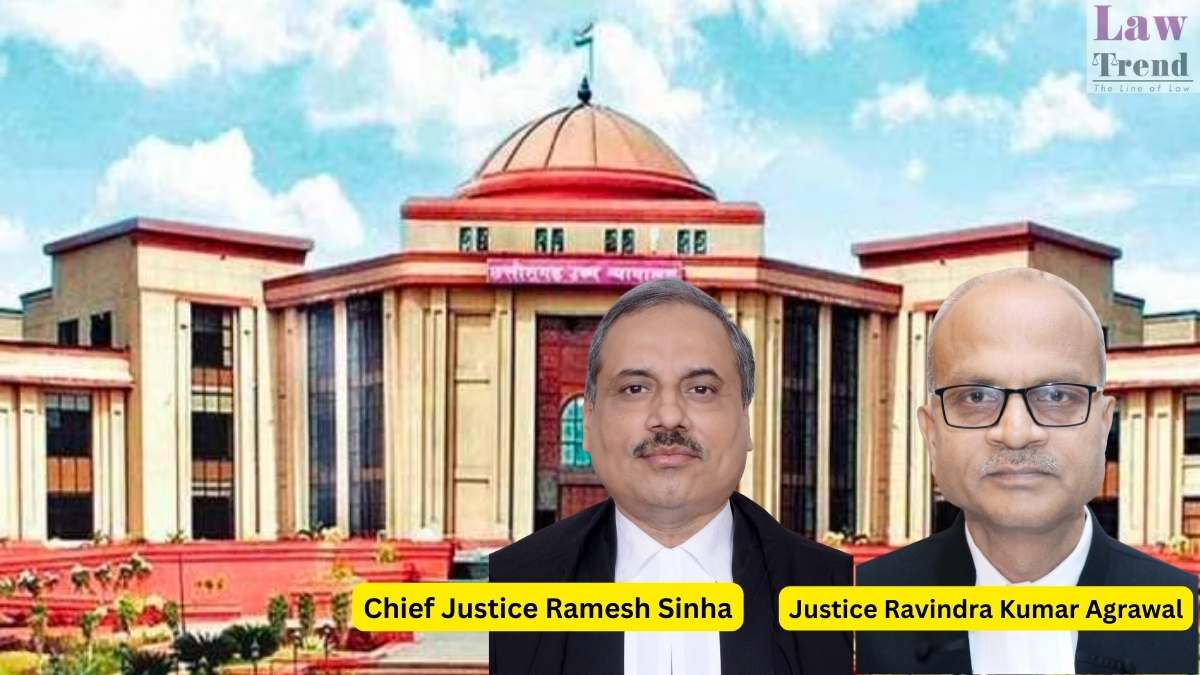

The High Court of Chhattisgarh at Bilaspur has ruled that when a plaintiff’s title over a property is under a cloud and the defendant claims their own title over the same, the plaintiff must file a comprehensive suit for declaration of title and possession. A Division Bench comprising Chief Justice Ramesh Sinha and Justice Ravindra Kumar Agrawal held that without a definitive finding on the title in favor of the plaintiff, a decree for possession cannot be granted.

With this observation, the High Court dismissed two First Appeals filed by the legal representatives of the deceased proprietor of M/s. Goyal Material Suppliers against a trial court’s judgment. The trial court had dismissed the plaintiffs’ suit for vacant possession and damages, and partly decreed the defendant’s counter-claim by granting a permanent injunction protecting the defendant’s possession over 4 dismil of land containing his house.

Background of the Case

The appeals arose out of a common judgment and decree dated January 16, 2024, passed by the 3rd Additional District Judge, Raipur, in Civil Suit No. 122-A/2014. The plaintiffs (now appellants) had instituted a suit for vacant possession, damages, and permanent injunction over Khasra No. 356/1 and 357/1, totaling an area of 0.324 Hectare (0.80 Acre) located in village Sasaholi, Tehsil Tilda, District Raipur, which included a small portion containing a hutment.

The plaintiffs asserted that they had purchased the entire 80 dismil (0.80 Acre) of land from the defendant, Prahlad Dewangan, through a registered sale deed dated April 15, 1994, and had taken possession of it. After getting the land diverted for non-agricultural purposes, they applied for demarcation on June 24, 1997. The demarcation revealed that the defendant was in possession of 4 dismil of land, shown as the ‘ABCD’ part in the plaint map, where a hutment was situated.

To remove the defendant, the plaintiffs initially filed an application on May 20, 1999, under Section 250 of the Chhattisgarh Land Revenue Code, 1959. Although the Tehsildar rejected the application, successive appeals by the plaintiffs were allowed by the SDO (Revenue), the Additional Commissioner, and the Chhattisgarh Board of Revenue. However, the defendant challenged these orders before the High Court in Writ Petition (227) No. 257 of 2013. On March 31, 2014, the High Court set aside the revenue courts’ orders, holding that the plaintiffs could not take recourse to Section 250 of the Code and must instead approach a competent civil court to seek vacant possession. Consequently, the plaintiffs filed the civil suit in 2014.

READ ALSO  State Amendment to Indian Succession Act Removes Probate Requirement for Wills of Indian Christians and Muhammadans: Kerala High Court

In his written statement, the defendant denied the plaintiffs’ claims. He contended that he had suffered from mental illness between 1992 and 1995, during which he was treated by a psychiatrist, Dr. Anand Dubey, and was not aware of his own well-being. He claimed the suit land was ancestral property obtained via a family partition on December 26, 1968, and that his sons held coparcenary rights over it by birth. The defendant argued that he possessed alienable title only to the extent of 65 dismil, and the plaintiffs had fraudulently executed a sale deed for 80 dismil. He asserted that the plaintiffs obtained possession of only 65 dismil (where a petrol pump now runs), while the remaining 15 dismil (including 4 dismil over which his house is built) remained in his family’s possession. He also raised a plea of limitation, pointing out that the suit was filed 20 years after the sale deed’s execution.

The defendant further filed a counter-claim seeking a permanent injunction to restrain the plaintiffs from interfering with his peaceful possession of the remaining 15 dismil of land.

The trial court dismissed the plaintiffs’ suit, finding that they had failed to prove the defendant was in unauthorized possession of the 4 dismil of land where his house stood. It also held that the defendant had been in possession of this 4 dismil portion since the execution of the sale deed on April 15, 1994, and was therefore entitled to a permanent injunction over it.

Arguments of the Parties

The learned counsel for the appellants/plaintiffs argued that the defendant had executed a valid sale deed on April 15, 1994, for the entire 80 dismil of land, transferring full title to the plaintiffs. Since the defendant did not challenge the execution of the sale deed on the grounds of fraud or coercion during the initial revenue proceedings and admitted receiving the entire sale consideration, he could not claim to retain any portion of the land. The appellants argued that since they are the titleholders of the entire 80 dismil, and the defendant’s possession lies within this area, they are entitled to vacant possession. The appellants also filed an application under Order 41 Rule 27 of the CPC, seeking to introduce the original sale deed and demarcation report as additional evidence, explaining that the trial court had wrongly noted their absence.

READ ALSO  Auction Sale Smells of Collusion: Chhattisgarh High Court Quashes Land Auction Over Procedural Irregularities 

Conversely, the learned counsel for the respondent/defendant supported the trial court’s decree. They argued that because of coparcenary rights within the family, the defendant had no right to alienate the entire 80 dismil of land and could only alienate up to 65 dismil. They maintained that the defendant had delivered physical possession of only 65 dismil and had consistently resided on the remaining portion for decades. They further argued that the plaintiffs’ complete inaction for 20 years from the execution of the sale deed in 1994 until the filing of the suit in 2014 barred the suit under the law of limitation. They also opposed the admission of additional documents under Order 41 Rule 27 CPC, citing gross negligence on the plaintiffs’ part for not producing their own title deeds during the trial.

Court’s Analysis

The High Court first rejected the appellants’ application under Order 41 Rule 27 of the CPC to bring the sale deed and demarcation report on record. Citing the Supreme Court judgment in Union of India v. Ibrahim Uddin and Another (2012) 8 SCC 148, the Court noted:

“Hence, in the absence of satisfactory reasons for the non-production of the evidence in the trial court, additional evidence should not be admitted in appeal as a party guilty of remissness in the lower court is not entitled to the indulgence of being allowed to give further evidence under this rule.”

Addressing the evidentiary value of mutation records, the Bench observed:

“It is settled law that mutation entries does not confer any title in favour of the persons whose name is mutated in the revenue records. It is only for the physical purposes…”

To support this conclusion, the Bench relied upon the Supreme Court rulings in Balwant Singh v. Daulat Singh (1997) 7 SCC 137 and Jitendra Singh v. State of MP & Others (2021) SCC Online SC 802.

READ ALSO  Chhattisgarh School Education Services Rules 2019 Rule 8(III) Prescribing qualification of B.Ed. as eligibility criteria for Asst Teacher of Primary School is Ultra Vires: HC

On the core legal issue of seeking possession without a declaration of title, the High Court observed that the plaintiffs had filed the suit for possession, damages, and a permanent injunction, but crucially failed to pray for a declaration of their title. Since the defendant explicitly denied the plaintiffs’ title over the remaining 15 dismil of land, claiming it was ancestral property and that the sale deed was invalid beyond 65 dismil, a clear “cloud” was cast over the plaintiffs’ title.

The Court referred to the landmark ruling of the Supreme Court in Anathula Sudhakar v. P. Buchi Reddy (Dead) By LRs and Others (2008) 4 SCC 594, quoting paragraph 21:

“(a) Where a cloud is raised over plaintiff’s title and he does not have possession, a suit for declaration and possession, with or without a consequential injunction, is the remedy. Where the plaintiff’s title is not in dispute or under a cloud, but he is out of possession, he has to sue for possession with a consequential injunction.”

The Division Bench observed that because the defendant had specifically denied the plaintiffs’ ownership of the disputed portion of the property, the title of the plaintiffs had “went in cloud and he requires to claim the declaration of title in his suit also.”

Decision of the Court

The High Court concluded that the trial court’s judgment was based on a proper appreciation of the evidence and the applicable legal principles, requiring no interference. Accordingly, the Court dismissed both appeals, leaving the parties to bear their own costs and directing that an appellate decree be drawn.

Case Details

  • Case Title: M/s. Goyal Material Suppliers Through Its Proprietor Late Suresh Kumar Agrawal (Since Died Through Legal Representatives) & Others v. Prahlad Dewangan
  • Case No.: FA No. 74 of 2024 and FA No. 75 of 2024
  • Bench: Chief Justice Ramesh Sinha and Justice Ravindra Kumar Agrawal
  • Date of Judgment: May 5, 2026

Law Trend
Law Trendhttps://lawtrend.in/
Legal News Website Providing Latest Judgments of Supreme Court and High Court

Related Articles

Latest Articles

