

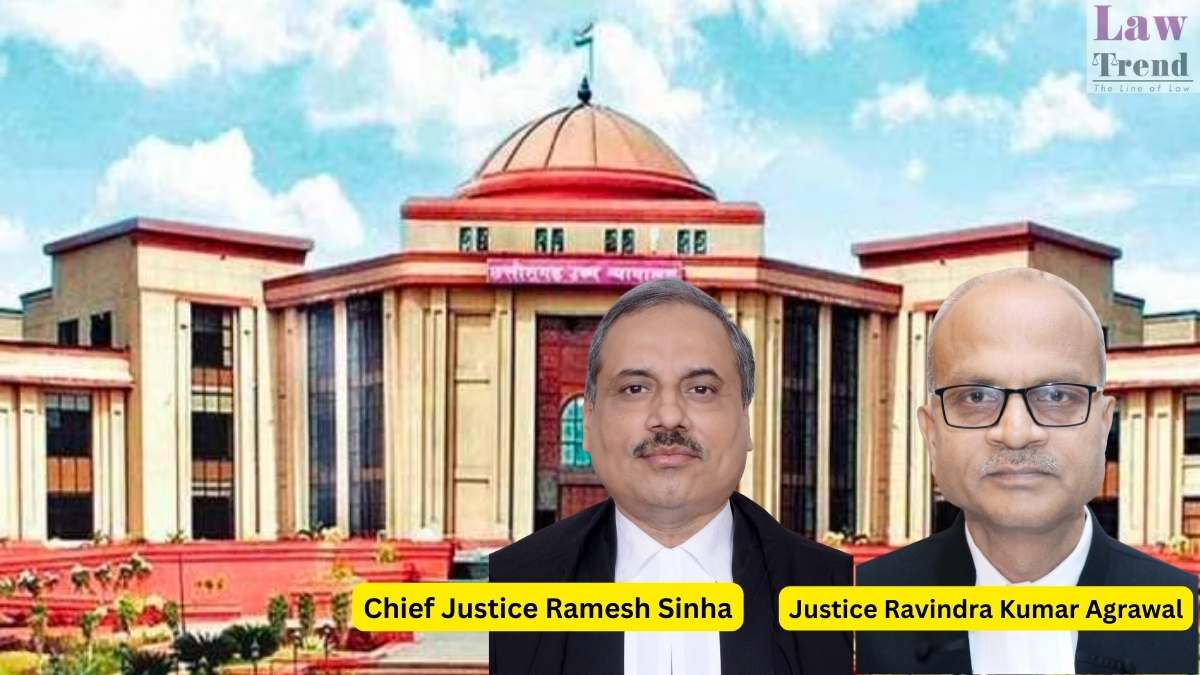
The High Court of Chhattisgarh at Bilaspur has dismissed a batch of criminal appeals filed by five individuals, thereby confirming their convictions and sentences of life imprisonment for the kidnapping and confinement of a nine-year-old child for ransom.
A Division Bench comprising Chief Justice Ramesh Sinha and Judge Ravindra Kumar Agrawal ruled that the prosecution successfully established that the accused persons, in furtherance of a criminal conspiracy, kidnapped the minor child for ransom. In its landmark ruling, the Court clarified that the charge of criminal conspiracy under Section 120-B of the Indian Penal Code (IPC) and Kidnapping for Ransom under Section 364-A IPC stood fully proved through a combination of cogent and reliable oral evidence, an official identification memo, electronic evidence including Call Detail Records (CDR), and cyber analysis reports.
Background of the Case
The case arises from Crime No. 145 of 2019, registered at Police Station City Kotwali, Bilaspur, involving the kidnapping of nine-year-old Virat Saraf (PW-9). According to the prosecution, appellant Nita Saraf was the aunt of the victim and was well-acquainted with his family’s daily affairs. She had ongoing financial dealings and outstanding dues with another appellant, Anil Singh.
To resolve their financial strain, Nita Saraf and Anil Singh conspired to kidnap the son of another relative, Satyanarayan Saraf, for ransom. To execute this plan, they hired Rajkishor Singh, Harekrishna Kumar, and Satish Sharma. When their original target left town with his family, the conspirators shifted their focus to the minor victim, Virat Saraf.
The execution of the conspiracy occurred in several steps:
- April 10, 2019: The appellants went to a local vegetable market in Tifra and deceitfully took two SIM cards from the mobile phone of Naresh Dewangan (PW-6), a snack cart seller, under the pretext of needing a mobile torch.
- April 18, 2019: They purchased an old mobile phone from Chhattisgarh Mobile Shop, Chakarbhata, owned by Rahul Kumar Suryavanshi (PW-8), in which they inserted the stolen SIM cards and recharged them.
- April 20, 2019: After conducting surveillance (Reiki) around the victim’s house, Anil Singh, Rajkishor, Harekrishna, and Satish Sharma arrived near the house in a white Wagon-R car (CG 10 AM 2818). Harekrishna identified the victim, gagged his mouth, and pulled him into the vehicle.
- The Confinement: The victim was taken to the Bilaspur Railway Station and shifted to a Renault Duster car (CG 04 KR 5232) driven by Anil Singh. He was then brought to Rajkishor’s house at Panna Nagar, Jarhabhata, where his hands and legs were tied, and he was confined in a room guarded by Harekrishna and Satish Sharma.
- Ransom Calls: Rajkishor traveled towards Bihar and Uttar Pradesh, making multiple ransom calls using the stolen SIM card to the victim’s father, Vivek Saraf (PW-1), demanding Rs. 6 crores (later negotiated down to Rs. 4 crores).
- The Rescue: On April 26, 2019, police raided the house of Rajkishor Singh, broke open the lock, and rescued the victim from the custody of Harekrishna and Satish Sharma.
Following a trial, the First Additional Sessions Judge, Bilaspur, convicted all five appellants on September 23, 2022, under Sections 120-B, 363, 364-A, 365, and 368 read with Section 120-B of the IPC, sentencing them to life imprisonment.
Arguments of the Parties
Appellants’ Submissions
Counsel for the appellants raised several legal and factual challenges to the trial court’s judgment:
- Anil Singh: Counsel argued there was no direct evidence against him, the victim did not identify him during dock identification, and the recovery of his fingerprint inside the Wagon-R was natural.
- Nita Saraf: Counsel submitted that she was convicted purely on suspicion and inadmissible memorandum statements of the co-accused under Sections 25 and 26 of the Indian Evidence Act.
- Rajkishor: Counsel challenged the admissibility of the CDRs under Section 65-B of the Evidence Act, asserting they were secondary electronic printouts lacking original authenticity. It was also argued that the house from which the child was recovered was not in his exclusive possession.
- Satish Sharma and Harekrishna Rai: Counsel argued that there was no active participation or recovery of incriminating articles from Satish Sharma, while counsel for Harekrishna Rai claimed that the threat of death or hurt required to attract Section 364-A was absent.
State’s Submissions
The State, represented by Deputy Government Advocate Ms. Vaishali Mahilong, strongly opposed the appeals. The State argued that the prosecution had proved the entire sequence of the conspiracy, the active coordination among the accused via CDRs, the matching of voice samples of Rajkishor with the threat calls, and the recovery of the child from a locked room in Rajkishor’s house where Harekrishna and Satish were present.
Court’s Analysis: Proving the Offence
In evaluating the conviction of the appellants, the High Court focused on the standard of proof required for both the conspiracy under Section 120-B IPC and the kidnapping for ransom under Section 364-A IPC. The Court’s analysis matched the parameters set forth in the official headnote:
1. Proof of Conspiracy: Prior Meeting of Minds (Section 120-B IPC)
The Court observed that direct evidence of a conspiracy is rarely available because such agreements are hatched in secrecy. Referring to Ajay Aggarwal v. Union of India (AIR 1993 SC 1637), the Court held:
“A conspiracy thus, is a continuing offence and continues to subsist and committed wherever one of the conspirators does an act or series of acts. So long as its performance continues, it is a continuing offence till it is executed or rescinded or frustrated by choice or necessity.”
The Court ruled that the prior meeting of minds and coordinated acts of the accused persons in the execution of the kidnapping and ransom demand proved the charge of criminal conspiracy under Section 120-B IPC. This was demonstrated by the division of labor, the fraudulent procurement of SIM cards, and the structured swapping of mobile handsets.
2. Cogent and Reliable Oral Evidence
The Court emphasized that the prosecution’s case was anchored on highly reliable oral testimony. It rejected the defense’s argument that the child victim (PW-9) was a tutored witness, finding his testimony to be “natural, trustworthy and inspires confidence.” The testimony of the victim’s father, Vivek Saraf (PW-1), and the independent neighborhood witnesses further corroborated the exact timeline of the abduction and the subsequent ransom calls.
3. Verification via Identification Memo
The Court held that the Test Identification Parade (TIP), conducted by Deputy Collector Narayan Prasad Gabel (PW-26) and recorded in the identification memo, was highly reliable. The child victim, as well as crucial witnesses like Rahul Kumar Suryavanshi (PW-8) and Naresh Dewangan (PW-6), successfully identified the key players (Harekrishna Rai, Anil Singh Rajput, Satish Sharma, and Rajkishor Singh), legally connecting them to the crimes of abduction and containment.
4. Electronic Evidence (CDR) and Cyber Analysis Reports
A vital pillar of the “Proof of Offence” was the digital trail left by the accused. The Court assessed the Call Detail Records (CDRs) and cyber analysis reports, which “consistently connected the accused with the commission of the crime.”
- Nodal officers and cyber forensic experts (PW-51 Hemant Aditya and PW-48 Omprakash Sharma) verified the electronic records and provided the required certificates under Section 65-B of the Indian Evidence Act.
- The cyber analysis reports proved that the mobile locations of the conspirators shifted in tandem from Bilaspur to the remote area of Ramanujganj (the origin point of the ransom calls), and back to the hideout at Panna Nagar.
The Court relied upon Anvar P.V. v. P.K. Basheer (2014) 10 SCC 473 and Arjun Panditrao Khotkar v. Kailash Kushanrao Gorantyal (2020) 7 SCC 1 to hold that these electronic records and cyber reports were fully admissible and carried high probative value.
The Legal Threshold of Section 364-A IPC
Addressing the legal requirements to attract Section 364-A IPC, the High Court analyzed Shaik Ahmed v. State of Telangana (2021) 9 SCC 59. The Court noted that in addition to establishing the kidnapping/detention, the prosecution must prove a “threat to cause death or hurt” or conduct giving rise to a “reasonable apprehension” of such.
In this case, the verbal threat recorded during the ransom calls:
“बच्चे की सलामती चाहते हो तो पैसा का इंतजाम कर लेना, नहीं तो बच्चे को काटकर फेंक देंगे” (“If you want the child’s safety, arrange the money, otherwise we will cut the child and throw him away.”)
was proved to be in the voice of Rajkishor through forensic frequency matching. The Court held that this specific threat to cause death, coupled with the illegal detention of the minor, fully satisfied the requirements of Section 364-A IPC.
Decision of the Court
The High Court concluded that the prosecution established the guilt of the appellants beyond all reasonable doubt, completing an unbroken chain of circumstantial evidence as governed by the principles in Sharad Birdhichand Sarda v. State of Maharashtra (1984 (4) SCC 116) and Nagendra Sah v. State of Bihar (2021 (10) SCC 725).
Finding no illegality, perversity, or infirmity in the trial court’s judgment, the High Court dismissed all the criminal appeals and upheld the convictions and sentences.
Case Details
- Case Title: Nita Saraf v. State of Chhattisgarh (with connected appeals)
- Case No.: Criminal Appeal No. 1555 of 2022 (with CRA Nos. 1798 of 2022, 1823 of 2022, 2018 of 2022, and 218 of 2023)
- Bench: Chief Justice Ramesh Sinha and Judge Ravindra Kumar Agrawal
- Date: May 15, 2026




