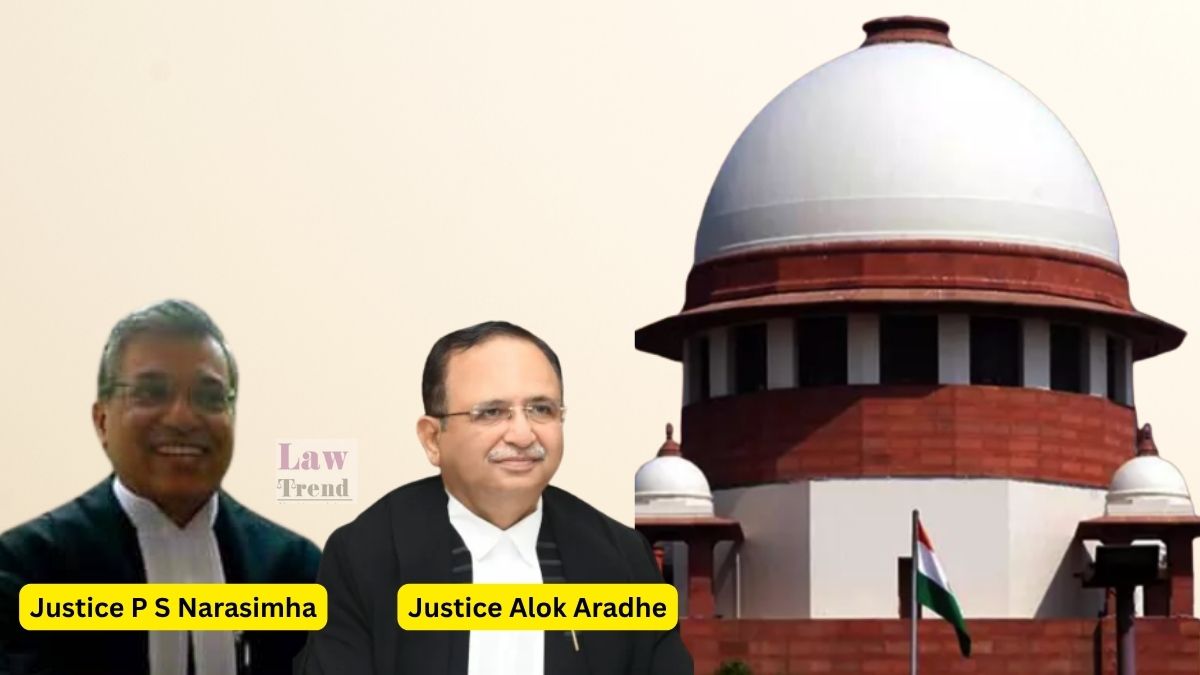
The Supreme Court of India, in a judgment delivered on April 21, 2026, has set aside a Madras High Court order that had rejected a civil plaint filed by M/s. Marg Limited. The Bench, comprising Justice Pamidighantam Sri Narasimha and Justice Alok Aradhe, held that a court cannot reject a plaint for undervaluation or insufficient court fees without first providing the plaintiff an opportunity to rectify the defect.
The Court emphasized that the power under Order VII Rule 11(b) and (c) of the Code of Civil Procedure (CPC) is conditional and not automatic.
Background of the Case
The appellant, M/s. Marg Limited, a real estate development company, purchased land in Karapakkam Village, Chennai, and constructed a commercial building known as “Digital Zone-I.” To secure loans from Standard Chartered Bank, the property was equitably mortgaged. Due to financial difficulties, the account became a Non-Performing Asset (NPA).
Following negotiations, the appellant entered into a commercial arrangement with the respondents. According to the appellant, this was a composite arrangement involving:
- The execution of eight separate sale deeds for a consideration of ₹58.60 crores (of which ₹32.50 crores was paid to the Bank).
- A Memorandum of Agreement (MoA) dated March 17, 2023, which allegedly mandated an additional payment of approximately ₹53 crores contingent upon refurbishment and leasing performance.
While the sale deeds were executed on April 3, 2023, the respondents did not sign the MoA. In June 2024, the appellant filed a suit seeking a mandatory injunction to direct the respondents to execute the MoA and pay the balance consideration, or alternatively, for reconveyance of the property.
Proceedings and High Court Ruling
The respondents filed an application under Order VII Rule 11 of the CPC for rejection of the plaint, arguing it lacked a cause of action and was undervalued. While the Trial Court rejected this application on September 24, 2024, the Madras High Court reversed the decision on July 28, 2025.
The High Court held that the MoA was not a concluded contract and that the sale was finalized upon the execution of the sale deeds. It further concluded that the suit was, in substance, a claim for recovery of ₹53–55 crores, requiring ad valorem court fees which had not been paid. Consequently, the High Court rejected the plaint.
Arguments of the Parties
Appellant’s Submissions: Senior Counsel for the appellant argued that the transaction was a “composite commercial arrangement” and that the High Court erred by treating it as a simple concluded sale. They contended that WhatsApp communications and the incorporation of Special Purpose Vehicles (SPVs) by the respondents proved consensus ad idem. Furthermore, they argued that any deficiency in court fees was a “curable defect” and the High Court had impermissibly conducted a “mini-trial.”
Respondents’ Submissions: Senior Counsel for the respondents maintained that no enforceable rights survived after the registered sale deeds. They argued the MoA was never signed by the respondents and therefore was not a binding contract. They further asserted that the suit was a recovery claim disguised as an injunction to avoid paying proper court fees.
Court’s Analysis and Observations
The Supreme Court analyzed the principles governing Order VII Rule 11. On the issue of “Cause of Action,” the Court noted that a holistic reading of the plaint revealed a “live and subsisting dispute.” The Bench observed:
“Whether a plaint discloses a cause of action is essentially a question of fact, to be determined on a holistic reading of the plaint itself. It is impermissible to isolate a sentence or a passage and to read it out of context.”
The Court found that the appellant had pleaded specific material facts regarding negotiations and staged payments. It held that determining whether the MoA was a concluded contract is a matter for trial, not for a threshold rejection.
“The approach adopted by the High Court, in proceeding to examine the enforceability of the MoA and to conclude that no cause of action survives, amounts to conducting a mini-trial, which is impermissible in law.”
Regarding the “Valuation and Court Fees,” the Supreme Court highlighted the statutory safeguard in Order VII Rule 11(b) and (c). It noted that the law contemplates a two-step process: first, the Court must form an opinion on the deficiency; second, it must fix a time for the plaintiff to correct it.
“The requirement to grant an opportunity is not a mere procedural formality, but a substantive safeguard intended to ensure that a litigant is not non-suited on a curable defect.”
The Bench criticized the High Court for rejecting the plaint “outrightly” without giving the appellant a chance to make good the deficit.
Decision
The Supreme Court allowed the appeal and quashed the Madras High Court’s order. The Trial Court has been directed to afford the appellant an opportunity to correct the valuation of the suit and pay the requisite court fees within a fixed time limit. No order as to costs was made.
Case Details
- Case Title: M/s. MARG LIMITED v. SUSHIL LALWANI & ORS.
- Case No.: CIVIL APPEAL No. OF 2026 (@SLP (C) No. 25132 OF 2025)
- Bench: Justice Pamidighantam Sri Narasimha and Justice Alok Aradhe
- Date: April 21, 2026