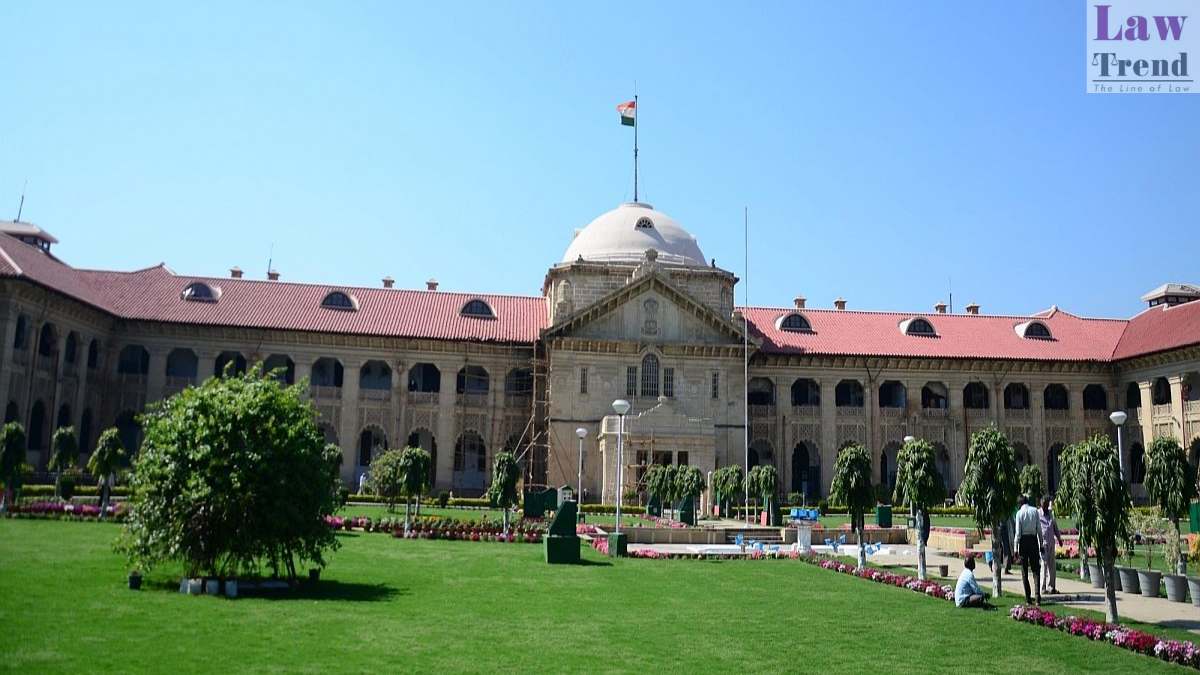
The High Court at Allahabad has dismissed an application filed under Section 528 of the Bharatiya Nagarik Suraksha Sanhita (BNSS), seeking to set aside a Trial Court order that rejected a prayer to recall a material witness three years after his cross-examination. The Court ruled that the power to recall a witness under Section 311 of the Code of Criminal Procedure (Cr.P.C.)—now applicable under BNSS—is a discretionary power that must be exercised with extreme care and cannot be used to fill gaps in the prosecution’s case or to reconcile discrepancies.
Legal Issue
The application was filed by Smt. Ramvati (mother of the deceased) challenging an order dated November 10, 2025, passed by the Additional District and Sessions Judge, Gautam Budh Nagar. The applicant sought the re-examination of P.W.-3, Rishipal Singh (father of the deceased), who had resiled from his earlier testimony during cross-examination. The High Court, presided over by Justice Nand Prabha Shukla, upheld the Trial Court’s decision to reject the recall application.
Background of the Case
The matter pertains to Case Crime No. 1310 of 2019 under Sections 302 (Murder) and 201 (Causing disappearance of evidence) of the IPC. An FIR was lodged on September 3, 2019, after two dead bodies, identified as Rahul (applicant’s son) and Kuldeep Nagar, were found with gunshot wounds in a field in District Gautam Budh Nagar. Following investigations, a charge sheet was submitted against Sukhmeet, Yogesh alias Bachhi, and Saurabh Rana.
During the trial, P.W.-3, Rishipal, was examined-in-chief on September 23, 2021, where he supported the prosecution case. However, during his cross-examination on July 28, 2022, he retracted his testimony and resiled from his previous statements. Despite this, the prosecution did not declare him hostile or seek re-examination at that time. On August 14, 2025, over three years later, the applicant moved a Section 311 Cr.P.C. application to recall Rishipal.
Arguments of the Parties
The applicant, represented by Sri Saksham Srivastava, contended that the witness did not testify out of his own free will during cross-examination. It was alleged that he deposed under coercion and threats meted out by local villagers having affinity with the accused. An affidavit by P.W.-3 was filed in October 2025 supporting these claims.
The State, represented by learned AGA-I Shri Ratan Singh, opposed the application. The prosecution highlighted that P.W.-3 had specifically stated during his cross-examination in 2022 that he was giving his testimony without any fear or coercion and that his statements were true.
The Court’s Analysis
The Court observed that the application was moved at a “belated stage” after a gap of more than three years. It noted that the applicant, being the mother of the deceased, was neither the first informant nor an eyewitness. The Court found that the application appeared to be an attempt to “fulfil the lacuna in a prosecution case” and to reconcile discrepancies between the examination-in-chief and cross-examination.
Referring to the Supreme Court’s decision in Raja Ram Prasad Yadav vs. State of Bihar and Another (2013), the Court highlighted several principles governing Section 311 Cr.P.C.:
- The power is invested with the Courts to ensure a “just decision.”
- The exercise of such power must be made judicially and with “extreme care and caution.”
- The additional evidence must not be received as a “disguise for retrial” or to change the nature of the case.
The Court explicitly observed:
“The trial is in progress and the application dated 14.08.2025 under section 311 Cr.P.C has been moved by the applicant at a belated stage after a gap of more than three years to fulfil the lacuna in a prosecution case and to reopen and to avail another opportunity to reconcile the discrepancies if any between the statements in the examination-in-chief and cross examination and further to explain any statement inadvertently made in cross examination…”
The Court also noted that neither the applicant nor the witness had raised any grievance regarding threats or coercion to any authorities or the Trial Judge in the preceding years. It held that re-examining the witness at this stage would cause “serious prejudice to the accused and may result in the miscarriage of justice.”
The Decision
The High Court concluded that the factors noted by the Trial Court were appropriate and just. It held that the impugned order did not call for any interference.
“In view of the foregoing discussions and applying the various principles set out above, the factors noted by the Trial Court and the conclusion drawn are all appropriate and just and the order impugned does not call for any interference.”
Accordingly, the application under Section 528 BNSS was dismissed, and the Trial Court was directed to proceed with and conclude the trial expeditiously in accordance with law.
Case Details
Case Title: Smt. Ramvati Versus State Of U.P. And 3 Others
Case No.: APPLICATION U/S 528 BNSS No. 50778 of 2025
Bench: Justice Nand Prabha Shukla
Date: April 20, 2026