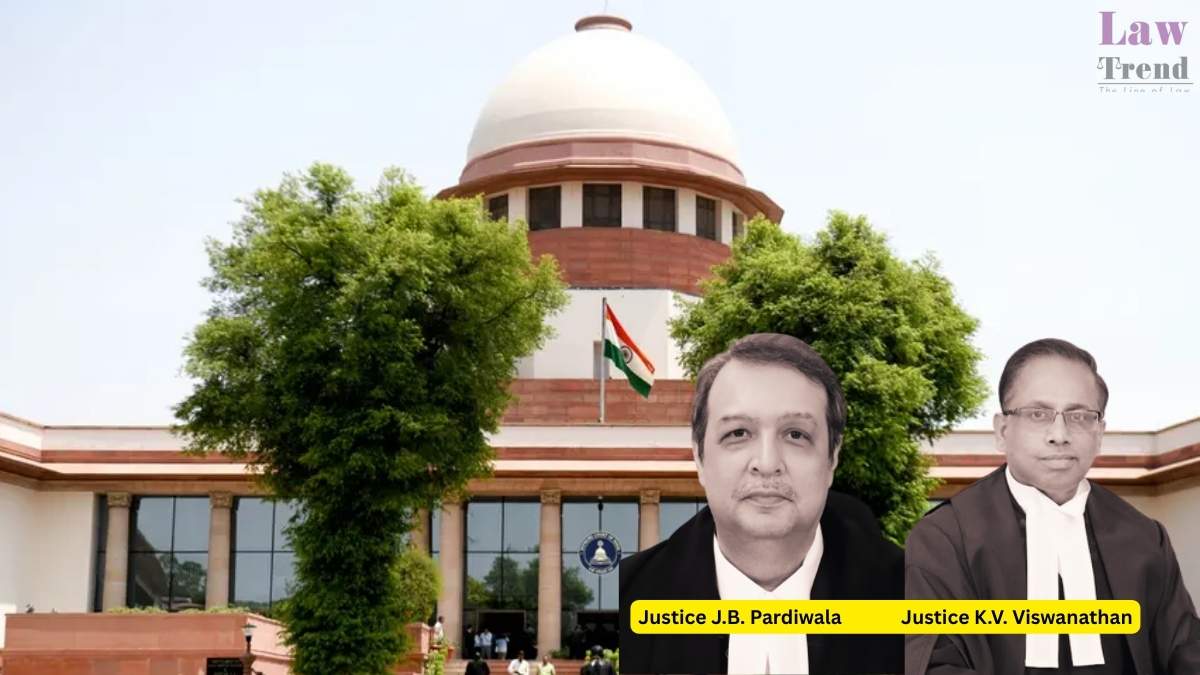
The Supreme Court, in a judgment delivered by a Bench of Justice J.B. Pardiwala and Justice K.V. Viswanathan, has enhanced compensation in a motor accident case, holding that compensation for prosthetic limbs must be guided by the principle of restitutio in integrum—restoring the claimant, as far as possible, to their original condition. The Court awarded a total compensation of ₹36.20 lakh, including ₹26 lakh towards prosthetic limb and maintenance costs.
Background
The case arose from a road accident on May 2, 2007, in Jaipur, where the appellant Prahlad Sahai suffered severe injuries after a Haryana Roadways bus hit his motorcycle from behind. His right leg had to be amputated below the knee.
The Motor Accident Claims Tribunal awarded ₹8.73 lakh, which was enhanced to ₹13.02 lakh by the Rajasthan High Court. Dissatisfied, the appellant approached the Supreme Court seeking further enhancement.
Submissions
The appellant argued that no compensation had been granted for prosthetic limb expenses, despite it being a lifelong necessity requiring periodic replacement. He also sought recognition of his monthly income at ₹6,000 and claimed 100% functional disability.
The respondents contended that compensation must remain “just and reasonable” and should not result in a windfall. They relied on varying precedents and government-notified rates.
Court’s Analysis
The Court emphasized that compensation under the Motor Vehicles Act must be fair and reasonable, neither excessive nor inadequate. It observed:
“Compensation for loss of limbs or life can hardly be weighed in golden scales… the compensation must be ‘just’ and it cannot be a bonanza; not a source of profit; but the same should not be a pittance.”
On prosthetic limbs, the Court held that such devices are essential for dignity and mobility. It adopted a structured approach:
- Life expectancy fixed at 70 years
- Replacement cycle of 5 years
- Multiple replacements over lifetime
The Court rejected government-notified rates as “abysmally low” and held that a claimant is entitled to procure appropriate prosthetic devices based on reasonable needs.
Findings
The Court accepted ₹6,000 as the appellant’s monthly income and held that his functional disability was 100%, as he could no longer work as a driver.
Decision
Allowing the appeal, the Court awarded:
- ₹21 lakh for seven prosthetic limbs
- ₹5 lakh for maintenance
- Enhanced compensation for loss of future income
- ₹2 lakh towards litigation costs
The total compensation was fixed at ₹36,20,350, payable within four weeks, failing which 9% interest would apply.