

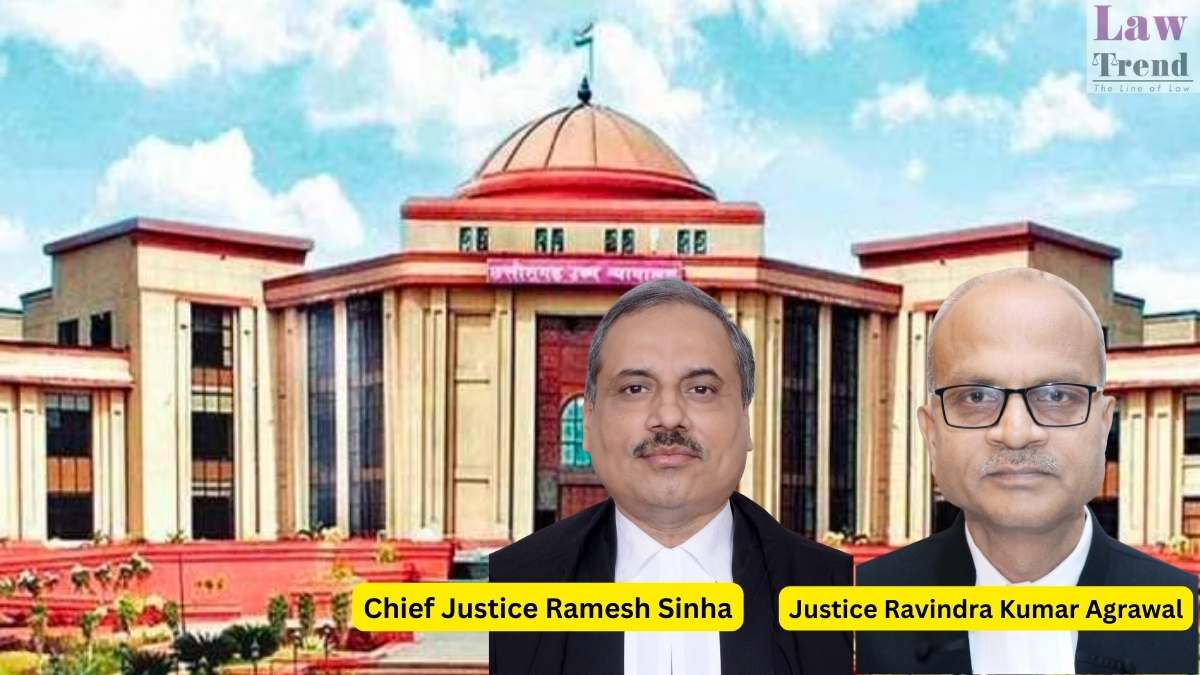
Account Books Alone Insufficient to Fasten Liability Without Corroborative Evidence: Chhattisgarh High Court

The High Court of Chhattisgarh has dismissed an appeal filed by a coal merchant seeking recovery of over ₹21 lakh, ruling that entries in books of account are merely corroborative and cannot, by themselves, create a legal liability. A Division Bench comprising Chief Justice Ramesh Sinha and Justice Ravindra Kumar Agrawal held that such records are “private and unilateral” and require independent evidence of the actual transactions they represent.

Background of the Case

The case originated from a business relationship between the appellant, Lalwani and Sons (through proprietor Kalyan Das Lalwani), and the respondents, Firm Cheema Bricks. The appellant claimed to have supplied significant quantities of coal to the defendants on credit during the financial years 2011-12 and 2012-13.

According to the appellant, coal worth approximately ₹78.35 lakh was sold in 2011-12 and ₹15.29 lakh in 2012-13. The plaintiff alleged that after adjusting payments, an outstanding balance of ₹18,45,201 remained unpaid. Seeking this principal amount along with damages and interest, the plaintiff filed a civil suit for recovery totaling ₹21,18,500.

The Additional District Judge, Bilaspur, dismissed the suit on August 23, 2017, leading to the present appeal under Section 96 of the Code of Civil Procedure, 1908.

READ ALSO  Offence under Section 138 Can Be Compounded Even After Conviction: Himachal Pradesh High Court

Arguments of the Parties

The appellant, appearing in person, argued that the business relationship and the supply of coal were admitted by the defendants. He contended that once the supply was proven via delivery vouchers and SECL delivery orders, the burden shifted to the defendants to prove payment. He further argued that his audit reports and computerized ledger accounts established the debt.

The respondents, represented by Senior Advocate Manoj Paranjpe, countered that the plaintiff failed to produce original cash books, ledgers, or acknowledged invoices. They argued that the schedules provided were “self-served statements” and that the plaintiff had actually received excess payments. They also pointed out that the audit report’s author was not examined and that the report had not been submitted to the Income Tax Department to verify its genuineness.

The Court’s Analysis

The High Court scrutinized the evidence under the lens of Section 34 of the Indian Evidence Act, 1872 (now Section 28 of the Bharatiya Sakshya Adhiniyam, 2023). The Court observed that while entries in books of account are relevant, they “shall not alone be sufficient evidence to charge any person with liability.”

READ ALSO  [READ JUDGMENT] Full Bench of Lucknow HC - How to Present Election Petition before Prescribed Authority?

The Bench noted several critical deficiencies in the plaintiff’s evidence:

  • Lack of Originals: The plaintiff admitted in cross-examination that he had not produced original registers, cash books, or delivery orders from which the computerized schedules were prepared.
  • Self-Serving Records: The Court described the schedules and credit memos as “private extracts” and “self-generated,” noting that they did not inspire confidence without independent verification.
  • Unverified Audit Report: The audit report was not filed with the Income Tax Department, nor was the Chartered Accountant examined to prove its contents.
  • Delivery Discrepancies: The plaintiff failed to prove that the trucks used for transport were authorized by or belonged to the defendants.

Citing the Supreme Court in Central Bureau of Investigation vs. V.C. Shukla (1998) and Ishwar Dass Jain vs. Sohan Lal (2000), the High Court emphasized:

“The rationale behind admissibility of parties’ books of account as evidence is that the regularity of habit, the difficulty of falsification and the fair certainty of ultimate detection give them in a sufficient degree a probability of trustworthiness.”

The Court further observed that:

“A man cannot be allowed to make evidence for himself by what he chooses to write in his own books behind the back of the parties. There must be independent evidence of the transaction to which the entries relate.”

READ ALSO  Gravity of Offense Cannot be the Ground to Deny the Bail Application of a Juvenile: Jharkhand HC

Decision

The High Court concluded that the plaintiff failed to discharge the burden of proof under Section 101 of the Evidence Act. It held that the trial court correctly applied the principle of “preponderance of probability,” finding the defendants’ evidence—which included bank deposit receipts—to be on a “better footing” than the plaintiff’s uncorroborated records.

“The account book is a private and unilateral record maintained by one party and such record cannot be treated as substantive evidence… to impose liability for enforcement of a legal right without independent and corroborative evidence,” the Court’s headnote stated.

Dismissing the appeal, the Court ordered parties to bear their own costs.

Case Details:

  • Case Title: Lalwani And Sons vs. Firm Cheema Bricks and Others
  • Case Number: FA No. 549 of 2017
  • Coram: Chief Justice Ramesh Sinha and Justice Ravindra Kumar Agrawal
  • Date: March 18, 2026

Law Trend
Law Trendhttps://lawtrend.in/
Legal News Website Providing Latest Judgments of Supreme Court and High Court

Related Articles

Latest Articles

