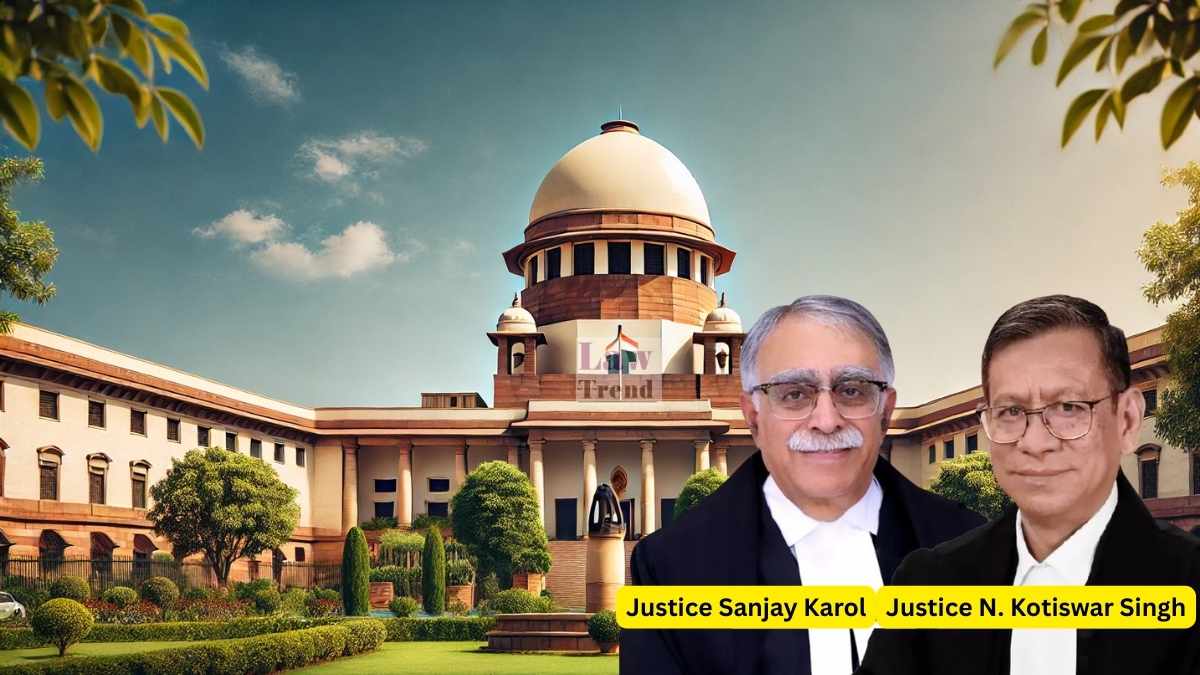
The Supreme Court of India has approved a comprehensive Standard Operating Procedure (SOP) designed to address “inordinate delays” in the filing of appeals and Special Leave Petitions (SLPs) by convicts seeking legal aid. In a judgment delivered by a Bench comprising Justice Sanjay Karol and Justice Nongmeikapam Kotiswar Singh, the Court directed all High Courts to consider administrative changes to streamline the translation and transmission of judicial records.
The Court emphasized that legal aid is a “constitutional responsibility” tied to the Preamble’s vision of social, economic, and political justice, as well as the mandate under Article 39A of the Constitution.
Background and Procedural History
The proceedings originated from a challenge by the appellant, Shankar Mahto, against a death sentence confirmed by the Patna High Court in 2014. During the hearing on May 5, 2017, the Supreme Court noticed significant delays in matters involving legal aid. To investigate the cause and issue necessary directions, the Court appointed Senior Counsel Ms. Vibha Datta Makhija as amicus curiae.
Over several years, the Court engaged with stakeholders including the Supreme Court Legal Services Committee (SCLSC), the National Legal Services Authority (NALSA), and various State Governments. An affidavit filed by the SCLSC in July 2025 revealed critical systemic gaps, including the lack of a feature to track filing delays on its portal and the absence of timely official communication from panel advocates post-assignment.
The Court’s Analysis of Legal Aid
The Bench provided a detailed conceptual framework for legal aid in India, noting that “equality before the law must be real and not symbolic.” The Court observed:
“Legal aid contributes directly to this goal by enabling disadvantaged individuals to assert their rights and seek remedies against injustice… Articles 21, 39A, and 142 of the Constitution of India, ensuring access to justice for all legal aid beneficiaries.”
Citing historical precedents, the Court referred to Sunil Batra v. Delhi Administration, noting that prisoners do not surrender their fundamental rights at the gate. It also discussed Hussainara Khatoon v. State of Bihar, which established that “speedy trial to be a facet of Article 21 and free legal aid is an essential component of fair, just and reasonable procedure in law.”
The Court further noted the recent decision in Suhas Chakma v. Union of India (2024), which dealt with systemic deficiencies in legal aid for undertrials and issued directions for “Early Access to Justice.”
The New Standard Operating Procedure (SOP), 2025
The result of the deliberations is the “Standard Operating Procedure (SOP) for Translation and Transmission of Records for Filing Legal Aid Appeals and Special Leave Petitions (SLPs), 2025.” The SOP categorizes cases into:
- Category A1: High-Priority Criminal Cases (death sentences, life imprisonment, or 10+ years).
- Category A2: High-Priority Civil Cases (demolitions, evictions, child custody, etc.).
- Category B & C: Medium and standard priority matters.
Key features of the SOP include:
- Mandatory Timelines: For Category A cases, High Court Legal Services Committees (HCLSC) must obtain convict consent within 15 days of judgment and assign translators within 15 days.
- Digital Integration: The NIC is directed to create a unified platform for SCLSC, HCLSCs, and Jail Authorities to exchange information seamlessly.
- Translator Cadre: High Courts are urged to create or upgrade the cadre of Translators and Translation Supervisors, with staff strength not less than one-third of the judge strength.
- Monitoring Committees: Each High Court and the Supreme Court must constitute a Monitoring Committee comprising senior advocates and the Member Secretary to review progress weekly.
Decision and Directions
The Supreme Court directed that the timelines mentioned under Heading 5 of the SOP shall be “treated as binding” for streamlining the filing of appeals.
The Court further ordered:
- Digital Platform: The National Informatics Centre (NIC) must create the unified digital platform within two months.
- Monitoring Committees: SCLSC and HCLSCs must constitute Monitoring Committees within one month.
- Delay Explanation: A new mandatory checklist explaining delays (including dates of judgment communication, consent, and lawyer appointment) must be incorporated into all legal aid applications within two weeks.
- Nodal Officer: The Member Secretary of NALSA is designated as the nodal officer to oversee the implementation and periodic review of the SOP.
Regarding the quality of translations, the Bench observed:
“The poor quality of translation has engaged the attention of this Court, recently, on quite of few occasions, indicating that some sort of structural change is necessitated in this regard.”
The Registrar (Judicial) was directed to circulate the order to all High Court Registrars General to ensure the directions are placed before the respective Chief Justices and Executive Chairpersons of State Legal Service Committees.
Case Details:
- Case Title: Shankar Mahto v. State of Bihar
- Case No.: Criminal Appeal No. of 2026 (Arising out of SLP (Crl.) No(s). of 2026 @ Crl.MP. 7862 of 2017)
- Bench: Justice Sanjay Karol and Justice Nongmeikapam Kotiswar Singh
- Date: April 16, 2026