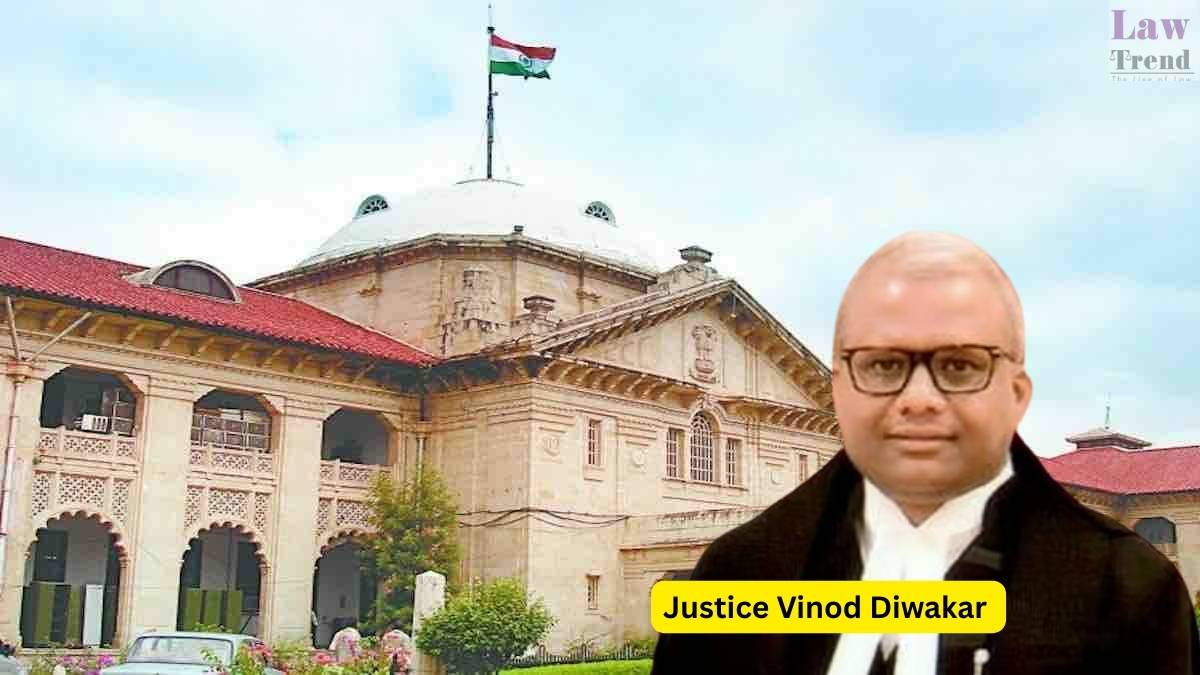
The Allahabad High Court has observed that despite the lapse of nearly a year, key police reform directives aimed at standardizing criminal investigations and ensuring prosecutorial accountability remain largely unimplemented across Uttar Pradesh. Disposing of a habeas corpus petition following the recovery of a minor girl, Justice Vinod Diwakar criticized the state’s administrative apparatus for its systemic non-compliance with the court-mandated Subhash Chandra guidelines and directed the Union Department of Personnel and Training (DoPT) to place the record of the Additional Chief Secretary (ACS), Home, before the Appointment Committee of the Cabinet (ACC) to assess his suitability for future assignments.
Background of the Case
The matter arose from a habeas corpus petition filed by Megha Raikwar, seeking the recovery of her 15-year-old daughter who was allegedly enticed away by an accused named Kallu on June 10, 2025. Following the complaint, an FIR was registered on June 11, 2025, under Sections 87 and 137(2) of the Bharatiya Nyaya Sanhita (BNS), 2023, at P.S. Sipri Bazar in District Jhansi.
Although the accused was arrested and subsequently released on bail, the investigating authorities filed a charge-sheet on August 13, 2025—within sixty days of registering the FIR—without actually recovering the minor victim. The charge-sheet relied primarily on statements from the accused and witnesses claiming the minor girl had boarded a train while the accused was asleep at a railway station.
Expressing deep concern over the superficial nature of the investigation, the High Court intervened and directed the Senior Superintendent of Police (SSP), Jhansi, to explain the failure to locate the minor. The Court specifically demanded to know if the mandatory investigative safeguards established by the High Court in Subhash Chandra & Others v. State of U.P. & Another had been complied with. The Subhash Chandra directives require comprehensive details to be recorded in Column-16 of police reports and mandate independent prosecutorial scrutiny of draft charge-sheets prior to their submission in court.
To evaluate systemic compliance across the state, the Court examined ten sample charge-sheets from ten different districts. The review revealed that the guidelines were not being uniformly adhered to, disclosing a widespread lack of effective implementation at the field level.
Arguments of the Parties
The petitioner’s counsel argued that the police had conducted a compromised and deficient investigation, rushing to submit a charge-sheet to close the file without recovering the minor girl or identifying all potential suspects.
The State, represented by the Additional Advocate General, submitted comprehensive search reports detailing the extensive efforts made by police teams across Uttar Pradesh and Madhya Pradesh. These included scanning call detail records (CDRs), conducting physical searches in red-light districts, issuing social media notices, and sending a statutory notice under the BNS to Meta Platforms regarding the victim’s Instagram account. Coordination was also established with local police in Bhonti, Shivpuri, to rule out any connection with a 90% burnt body of an unidentified young female recovered in September 2025.
On the policy issue of implementing the Subhash Chandra guidelines, the Secretary (Home), Government of Uttar Pradesh, filed an affidavit on February 20, 2026. The State argued that the Home Department had decided to challenge the Subhash Chandra ruling before the Supreme Court of India by filing a Special Leave Petition (SLP).
The State contended that while the Supreme Court in State of Gujarat v. Kishanbhai emphasized post-investigation scrutiny, it did not mandate that investigating officers must have charge-sheets reviewed by prosecution officers prior to submission. The State argued that such mandatory pre-submission reviews raise substantial questions of law under the Supreme Court precedent of R. Sarala v. T.S. Velu, and therefore, the directions could not be implemented in the manner contemplated by the High Court.
The Court’s Analysis
The Court expressed profound dissatisfaction with both the poor handling of the individual abduction case and the bureaucratic resistance to structural police reforms. The Court pointed out that while the Subhash Chandra judgment was delivered on May 12, 2025, no concrete administrative steps had been taken to enforce it over the subsequent year. The state’s sudden decision to file an SLP was disclosed only in February 2026, after the Court actively demanded compliance reports, and no stay or order from the Supreme Court had been produced despite a lapse of more than three months.
Invoking historical administrative principles, the Court drew a parallel with Kautilya’s Arthashastra, noting that even 2,300 years ago, public officials were subjected to daily examination because “men are by nature fickle-minded and, like horses at work, exhibit constant changes in their temperament.”
The Court criticized the executive’s reliance on unchecked administrative discretion, observing:
“unbridled discretion carries with it serious risks- it undermines the rule of law; it serves as a source of illicit power for administrative officials; it relieves them of the obligation to furnish reasons for their decisions; it undermines legal certainty; and it frees public officials from accountability to individuals whose rights may be affected.”
The Court strongly censured the conduct of the Additional Chief Secretary (Home), Sanjay Prasad, stating:
“The conduct of Shri Sanjay Prasad, as noticed above, prima-facie reflects a deliberate and calculated attempt to undermine the authority of this Court by projecting the proposed Special Leave Petition as a basis for seeking restraint in the enforcement of judicial directions, while simultaneously failing to pursue the said remedy with any degree of diligence or bona fides.”
To address these systemic failures, the Court recommended that the Secretary of the Department of Personnel and Training (DoPT), Government of India, develop a regulatory framework incorporating the “doctrine of superior responsibility” for the civil services. The Court declared:
“Superior officers must be held accountable for the conduct and performance of their subordinates, as it is their professional and administrative responsibility to ensure the effective delivery of public services.”
The Court noted that such administrative accountability should escalate to criminal liability where supervisory neglect results in corruption, fraud, or the willful suppression of court-mandated policies.
In analyzing the legal standards of investigation, the Court cited several key rulings emphasizing fair, impartial, and scientifically sound investigations, including Sanuj Bansal v. State of U.P. and Another, Dablu Kujur v. State of Jharkhand, R.K. Dalmia etc. v. Delhi Administration, and Sharif Ahmed and Another v. State of Uttar Pradesh and Another.
The Court’s Decision
The High Court was informed during the proceedings that the minor girl had been successfully recovered by the local police and safely restored to her parents. Consequently, the Court held that the principal grievance of the habeas corpus petition no longer survived.
While disposing of the petition, the Court recorded its appreciation for the concerted efforts made by the SSP, Jhansi, and the local police team in securing the minor’s recovery.
However, in light of the administrative conduct observed regarding the non-compliance of Subhash Chandra, the Court refrained from passing further compliance orders at this stage but ordered the Registrar (Compliance) to transmit a certified copy of the judgment to the Secretary, DoPT, Government of India. The Court directed the DoPT to place the service record of Sanjay Prasad, IAS, before the Appointment Committee of the Cabinet (ACC) to assess his suitability for future assignments.
Case Details:
Case Title: Megha Raikwar v. State of U.P. and 4 Others
Case No.: Habeas Corpus Writ Petition No. 946 of 2025
Bench: Justice Vinod Diwakar
Date: June 03, 2026