

Rejection of Passport NOC Unsustainable Amidst Stayed Proceedings and Decades-Long Delay: Allahabad High Court
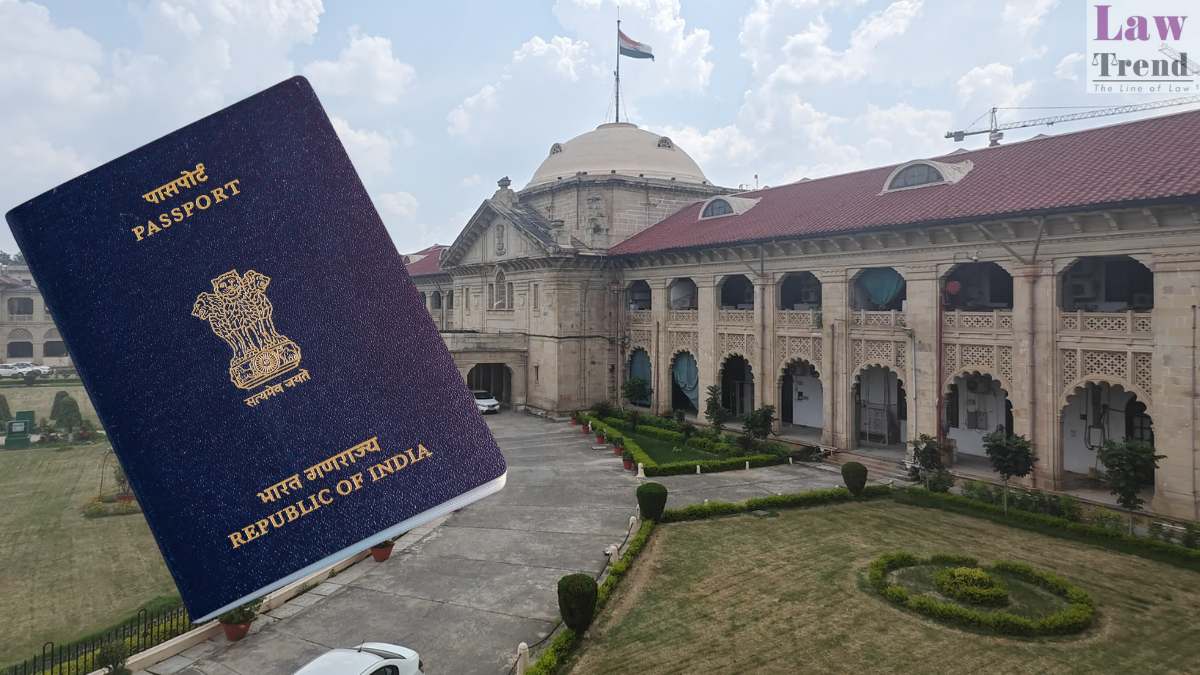
The Allahabad High Court has set aside a special court’s order rejecting a businessman’s application for a No Objection Certificate (NOC) for passport renewal, holding the rejection unsustainable given stayed criminal proceedings and an 18-year delay in filing the charge-sheet. In a judgment delivered by Justice Vinod Diwakar, the High Court allowed the petition under Article 227 of the Constitution of India, directing the Regional Passport Authority, Bareilly, to renew the passport of the petitioner, Avnesh Kumar Agarwal, in accordance with the prescribed procedure. The Court also issued directions to place the judgment before the Chief Minister of Uttar Pradesh to address systemic delays and introduce a doctrine of administrative accountability.

Background of the Case

The petitioner, Avnesh Kumar Agarwal, assailed an order dated September 20, 2025, passed by the Additional Sessions Judge/Special Judge (Prevention of Corruption Act), Bareilly, in Special Trial No. 18 of 2025. By the impugned order, the special court had rejected the petitioner’s application seeking an NOC for the renewal of his passport.

The case against the petitioner stemmed from two First Information Reports (FIRs) registered in 2007. The first, FIR No. 1634 of 2007, was registered on September 13, 2007, at Police Station Najibabad, District Bijnor, under Sections 406, 420, 424, 467, 468, 471, 120-B, and 218 of the Indian Penal Code (IPC). The second, FIR No. 318 of 2007, was registered at Police Station Mandawali, District Bijnor, under Sections 420, 406, 424, 467, 468, 471, 477, 218, and 120-B of the IPC, read with Section 13(1)(d) of the Prevention of Corruption Act, 1988.

Both FIRs arrayed senior officers of the Commercial Tax Department of District Bijnor as accused, along with owners of a transport company and truck drivers. The allegations involved corruption, forgery, and the destruction of official records by setting a government office on fire. In FIR No. 1634 of 2007, a Sub-Inspector of the Economic Offences Wing (EOW) of the Uttar Pradesh Police at Lucknow accused 25 persons—including 10 Trade Tax officers, truck drivers, traders, and the owner of a Calcutta-based transport company—of colluding to misuse official positions and cause heavy losses to the State treasury through fraudulent consignments. Substantially similar allegations were made in the second FIR.

Arguments of the Parties

The petitioner’s counsel, Shri Pavan Kumar, argued that the investigation in FIR No. 318 of 2007 had remained pending for nearly two decades. With respect to FIR No. 1634 of 2007, the charge-sheet was submitted only in the year 2024, representing an inordinate delay of 18 years. He pointed out that a Co-ordinate Bench of the Allahabad High Court had already stayed the proceedings arising from FIR No. 1634 of 2007 on November 21, 2025.

READ ALSO  Chhattisgarh High Court Orders State to Intensify Efforts Against Noise Pollution During Festive Seasons

The Co-ordinate Bench had stayed the proceedings after taking note of several contentions, including that the allegations were false, frivolous, and leveled with an ulterior motive to harass the petitioner; the primary allegations were against government officials who allowed loaded trucks to pass without receipts; the petitioner is a businessman; the charge-sheet was filed 18 years after the FIR; and there was no pre-summoning evidence on record. Consequently, the petitioner’s counsel urged that the rejection of the NOC was wholly erroneous.

In contrast, the learned Additional Government Advocate (AGA) for the State highlighted the gravity of the allegations. The State submitted that the accusations were of a highly serious nature, pointing specifically to the charge that the accused persons set a government office on fire with the intent to destroy official records.

READ ALSO  Orally Informing the Accused of his Rights in an NDPS case is not sufficient: P&H HC

The Court’s Analysis

The Court noted that during the proceedings, it had looked into the implementation of directions issued by a Division Bench of the High Court in Manish Kumar Singh v. State of U.P. & Ors. (2023) SCC OnLine All 2501. That ruling had directed the State Government to constitute a High-Powered Committee chaired by the Chief Secretary to formulate guidelines for monitoring investigations of corruption and cheating cases registered by government departments, ensuring their swift completion.

The Court observed that although the Division Bench had directed the guidelines to be formulated within three to six months, there was an inordinate delay of nearly two years in constituting the Committee. The High-Powered Committee, chaired by the Chief Secretary of Uttar Pradesh, was only established on December 10, 2025, after the Court took active cognizance of the delay in the present petition.

The Court scrutinized the State’s compliance affidavits, noting that divisional and district-level monitoring committees had since been established to facilitate data collection and supervise departmental cases. Despite these steps, the Court expressed regret that the State law officers had failed to provide any update on the High-Powered Committee’s latest progress, despite the Court waiting for over three months after reserving the judgment.

Reflecting on the need for accountability in public administration, the Court observed that the time has come for the State to evolve and adopt a doctrine of “superior responsibility, whereby senior officers in an administrative hierarchy are held accountable- and, in appropriate cases, criminally responsible for their failure to prevent or punish acts of commission or omission by their subordinates.” The Court clarified that the failure to prevent includes the failure to take timely administrative measures or report matters to higher administrative authorities.

READ ALSO  हाई कोर्ट ने यूपी विधानसभा कर्मचारियों की भर्ती की सीबीआई जांच के खिलाफ याचिका खारिज की; वकील ने सीबीआई को 'पीछा करने वाली' एजेंसी बताया

Addressing bureaucratic bottlenecks, the Court noted that a major hurdle in implementing judicial orders is the “mindset of certain sections of the bureaucracy, whose approach is not inclusive and who tend to regard the retention of discretionary power as an end in itself, thereby undermining legal certainty. The apprehension of losing discretion may well be one of the principal drivers of ‘red-tapism in public administration.”

The Court’s Decision

On the merits of the case, and noting that no response had been received from the Regional Passport Authority, Bareilly, the High Court set aside the impugned order dated September 20, 2025.

The Court allowed the petition and issued an NOC in favor of the petitioner for his passport renewal. It directed the Regional Passport Authority, Bareilly, to issue or renew the passport in accordance with the prescribed procedure.

Furthermore, the Court directed the Registrar (Compliance) to transmit a certified copy of the order to the Chief Secretary of Uttar Pradesh, with instructions to conclude the High-Powered Committee’s proceedings in a timely manner, frame comprehensive guidelines, and establish swift accountability mechanisms for errant officers. The Chief Secretary was also directed to place the order before the Chief Minister of Uttar Pradesh to ensure due consideration of the administrative and criminal accountability concerns raised in the judgment.

Case Details

Case Title: Avnesh Kumar Agarwal Versus Union of India & 3 Ors
Case No.: Matter Under Article 227 No. 13425 of 2025
Bench: Justice Vinod Diwakar
Date: June 03, 2026

Law Trend
Law Trendhttps://lawtrend.in/
Legal News Website Providing Latest Judgments of Supreme Court and High Court

Related Articles

Latest Articles
