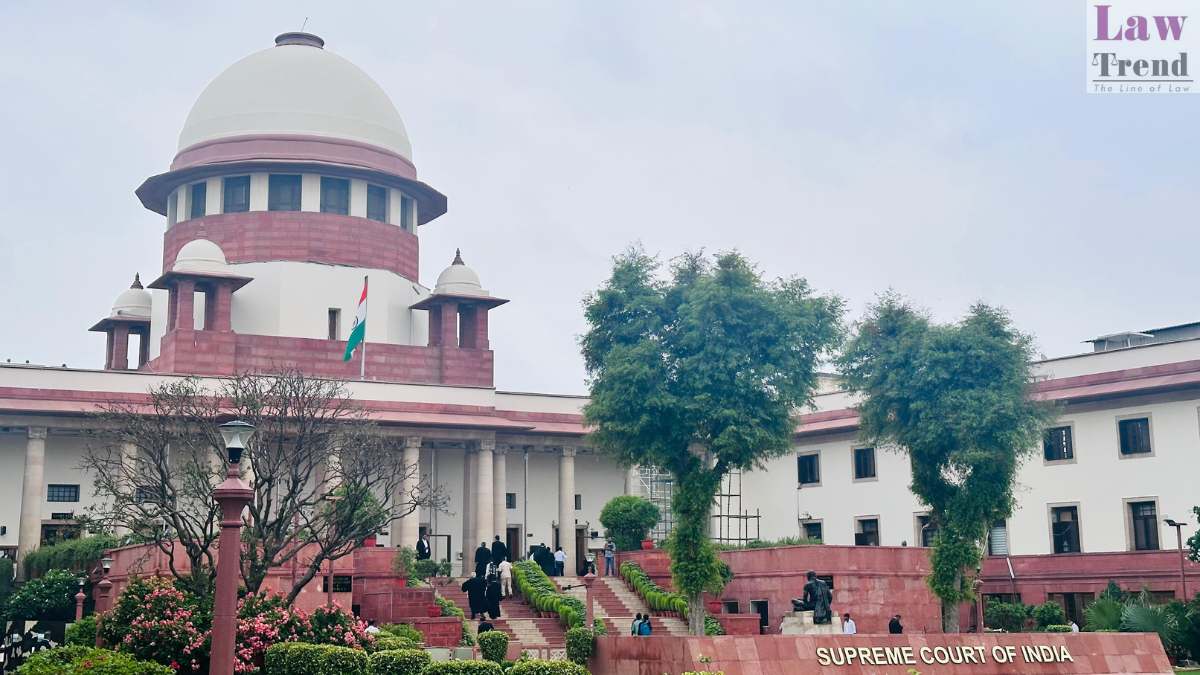
The Supreme Court of India has held that a government subsidy cannot be denied to an entity that has demonstrated persistent and bona fide efforts to comply with scheme requirements. Setting aside a Division Bench judgment of the High Court, the Court restored the entitlement of the Agriculture Produce Market Committee (APMC), Deesa, to a capital investment subsidy for its cold storage facility, noting that the authorities’ decision to withdraw and recover the funds was unjustified.
The central legal question involved the “Capital Investment Subsidy For Construction/Expansion/Modernization of Cold Storages/Storage of Horticultural Produce” scheme. The Court had to determine whether APMC Deesa was entitled to the remaining 50% of the subsidy and whether the National Bank for Agriculture and Rural Development (NABARD) was justified in seeking to recover the initial 50% advance already paid.
A Bench of Justice Sanjay Karol and Justice Augustine George Masih allowed the appeal, restoring the Single Judge’s order. The Court directed the immediate release of the remaining subsidy and protected the portion already disbursed.
Background of the Case
APMC Deesa, established under the Agricultural Produce Market Committee Act, 1963, constructed a cold storage facility utilizing a ₹1 crore loan from the Gujarat State Co-operative Agriculture and Rural Development Bank Ltd. (GSCARDB). It applied for a subsidy from the National Horticulture Board (NHB), which is operated through NABARD.
Initially, an advance of ₹25 lakhs was credited to the appellant. However, following a Joint Monitoring Visit on November 19, 2008, officials noted “minimum capacity utilization” (less than 20%) and kept further payments pending. In May 2011, the facility caught fire due to a short circuit. Subsequently, NABARD decided to withdraw the subsidy and recover the initial payment, citing a lack of compliance—a decision supported by the NHB.
While a Single Judge of the High Court ruled in favor of the APMC, a Division Bench later reversed that decision, prompting the present appeal to the Supreme Court.
Arguments of the Parties
The National Horticulture Board (NHB) contended in its written submissions that the appellant “miserably failed to establish any efforts made by it” after the 2008 inspection. They argued that the deficiencies found during the visit were never cured, rendering the APMC ineligible for the benefit.
The appellant, however, produced records of extensive correspondence from June 2009 to April 2011. These communications, sent by both the APMC and its lending bank (GSCARDB), repeatedly requested a re-inspection and the release of the final subsidy installment, asserting that the facility was fully functional and all chambers were in working condition.
Court’s Analysis
The Supreme Court scrutinized the communication logs and the authorities’ own inspection reports. Justice Karol, writing for the Bench, highlighted that the original Joint Monitoring Visit Report explicitly stated:
“The unit is completed and commissioned, it may be considered for the final subsidy as per NHB, NABARD guidelines and the parameters mentioned above.”
The Court expressed sharp disagreement with the NHB’s claim that no efforts were made by the appellant. It pointed to a table of ten separate formal communications requesting intervention and re-evaluation prior to the fire incident. The Court observed:
“It is clear from the above that efforts were indeed made by the appellant through its bank to have the money released… but the same was to no avail. Had the inspections requested been carried out or the money as requested released, this dispute would not have dragged on thus far.”
The Bench further noted that the authorities failed to provide clear reasons for withdrawing the subsidy, especially since the completion of the project was never in dispute and the appellant’s eligibility remained unquestioned throughout the construction phase.
The Decision
The Supreme Court allowed the appeal, set aside the Division Bench’s judgment, and restored the Single Judge’s directions. The Court concluded that the persistent follow-ups by the appellant constituted bona fide efforts that the authorities failed to honor.
The Court ordered:
- If the appellant had already returned the released portion of the subsidy, the entire amount (100%) must now be released in their favor.
- If the original amount had not yet been returned, the final installment of the subsidy must be released immediately.
Case Details
Case Title: Agriculture Produce Market Committee, Deesa v. National Horticulture Board & Ors.
Case No.: Civil Appeal No. OF 2026 (Arising out of SLP(Civil) No. 13129 of 2025)
Bench: Justice Sanjay Karol and Justice Augustine George Masih
Date: April 17, 2026