

Subjective Apprehension Or Unsubstantiated Allegations Against Judicial Officer Not Grounds To Transfer Trial: Chhattisgarh High Court
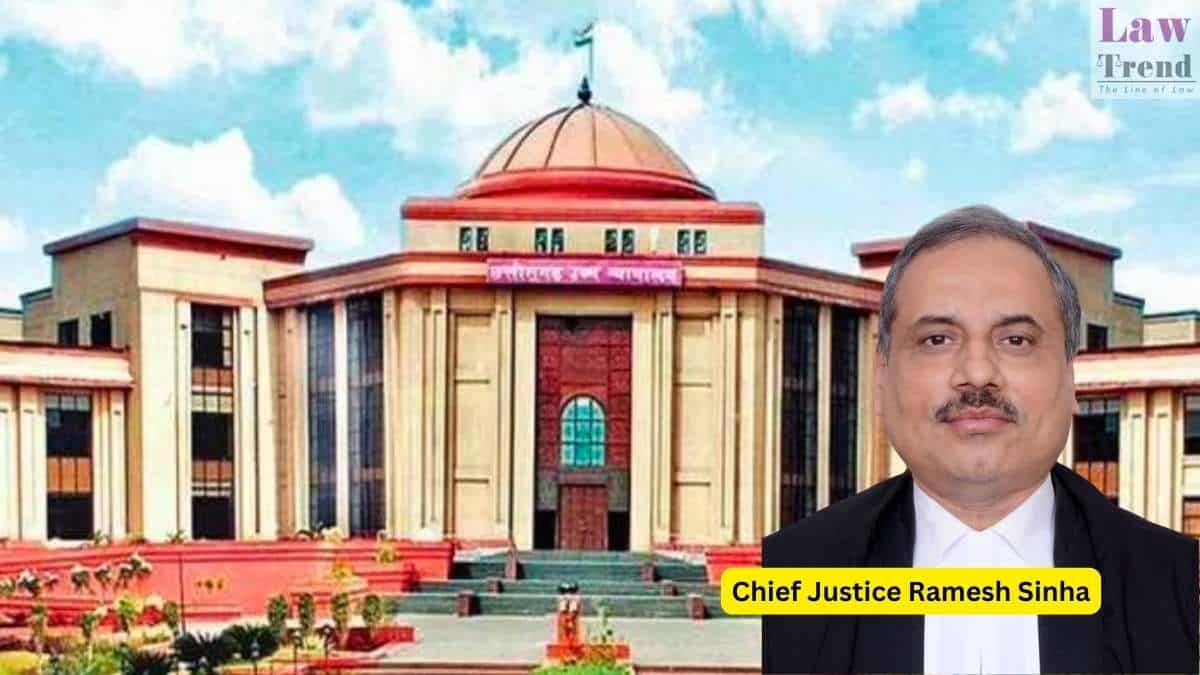

The High Court of Chhattisgarh has ruled that mere subjective apprehensions, dissatisfaction with judicial proceedings, or unsubstantiated allegations against a presiding officer cannot form the basis for transferring a criminal trial outside a district. Presiding over the matter, Chief Justice Ramesh Sinha dismissed a transfer petition filed by an accused facing murder and atrocity charges, holding that a transfer can only be ordered when objective material establishes a genuine and reasonable apprehension of a failure of justice.

Background of the Case

The petitioner, Karun Dahariya, filed a transfer petition under Section 447 of the Bharatiya Nagarik Suraksha Sanhita, 2023 (BNSS), seeking to transfer Special Sessions Trial (ST/Atrocities) No. 13/2026 from the Court of the District & Sessions Judge/Special Judge, SC/ST (Prevention of Atrocities) Act, Ramanujganj, District Balrampur-Ramanujganj, to any competent court outside the district.

The trial arises out of Crime No. 03/2026, registered at Police Station Korandha under Sections 103(1), 115(2), 3(5), 109(1), 296, and 238 of the Bharatiya Nyaya Sanhita, 2023 (BNS), alongside Sections 3(2)(V), 3(1), and 3(1)(H) of the Scheduled Castes and Scheduled Tribes (Prevention of Atrocities) Act, 1989. The prosecution case alleges that on February 15, 2026, around 9:00 p.m., the petitioner and other co-accused assaulted Ram @ Ramnaresh and injured Ajit Ram and Akash Agariya following disputes over alleged illegal bauxite mining and transportation, leading to the death of Ram @ Ramnaresh. The petitioner was arrested on February 16, 2026, and the charge-sheet was submitted on May 14, 2026.

Arguments of the Parties

Appearing for the petitioner, advocate Himanshu Pandey contended that the trial was being conducted in undue haste without providing complete digital records or charge-sheet documents, despite an application moved under Section 230 of the BNSS. The defence alleged that the learned Presiding Officer made oral remarks indicating a predetermined view of the petitioner’s guilt, instructed the Investigating Officer to ensure witnesses did not turn hostile, passed witness protection orders without granting adequate opportunity to the defence, and ignored a preliminary inquiry report prepared by the Collector.

The petitioner further highlighted subsequent procedural events during the pendency of the transfer petition, alleging that the trial court rejected requests for forensic examination of prosecution electronic evidence under the guidelines laid down in In Re: To Issue Certain Guidelines Regarding Inadequacies and Deficiencies in Criminal Trials, but later sent defence electronic evidence for forensic examination through the Investigating Agency. The defence also pointed out that examination-in-chief of certain witnesses had been conducted by the Presiding Officer or a Public Prosecutor instead of the appointed Special Public Prosecutor under the SC/ST Act.

READ ALSO  Maintenance Must Be Proportionate to Income; Allahabad High Court Reduces ₹11,000 Award to ₹7,500 Per Month

Opposing the petition, Panel Lawyer Sourabh Sahu, representing the State of Chhattisgarh, argued that the transfer petition was misconceived and intended solely to delay trial proceedings. The State contended that the power to transfer a trial is an extraordinary power to be exercised sparingly. It asserted that the allegations were vague, bald, and unsubstantiated by any judicial record, adding that administrative reports like the Collector’s inquiry cannot override statutory police investigations under the BNSS.

Pursuant to the High Court’s order dated July 21, 2026, the concerned Presiding Officer submitted written comments. The officer stated that charge-sheet copies and digital records were duly provided, adequate time for pre-charge arguments was granted, and trial proceedings were being conducted strictly as per law. The Presiding Officer clarified that witness protection measures were initiated after poor tribal witnesses expressed fears of intimidation from the accused—noting that the petitioner had previously served as a Sub-Divisional Magistrate (SDM) in the same area. The officer denied making biased observations, noted that none of the three co-accused expressed any lack of confidence in the court, and stated that while the allegations were unfounded, he had no objection if the High Court chose to transfer the case.

READ ALSO  Sec 138 NI Act Proceedings Cannot Be Sustained When Complainant Company is 'Struck-Off': Delhi High Court

Court’s Analysis and Key Observations

Evaluating the arguments and trial records, Chief Justice Ramesh Sinha emphasized the legal principles governing the transfer of criminal proceedings under Section 447 of the BNSS. The High Court observed that subjective dissatisfaction or unverified oral remarks cannot justify transferring a trial.

Reflecting on the statutory thresholds for transferring a case, the Court observed:

It is well settled that transfer of a criminal trial can be directed only where the Court is satisfied that there exists a real, reasonable and bona fide apprehension that justice would not be done or that circumstances exist which are likely to undermine public confidence in the fairness of the trial.

The Court further clarified that procedural rulings or adverse judicial orders passed during a trial do not demonstrate bias, noting:

Equally settled is the principle that judicial orders passed during the course of trial, if otherwise challengeable in law, cannot by themselves furnish a ground for transfer unless they disclose manifest bias or conduct indicating a predetermined approach.

Addressing the trial court’s order for witness protection, the High Court held that such actions were proper measures to ensure uninfluenced testimony:

The duty of every criminal Court is not merely to safeguard the rights of the accused but also to ensure that prosecution witnesses are able to depose freely and without intimidation.

Regarding the petitioner’s reliance on an administrative inquiry by the Collector, the High Court held:

READ ALSO  Mere Association with a Terrorist Organisation is not Enough to Attract UAPA: Chhattisgarh HC

Such administrative inquiry cannot override or substitute the statutory investigation undertaken by the investigating agency under the provisions of the BNSS.

The High Court also rejected the contention that the Presiding Officer’s “no objection” statement should prompt a transfer, observing:

Acceptance of such a proposition would enable litigants to obtain transfer merely by making unfounded allegations against Judicial Officers, a course which would seriously erode the independence of the subordinate judiciary and encourage forum shopping.

Reiterating the high burden of proof required for establishing bias, the Court stated:

The apprehension must be reasonable, bona fide and founded upon tangible circumstances capable of creating a genuine likelihood of failure of justice.

Decision

Finding no objective material, compelling circumstances, or evidence of bias on record, the High Court concluded that the petitioner’s apprehensions were subjective in nature.

Accordingly, the High Court dismissed the transfer petition. The Court expressed trust that the trial court will continue the proceedings strictly in accordance with law, maintaining fairness, dignity, and decorum, and directed the Registrar (Judicial) to forward a copy of the order to the trial court immediately.

Case Title: Karun Dahariya v. State of Chhattisgarh & Anr.
Case No.: TPCR No. 10 of 2026
Bench: Chief Justice Ramesh Sinha
Date: 28/07/2026

Law Trend
Law Trendhttps://lawtrend.in/
Legal News Website Providing Latest Judgments of Supreme Court and High Court

Related Articles

Latest Articles

