

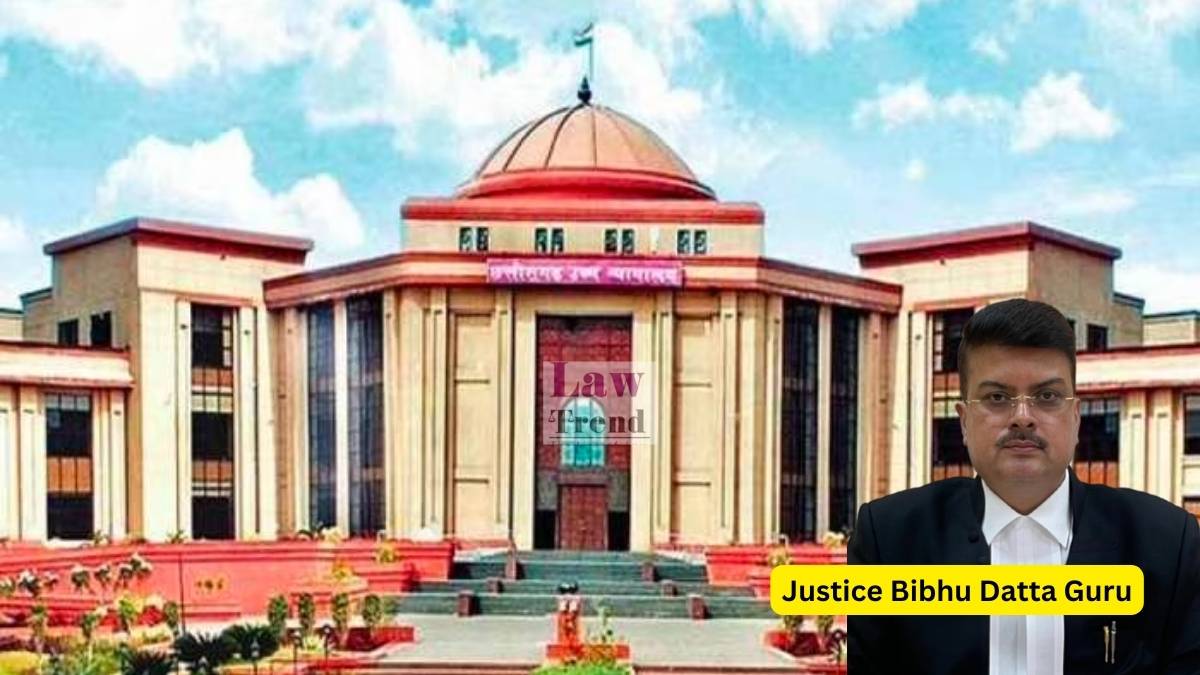
In a significant ruling on public employment and character verification, the High Court of Chhattisgarh has set aside the termination of an Assistant Professor who had failed to disclose two decades-old criminal cases in his verification form, ruling that authorities cannot mechanically terminate an employee without an objective assessment of suitability. A Single Judge Bench comprising Justice Bibhu Datta Guru held that employers must cumulatively consider the employee’s minor age at the time of the alleged offence, subsequent acquittals, decades of clean conduct, higher educational attainments, and rendered service before arriving at the extreme consequence of dismissal.
Background of the Case
The petitioner, Hira Prasad Yadav (aged about 48 years), was selected through a regular recruitment process initiated under Advertisement No. 11/2014 and appointed to the post of Assistant Professor (Commerce). He received his appointment order on October 5, 2018, joined his duties on October 10, 2018, and was posted at Government Rajmohini Devi Girls P.G. College, Ambikapur.
Two criminal cases had been registered against Yadav in 1994, when he was about 17 years old and studying in Class XI. The first case arose out of Crime No. 969/1994 under Sections 399 and 402 of the Indian Penal Code (IPC), in which he faced Session Trial No. 62/1995 and was acquitted on December 11, 1997. The second case arose out of Crime No. 443/1994 under Sections 324, 147, and 323 read with Section 34 of the IPC, which ended in his acquittal on November 13, 1995.
Following the criminal proceedings, Yadav had no subsequent criminal cases against him. Over the intervening years, he pursued higher education, earning M.Com., M.Phil., and Ph.D. degrees in Commerce. However, while submitting his character verification form, he did not mention these cases in Column No. 12.
Subsequently, on January 15, 2021, Yadav submitted an affidavit disclosing the criminal cases and his acquittals. On September 7, 2021, the Department issued a show-cause notice regarding the omission, to which he replied on September 15, 2021, stating that the non-disclosure was inadvertent. Nevertheless, by an order dated February 17, 2025, the Secretary, Department of Higher Education, Government of Chhattisgarh, brought his services to an end on grounds of non-disclosure of criminal antecedents. Aggrieved after having rendered more than six years of service, Yadav approached the High Court through a writ petition under Articles 226/227 of the Constitution of India.
Submissions of the Parties
Appearing for the petitioner, Senior Advocate Manoj Paranjpe contended that the termination was arbitrary, unsustainable, and suffered from non-application of mind. He argued that the criminal cases were from 1994, when the petitioner was a minor school student, and had resulted in acquittals more than two decades before his entry into government service. The omission in Column No. 12 was inadvertent and neither deliberate nor intended to conceal records, as corroborated by his subsequent explanatory affidavit dated January 15, 2021, and reply to the show-cause notice.
Counsel stressed that the petitioner had earned advanced qualifications (M.Com., M.Phil., Ph.D.), had served unblemished for over six years, and had no subsequent criminal cases. Reliance was placed on the Supreme Court ruling in Ravindra Kumar v. State of U.P. (2024) and the High Court Division Bench ruling in Prahlad Prasad Rathour v. State of Chhattisgarh (2025) to contend that non-disclosure of old criminal cases cannot automatically disqualify an employee without an objective assessment of facts and circumstances.
Opposing the petition, State Panel Lawyer Akanksha Verma submitted that the petitioner failed to disclose the criminal cases not only in the verification form but also in an affidavit submitted in 2018. The State contended that the subsequent affidavit of 2021 could not wipe out, neutralize, or retrospectively make the earlier declarations truthful. The State asserted that police verification brought the antecedents to light, involving offences requiring scrutiny under character verification instructions.
The State further argued that acquittal per se does not absolve a candidate from the duty to disclose information when specifically sought. While conceding that the controversy is covered by the principles in Ravindra Kumar, State counsel maintained that the authorities acted within their jurisdiction to assess suitability and prayed for dismissal of the petition. Counsel for the Chhattisgarh Public Service Commission made no independent submissions on the merits.
The Court’s Analysis and Observations
Justice Guru observed that while the petitioner’s omission in Column No. 12 and the 2018 affidavit was not in dispute, the core issue was whether that omission alone justified the extreme penalty of termination without examining its effect on suitability.
The Bench highlighted that the employer undoubtedly possesses the power to verify character and antecedents, but reiterated that this power cannot be exercised arbitrarily. Referring to the Supreme Court’s landmark ruling in Ravindra Kumar v. State of U.P., which extensively cited Avtar Singh v. Union of India, Commissioner of Police v. Sandeep Kumar, Ram Kumar v. State of U.P., Pawan Kumar v. Union of India, Mohammed Imran v. State of Maharashtra, and Satish Chandra Yadav v. Union of India, the Court underscored that every non-disclosure cannot be broad-brushed into an automatic disqualification.
Examining the impugned termination order, the Court found that the competent authority had acted mechanically:
“On examination of the impugned order, however, what is conspicuously absent is a cumulative consideration of the circumstances referred to above. The order records the non-disclosure and proceeds to conclude that the petitioner was not fit for Government service, but it does not disclose a meaningful consideration of the petitioner’s age at the time when the cases were registered, the fact that the proceedings had culminated in acquittal long before his appointment, the considerable passage of time, his educational qualifications, his appointment in the year 2018, his subsequent service and the explanation furnished by him.”
The Court held that the nature and vintage of the cases, the petitioner’s minor age of 17 years at the time, his subsequent academic achievements, six years of unblemished service, and prompt acquittal in the 1990s were vital considerations:
“Where the criminal proceedings had long since concluded, particularly where they had culminated in acquittal much prior to the petitioner’s entry into service, the mere non-disclosure of such antecedents cannot, by itself, be treated as suppression of material facts warranting termination of service. The effect of such non-disclosure must necessarily be examined in the context of the nature of the cases, the age of the petitioner at the relevant time, the outcome of the proceedings, the passage of time and the bearing, if any, of such antecedents upon his suitability for continuance in service.”
Addressing the State’s contention regarding moral turpitude and the 2018 affidavit, the Court clarified that although a subsequent disclosure does not completely cure or erase an earlier omission, authorities must still evaluate whether the omission rendered the employee genuinely unfit for service:
“The distinction between the existence of the power and the manner of its exercise assumes significance in the present case. The former cannot be converted into an automatic consequence of the latter. Even where suppression is established, the employer is required to act reasonably and objectively, upon due consideration of the relevant facts and circumstances governing the individual case.”
The Court reaffirmed the foundational legal principle:
“The power to take action on the ground of supression of criminal antecedents must be exercised objectively and reasonably, upon due consideration of all relevant facts and circumstances of the case and such power cannot be exercised arbitrarily or mechanically.”
The Decision
Holding that the termination order dated February 17, 2025, failed the test of objective and cumulative assessment, the High Court quashed the order passed by the Secretary, Higher Education Department.
The Court directed the State respondents to reinstate the petitioner in service forthwith. The Court ruled that Yadav shall be entitled to continuity of service for the purpose of seniority; however, having not actually rendered service during the intervening period pursuant to the termination order, he shall not be entitled to arrears of salary. The writ petition was allowed with no order as to costs.
Case Details:
Case Title: Hira Prasad Yadav v. State of Chhattisgarh & Others
Case No.: WPS No. 1470 of 2025
Bench: Justice Bibhu Datta Guru
Date: 09.09.2026




