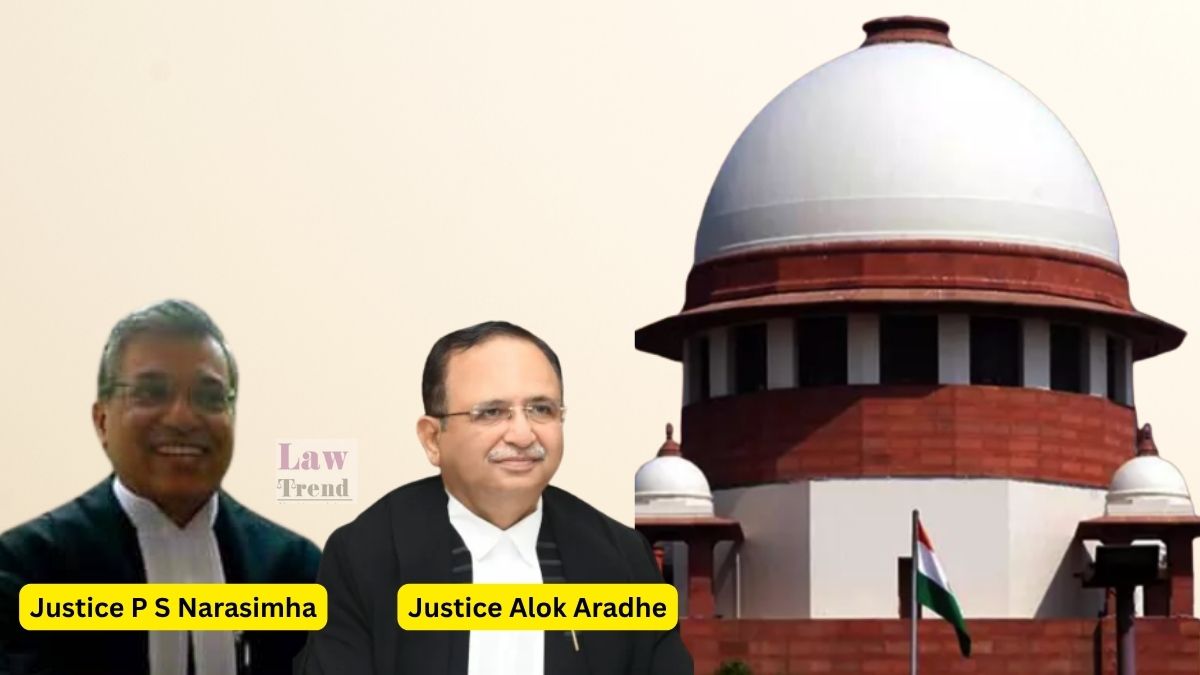
The Supreme Court of India, comprising a bench of Justice Pamidighantam Sri Narasimha and Justice Alok Aradhe, ruled that passenger elevators must be treated as common carriers, imposing a heightened duty of care on manufacturers and operators to ensure passenger safety. Dismissing an appeal filed by M/s Otis Elevator Co. (India) Ltd. (“OTIS”), the Court upheld the order of the National Consumer Disputes Redressal Commission (“NCDRC”) apportioning 70% liability on OTIS, 25% on the Military Engineering Service (“MES”), and 5% on the Research and Analysis Wing (“RAW”) for a fatal lift accident in 2003. The Court also allowed a connected appeal filed by the victim’s family, directing the NCDRC to proceed with execution proceedings to recover the awarded compensation of Rs 3,01,48,195 with interest.
Examining the role of modern passenger lifts in urban infrastructure, the Court observed:
Given the ever-increasing usage of passenger elevators in the modern-day urbanising societies, recognising them as a mode of vertical transportation is imperative. In this transportation, passengers have no control over the conveyance and they have to entirely rely on automation or the operator as the case may be. It is not merely reasonable, but a legal necessity to impose a heightened duty to care, akin to that of common carriers in view of the intrinsic passenger vulnerability. An elevator must be construed and deemed to be a common carrier and the operator, in the wider sense must undertake greater responsibility to transport passengers from floor to floor and exit safely.
Highlighting the responsibilities involved in contracts of carriage, the Court noted:
A contract of carriage is fundamentally between the carrier and the passenger. The carrier, in the context of user of an elevator at public places will take within its sweep the manufacturer, the operator and owner of the premises provisioning its services for the users. Therefore, from the perspective of a public law identifying and provisioning effective and efficacious restitutionary remedies, it is appropriate to hold the manufacturer, the operator and owner of the premises as the duty bearers and shall jointly and severally be liable to safeguard the user.
Background of the Case
In December 2001, OTIS installed a passenger lift in the RAW office complex at Lodhi Road, New Delhi, reserved for officers of the rank of Joint Secretary and above. On May 24, 2002, MES entered into a comprehensive Maintenance and Repair Contract with OTIS for the upkeep of the lifts.
On March 20, 2003, around 10:40 a.m., following a meeting on the 11th floor, thirteen occupants boarded the lift. During its descent, the lift abruptly stopped between the 6th and 7th floors. Staff from the control room manually opened the lift door on the 7th floor, switched off the Miniature Circuit Breaker (“MCB”) in the 11th-floor Machine Room, and began rescuing the trapped officers. The first officer was rescued safely. However, while the second officer was being extricated—with his body half inside and half outside the lift cabin—the lift suddenly moved downwards for 5 to 7 seconds. His neck was crushed between the cabin roof panel and the floor, causing his death. The remaining eleven occupants were later rescued.
An FIR was registered under Section 304-A of the Indian Penal Code at Lodhi Colony Police Station. A technical investigation report submitted by Prof. C.M. Bhatia of IIT Delhi on April 27, 2003, indicated that the downward movement occurred because someone entered the Machine Room and manually released the brakes using the Brake Release Key while the power was off.
On March 18, 2005, the deceased officer’s widow, Ms. Rashmi Handa, and her two children filed a complaint before the NCDRC. By an order dated January 21, 2014, the NCDRC held OTIS, MES, and RAW jointly and severally deficient in service and awarded Rs 3,01,48,195 as compensation with interest, apportioning financial liability at 70% for OTIS, 25% for MES, and 5% for RAW. Appeals filed earlier by RAW and MES were dismissed by the Supreme Court, leaving OTIS as the primary appellant.
Arguments of the Parties
Senior Counsel Gopal Sankaranarayanan, appearing for OTIS, submitted that the sole issue was the determination of liability. He argued that the technical report of Prof. C.M. Bhatia explicitly attributed the downward movement of the lift to human error—specifically, the manual release of mechanical brakes via the Brake Release Key in the Machine Room, which was in the exclusive control of MES. He further argued that OTIS had identified voltage fluctuations as early as July 4, 2002, and recommended a 50 KVA Voltage Stabiliser to MES, which MES failed to install. Additionally, he noted that the accident occurred around 10:45 a.m., outside the contractually designated shift hours for OTIS mechanics, and that the police chargesheet named MES personnel.
Counsel Saurabh Suman Sinha, representing the deceased’s family, contended that the Maintenance Contract imposed a comprehensive, non-delegable duty on OTIS under Clause 3.1 to maintain the lift in a sound condition and avoid risks of accidents. He pointed out that OTIS failed to produce any attendance registers or logbooks showing its mechanic was present on or near the date of the incident. He emphasized that the lift had recorded at least nine separate breakdowns in July and August 2002 alone, putting OTIS on continuous notice of defects. He argued that OTIS took no proactive measures to ensure the recommended stabiliser was installed or to halt the lift’s operation if it was unsafe.
Additional Solicitor General Aishwarya Bhati appeared for MES.
Court’s Analysis and Cited Precedents
In addressing the legal status of elevators and carrier obligations, the Supreme Court referred to international and historical jurisprudence, including the 1889 decision of the Supreme Court of California in Treadwell v. Whittier, which underscored that passengers in elevators place complete trust in mechanical systems, requiring the highest degree of care. The Court also cited classic legal authorities on common carriers, including Christie v. Griggs (1809), Galena and Chicago Union Ry. Co. v. Yarwood (1854), and Springer v. Ford (1901), alongside the principles of composite negligence established in Khenyei v. New India Assurance Co. Ltd. & Ors. (2015) regarding the recovery of damages from joint tortfeasors.
Examining the distinction between the cause of an accident and the legal cause of action, the Court rejected OTIS’s defense that manual brake intervention absolved it of liability:
For the purpose of determining deficiency of service and the consequential relief of compensation, it is necessary to take note of a number of incidents giving rise to the cause of action which is very different from cause of accident. That crucial distinction is lost in the submission advanced by OTIS.
The Court observed that the need for emergency manual intervention arose only because the lift stopped mid-operation due to persistent, unrectified defects. As both manufacturer and maintenance contractor, OTIS possessed technical knowledge superior to RAW and MES. Despite being aware of voltage issues since July 2002, OTIS failed to follow up, did not refuse to certify the lift, and failed to demonstrate that it had provided emergency rescue training to RAW or MES staff.
Regarding OTIS’s standard of duty, the Court held:
A party that undertakes the comprehensive maintenance of a machine, which is in the nature of a vehicle, owes a heightened duty of care towards its users. OTIS was not a stranger to the defect that culminated in the accident. It was cognizant of the problem, and it had itself proposed the remedy. Having done so, its failure to ensure that the remedy was implemented, or, alternatively, to render the lift safe by other means pending its installation constitutes deficiency of service.
The Court affirmed that RAW’s liability (5%) was limited to administrative oversight and MES’s liability (25%) stemmed from leaving the Machine Room accessible and failing to monitor attendance, whereas OTIS held the primary responsibility (70%) for the machine’s mechanical safety.
Decision
The Supreme Court dismissed OTIS’s Civil Appeal No. 4081 of 2014, upholding the NCDRC order dated January 21, 2014, in its entirety.
Concurrently, the Court allowed Civil Appeal No. 1602 of 2020 filed by the deceased officer’s widow against the NCDRC’s execution order dated May 2, 2019, which had stayed execution pending OTIS’s appeal. The Supreme Court directed the NCDRC to immediately proceed with the execution petition in accordance with law. Pending applications were disposed of with no order as to costs.
Case Details
Case Title: M/s Otis Elevator Co. (India) Ltd. v. Rashmi Handa & Ors.
Case No.: Civil Appeal No. 4081 of 2014 (with Civil Appeal No. 1602 of 2020)
Bench: Justice Pamidighantam Sri Narasimha and Justice Alok Aradhe
Date: July 29, 2026