

Section 60(1)(ccc) CPC Exemption Is Personal To Judgment-Debtor, Cannot Be Claimed By Legal Representatives: Supreme Court
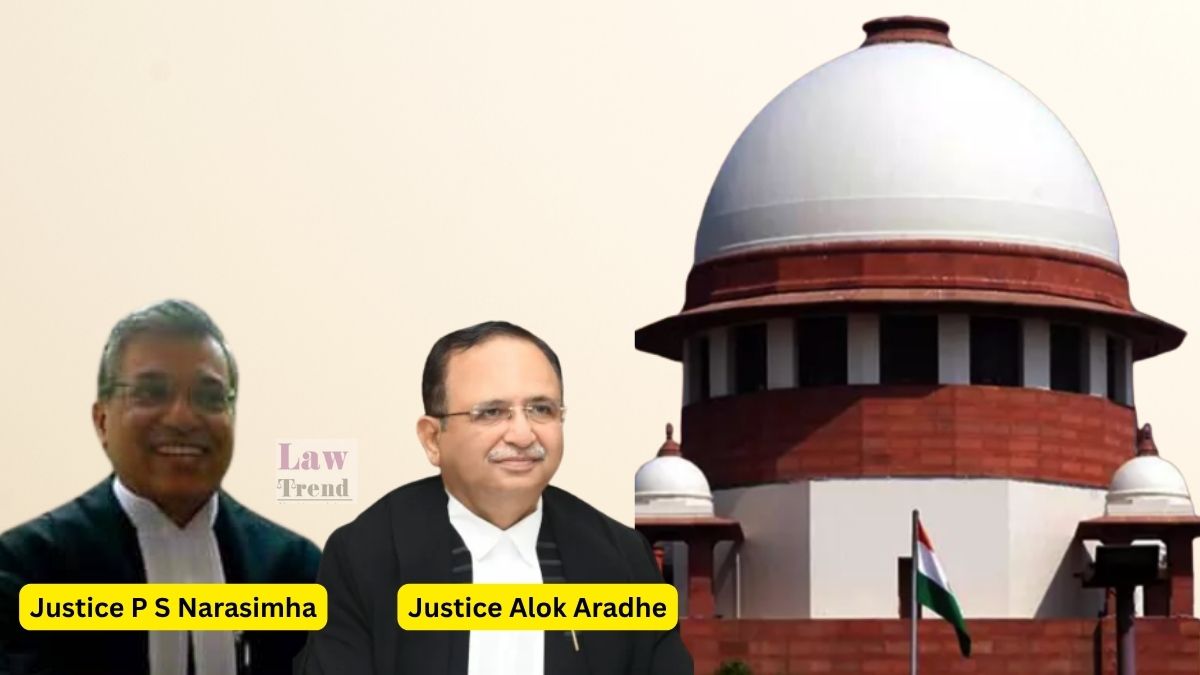

A Supreme Court bench comprising Justice P. S. Narasimha and Justice Alok Aradhe has held that the statutory protection exempting a main residential property from attachment and sale under Section 60(1)(ccc) of the Code of Civil Procedure, 1908 (CPC) is personal to the judgment-debtor and cannot be extended to their legal representatives. Setting aside a judgment of the High Court of Madhya Pradesh at Jabalpur, the apex court restored the order of the Debts Recovery Appellate Tribunal (DRAT), Allahabad, upholding the auction sale of a Delhi residential property under the Recovery of Debts Due to Banks and Financial Institutions Act, 1993 (now Recovery of Debts and Bankruptcy Act, 1993). The Court allowed the appeals filed by auction-purchaser Sheela Gehlot and Punjab & Sind Bank, while dismissing the appeal filed by the son of the deceased judgment-debtor.

Background of the Case

The dispute originated from credit facilities extended by Punjab & Sind Bank to M/s. Sterling Malt & Foods Pvt. Ltd., a company incorporated by Managing Directors Mr. Hardayal Singh (the original judgment-debtor) and Mr. N.S.S. Rao. The company manufactured malt at Banmore, District Morena, Madhya Pradesh, and created charges over its factory land, building, plant, and machinery, alongside personal guarantees furnished by both directors. The residential house bearing No. S-246, Panchsheel Park, New Delhi (the Delhi Property), owned by Hardayal Singh, was not mortgaged to the Bank.

Following defaults in repayment after operations ceased in 1983, the Bank initiated Civil Suit No. 1-B of 1987 before the District Court, Morena. Subsequently, L.K. Trust and its trustees acquired majority shareholding in the company to revive it. On October 15, 1991, the Morena court passed a compromise decree requiring the Trust to pay Rs. 1.80 crores in half-yearly instalments. Clause 2(e) of the compromise stipulated that title deeds of the Delhi Property furnished as collateral security would be released without affecting Hardayal Singh’s personal liability.

Hardayal Singh passed away on November 17, 1994. After paying approximately Rs. 82 lakh, the Trust defaulted. In 1995, the Bank instituted execution proceedings in the Morena court, impleading Hardayal Singh’s widow, Smt. Mohini Hardayal Singh (Respondent No. 1), and her children as judgment-debtors. Attempts between 1995 and 1997 to serve notices failed.

Following the establishment of the Debts Recovery Tribunal (DRT) at Jabalpur, the execution case was transferred to the DRT under Section 31 of the 1993 Act. On September 20, 2004, the Recovery Officer, DRT, ordered the auction of the Delhi Property. Mohini Hardayal Singh filed recall applications and appeals, alleging lack of notice and claiming exemption for the Delhi Property under Section 60(1)(ccc) of the CPC. The property was auctioned on November 27, 2006, where appellant Sheela Gehlot emerged as the successful bidder, and a sale certificate was issued on March 1, 2007.

READ ALSO  Kerala HC Allows A4 Size Papers for Court Proceedings

The DRAT dismissed Mohini Hardayal Singh’s appeal on April 19, 2007. However, the DRT later set aside the auction orders on May 29, 2007. On appeal, the DRAT reversed the DRT’s order on February 1, 2008. Mohini Hardayal Singh then approached the High Court of Madhya Pradesh in Writ Petition No. 2199 of 2008. On May 15, 2009, the High Court set aside the DRAT’s order and remitted the matter to the DRT to inquire into non-service of notice and the exemption claim under Section 60(1)(ccc) of the CPC. Aggrieved, the auction-purchaser, the Bank, and the judgment-debtor’s son filed separate appeals before the Supreme Court.

Arguments of the Parties

Dr. A.M. Singhvi, learned senior counsel appearing for auction-purchaser Sheela Gehlot, argued that the benefit under Section 60(1)(ccc) of the CPC is restricted to the judgment-debtor personally and does not extend to legal heirs. He contended that Mohini Hardayal Singh had full knowledge of the execution proceedings, filed detailed objections before the Recovery Officer in 2004, and therefore suffered no prejudice due to any lack of formal notice.

Mr. D.N. Goburdhun, learned senior counsel for Punjab & Sind Bank, submitted that an auction sale under the 1993 Act could not be set aside without filing an application under Rule 60 or 61 of the Second Schedule to the Income Tax Act, 1961, and demonstrating material irregularity resulting in substantial injury.

Mr. Rajiv Shakdher, learned senior counsel for Jagminder Singh (son of the judgment-debtor), argued that no execution notice was served on the legal representatives, rendering the auction invalid. He asserted that the Delhi Property served as their main residential house and remained protected under Section 60(1)(ccc) of the CPC.

READ ALSO  No Need for Father's Consent to Renew Child's Passport if Mother Provides Declaration, Unless Court Prohibits: MP High Court

Mr. Shekhar Naphde, learned senior counsel for Mohini Hardayal Singh, contended that compliance with Order XXI Rule 22 of the CPC and Rule 2 of the Second Schedule to the 1961 Act was mandatory, and non-service of notice rendered the entire execution and auction sale void.

Court’s Analysis

The Supreme Court examined three main legal questions:

1. Impact of Order XXI Rule 22 CPC on the Auction Sale

The Court observed that execution proceedings were transferred from the Morena court to the DRT pursuant to Section 31 of the 1993 Act. The Court emphasized:

“The transfer of execution proceeding from Morena court to the DRT, effected under Section 31 of the 1993 Act, did not merely change the forum of execution, it clothed the Recovery Officer, with the power to recover the amount in accordance with the procedure prescribed under Section 29 of the 1993 Act read with Second Schedule to the 1961 Act, in supersession of procedure under the Code before the Morena Court.”

Referring to the local amendment to Order XXI Rule 22(2) of the CPC applicable to Delhi, which provides that “Failure to record such reasons shall be considered an irregularity not amounting to a defect in jurisdiction,” the bench concluded that Order XXI Rule 22 of the CPC had no impact on the validity of the auction sale.

2. Effect of Non-Service of Notice Under Rule 2 of the Second Schedule to the 1961 Act

While noting that no notice under Rule 2 was served on the legal representatives, the bench highlighted that they were already parties to the execution proceedings and were fully aware of the auction. The Court observed:

“Therefore, the question of substantial injury being caused to respondent no. 1 and her children on account of non-service of notice under Rule 2 of the Second Schedule to the 1961 Act, does not arise.”

“Therefore, in the facts and circumstance of the case, absence of notice under Rule 2 of the Second Schedule to the 1961 Act, does not render either the execution or the sale void.”

3. Scope of Exemption Under Section 60(1)(ccc) of the CPC

Analyzing Section 60(1)(ccc) of the CPC as extended to Delhi via the Punjab Relief of Indebtedness Act, 1934, the Court held that the protection is strictly personal. The bench observed:

READ ALSO  Justice Ajay Rastogi Shutsdown A Virtual Hearing Link After Opining That Lawyers Are Misusing The Facility

“…the protection is by its own text personal to the judgment debtor as it is confined to a house belonging to and occupied by the judgment debtor and this protection does not extend to legal representatives of judgment debtor.”

“Thus, the plea of exemption under Section 60(1)(ccc) of the Code is personal to the judgment-debtor and is not available to be raised by his legal representatives.”

The Court affirmed the long-standing judicial view of the Delhi High Court in Yogesh Sharma v. Devi Dayal & Ors. (AIR 1977 Delhi 270) and the Punjab & Haryana High Court in K.L. Bawa v. Basant Textiles (AIR 1982 P&H 275) and Pargat Singh & Anr. v. Gurmail Kaur & Ors. (2014 SCC OnLine P&H 23436).

Additionally, relying on Greater Mohali Area Development Authority & Ors. v. Manju Jain & Ors. ((2010) 9 SCC 157), the Court noted that a mixed question of law and fact requiring inquiry cannot be agitating for the first time in a writ petition:

“Thus, a mixed question of law and fact cannot be raised for the first time in a writ petition.”

The Decision

The Supreme Court quashed and set aside the High Court judgment dated May 15, 2009. Civil Appeal No. 182 of 2016 (filed by the auction-purchaser) and Civil Appeal No. 190 of 2016 (filed by Punjab & Sind Bank) were allowed, while Civil Appeal No. 191 of 2016 (filed by the judgment-debtor’s son) was dismissed. The parties were left to bear their own costs.

Case Title: Sheela Gehlot v. Mohini Hardayal Singh & Ors.
Case No.: Civil Appeal No. 182 of 2016 (with C.A. No. 190 of 2016 & C.A. No. 191 of 2016)
Bench: Justice P. S. Narasimha, Justice Alok Aradhe
Date: August 14, 2026

Law Trend
Law Trendhttps://lawtrend.in/
Legal News Website Providing Latest Judgments of Supreme Court and High Court

Related Articles

Latest Articles

