

Parental Consortium Is Payable to Children on Premature Death of Parent in Motor Accident: Supreme Court
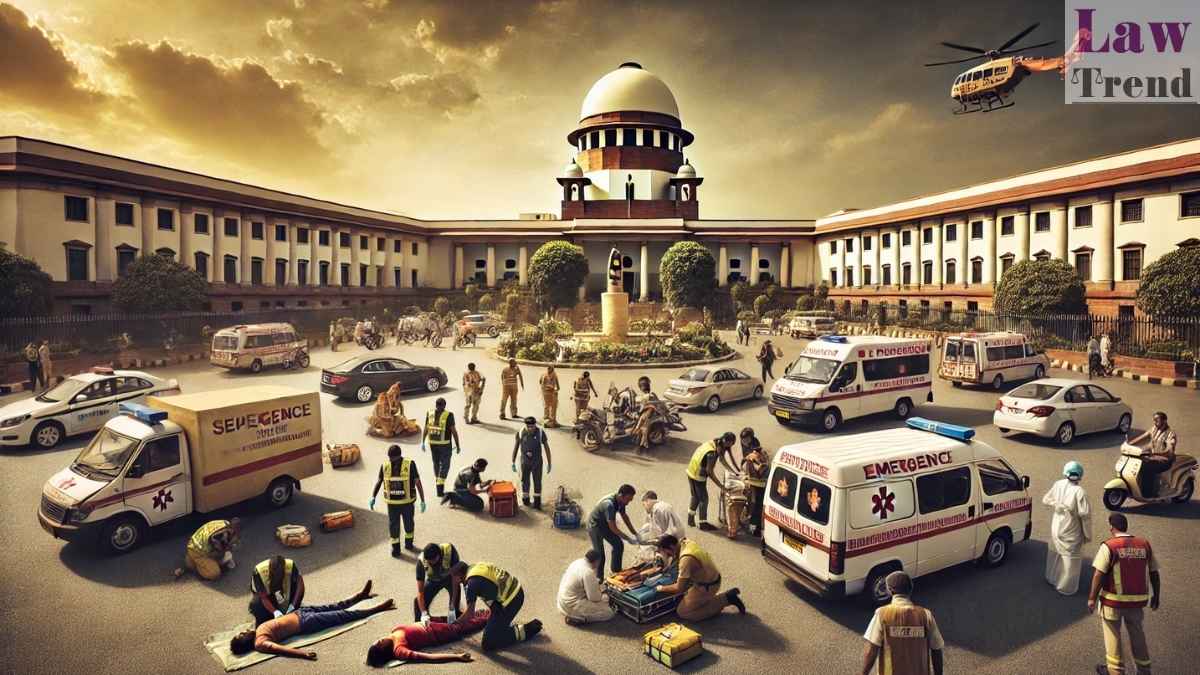

In a significant ruling on motor accident compensation, a Supreme Court bench comprising Justice N. Kotiswar Singh and Justice N.V. Anjaria held that children are legitimately entitled to parental consortium compensation upon the premature death of a parent, enhanced by 10 percent every three years. Modifying an order of the High Court for the State of Telangana, the apex court ruled that both surviving spouse and dependants—including major children—must be awarded individual consortium damages. Consequently, the Court enhanced the total compensation payable to the family of a deceased security personnel from Rs 11,00,672 to Rs 12,47,272, directing an additional payment of Rs 1,46,600 with 7.5 percent interest per annum.

Background of the Case

The facts surrounding the case originate from a road accident on June 23, 2012, when the deceased, Shaik Janimiya, was walking at Malkajgiri. A car bearing registration number AP-29-AK-3717, driven in a rash and negligent manner at high speed, struck him. He suffered severe injuries and succumbed while undergoing treatment at Raghavendra Hospital. A criminal case was registered against the car driver under Crime No. 284 of 2012.

The deceased was 48 years old at the time of the accident and worked as a private security personnel (Chief Security Incharge). His wife and three children—aged between 18 and 21 years—filed a claim petition before the Motor Accidents Claims Tribunal Cum II Additional Chief Judge, City Civil Court at Hyderabad, seeking Rs 9,00,000 in compensation on the premise that the deceased earned Rs 9,00,000 per month including allowances.

The Tribunal assessed the monthly income of the deceased at Rs 7,000 based on employer testimony and awarded Rs 8,44,000 in total, granting only Rs 5,000 towards spousal consortium and no parental consortium for the children. On appeal, the High Court enhanced the compensation to Rs 11,00,672 by adding 25 percent future prospects and awarding a lump-sum conventional amount of Rs 77,000. Aggrieved by the monthly income assessment and the omission of proper parental consortium, the family filed a Special Leave Petition before the Supreme Court.

Arguments of the Parties

Counsel appearing for the appellants argued that the High Court erred in affirming the monthly income at Rs 7,000, maintaining that salary certificates supported an income of Rs 9,00,000 per month. The appellants further contended that the children were wrongfully denied individual compensation under the head of parental consortium, which ought to have been calculated in accordance with established legal principles.

READ ALSO  Allahabad HC Mandates TET Qualification for Classes VI–VIII Teachers; Orders State to Amend Rule 8 and Clarify TGT Recruitment Limits

Counsel for the respondents supported the High Court’s determination, asserting that the lower courts correctly evaluated the evidence and that the awarded compensation was just and reasonable.

Court’s Analysis and Precedents

Addressing the income assessment, the Supreme Court noted that the Tribunal relied on the testimony of the employer’s Director (PW3), who confirmed the salary to be Rs 7,000 per month (Rs 84,000 annually). Consequently, the Court found no error in affirming that monthly income figure.

Turning to the entitlement of legal representatives and consortium heads, the Court examined several landmark precedents:

  • In Manjuri Bera v. Oriental Insurance Company Limited and Another (2007), the Court held that devolution of the estate is the governing factor and that liability to pay compensation does not cease due to an absence of dependency.
  • In National Insurance Company Limited v. Birender and Others (2020), the Court reiterated that major, earning sons are covered by the expression “legal representative” under Section 166(1)(c) of the Motor Vehicles Act, 1988, observing: “The major married son who is also earning and not fully dependent on the deceased, would be still covered by the expression “legal representative” of the deceased. This Court in Manjuri Bera had expounded that liability to pay compensation under the Act does not cease because of absence of dependency of the legal representative concerned…”
  • In Gujarat State Road Transport Corporation, Ahmedabad v. Ramanbhai Prabhatbhai and Another (1987), the Court recognized that any legal representative suffering on account of a motor vehicle death has a remedy for compensation.
READ ALSO  Supreme Court Reinstates Female Civil Judge Discharged During Probation for Alleged Irregularities in Educational and Employment Records

The bench highlighted that the Second Schedule of the Act had become unworkable, as noted in U.P. State Road Transport Corporation and Others v. Trilok Chandra and Others (1996) and Puttamma and Others v. K.L. Narayana Reddy and Another (2013).

Defining the scope of consortium, the Court referred to Rajesh v. Rajbir Singh (2013):

“In legal parlance, “consortium” is the right of the spouse to the company, care, help, comfort, guidance, society, solace, affection and sexual relations with his or her mate. That non-pecuniary head of damages has not been properly understood by our courts. The loss of companionship, love, care and protection, etc., the spouse is entitled to get, has to be compensated appropriately.”

The Court further referenced Magma General Insurance Company Limited v. Nanu Ram and Others (2018) regarding the three distinct categories of consortium:

“In legal parlance, “consortium” is a compendious term which encompasses “spousal consortium”, “parental consortium”, and “filial consortium”. The right to consortium would include the company, care, help, comfort, guidance, solace and affection of the deceased, which is a loss to his family. With respect to a spouse, it would include sexual relations with the deceased spouse.”

Applying the principles from National Insurance Company Limited v. Pranay Sethi and Others (2017), the Court highlighted the mandate for periodic enhancement:

“Therefore, we think it seemly to fix reasonable sums. It seems to us that reasonable figures on conventional heads, namely, loss of estate, loss of consortium and funeral expenses should be Rs.15,000, Rs.40,000 and Rs.15,000 respectively. The principle of revisiting the said heads is an acceptable principle. But the revisit should not be fact-centric or quantum-centric. We think that it would be condign that the amount that we have quantified should be enhanced on percentage basis in every three years and the enhancement should be at the rate of 10% in a span of three years. We are disposed to hold so because that will bring in consistency in respect of those heads.”

Supreme Court’s Decision

The Supreme Court concluded that both the Tribunal and the High Court missed their legal duty by failing to award due individual consortium compensation. The Court held that each of the four claimants—the wife (spousal consortium) and the three children (parental consortium)—is entitled to Rs 40,000, increased by 10 percent (Rs 4,400) to Rs 48,400 per person.

The revised compensation was recalculated as follows:

  • Loss of Dependency: Rs 10,23,672
  • Spousal Consortium (Wife): Rs 48,400
  • Parental Consortium (3 Children): Rs 1,45,200 (Rs 48,400 x 3)
  • Funeral Expenses: Rs 15,000
  • Loss of Estate: Rs 15,000
  • Total Compensation: Rs 12,47,272
READ ALSO  For Compassionate Appointment a Married and Unmarried Daughter are on Same Footing, Rules SC

The bench directed the insurance company to deposit the additional amount of Rs 1,46,600 along with 7.5 percent interest per annum from the date of filing of the claim petition till realization within six weeks. Upon deposit, the Tribunal will release the amount directly into the bank accounts of the claimants in equal proportions.

Case Title: Sameem Begum and Others v. K. Venkat Swamy and Another

Case No.: Civil Appeal No. of 2026 (Arising out of SLP (C) No. 18553 of 2023)

Bench: Justice N. Kotiswar Singh and Justice N.V. Anjaria

Date: August 14, 2026

Law Trend
Law Trendhttps://lawtrend.in/
Legal News Website Providing Latest Judgments of Supreme Court and High Court

Related Articles

Latest Articles

