

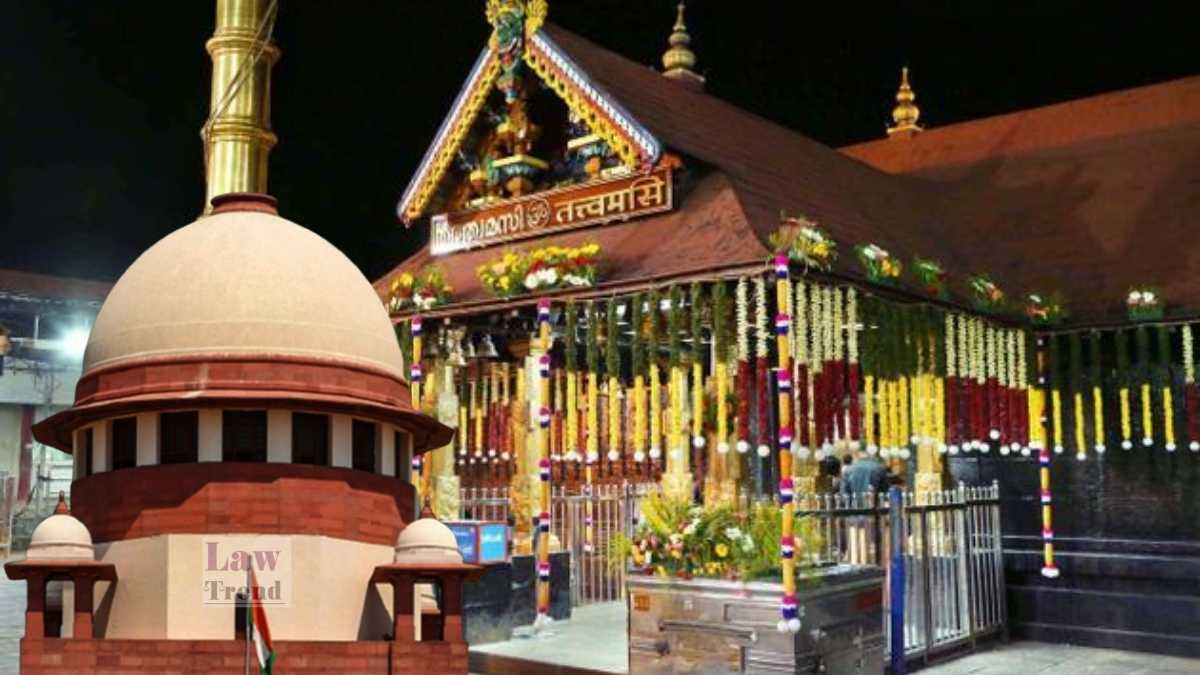
In a significant legal development regarding the intersection of faith and constitutional law, the Travancore Devaswom Board (TDB) informed a nine-judge Constitution Bench of the Supreme Court on Wednesday that religious beliefs and practices are subjective matters of a denomination that the judiciary cannot sit in judgment of. The Board, which manages the historic Sabarimala temple in Kerala, argued that the court is bound to accept the community’s subjective beliefs rather than applying external tests of “essentiality.”
Appearing for the TDB, Senior Advocate Abhishek Singhvi emphasized that religion constitutes a set of beliefs and practices followed by a group or denomination sharing a broadly similar identity. While acknowledging that Article 25 of the Constitution grants individuals the right to profess, practice, and propagate religion, Singhvi contended that these individual rights cannot override the collective rights of a religious denomination.
“Such individual rights cannot be allowed to extend to an area which intrudes upon the mass of individual rights of all other adherents of that religion or denomination,” Singhvi argued during the fourth day of the hearing.
The Board further challenged the judicial doctrine of “essential religious practices.” Singhvi stated that it is impermissible for courts to add, modify, or subtract from the constitutional text. He specifically noted that the “derogation of ‘essentiality’” as engrafted by various past judgments is entirely impermissible under the current constitutional framework.
The nine-judge bench, led by Chief Justice Surya Kant, is currently examining the ambit and scope of religious freedom across multiple faiths. The bench includes Justices B. V. Nagarathna, M. M. Sundresh, Ahsanuddin Amanullah, Aravind Kumar, Augustine George Masih, Prasanna B. Varale, R. Mahadevan, and Joymalya Bagchi.
The proceedings follow a 2018 verdict where a five-judge bench, in a 4:1 majority, lifted the ban on women aged 10 to 50 entering the Sabarimala temple, declaring the practice unconstitutional. However, in November 2019, a subsequent bench referred the matter to a larger bench to decide broader issues of discrimination at religious places and the conflict between different constitutional articles.
Earlier in the hearing, on April 9, the Supreme Court had expressed concerns that Hinduism would be “adversely impacted” and society divided if temples or “mutts” restricted entry based on sect or denomination. This observation came in response to submissions by Senior Advocate C. S. Vaidyanathan, representing Lord Ayyappa devotees, who argued that Article 26(b) (the right of a denomination to manage its affairs) should have primacy over Article 25(2)(b) (the State’s power to open Hindu institutions to all classes).
The TDB’s stance marks a pivotal moment in the long-standing legal battle over Sabarimala. By arguing that courts must accept the “subjective belief” of the community, the Board is seeking to limit the judiciary’s role in interpreting religious traditions. The TDB is a statutory autonomous body managing over 1,000 temples across South India, and its submissions carry significant weight regarding temple administration and traditional practices.
The ongoing hearing aims to resolve fundamental questions:
- The extent to which the court can interfere in religious practices.
- The definition of a “religious denomination.”
- Whether the “essential religious practices” test is constitutionally valid.
The hearing remains underway as the nine-judge bench continues to hear arguments from various stakeholders regarding the scope of freedom of conscience and the right to manage religious affairs.


