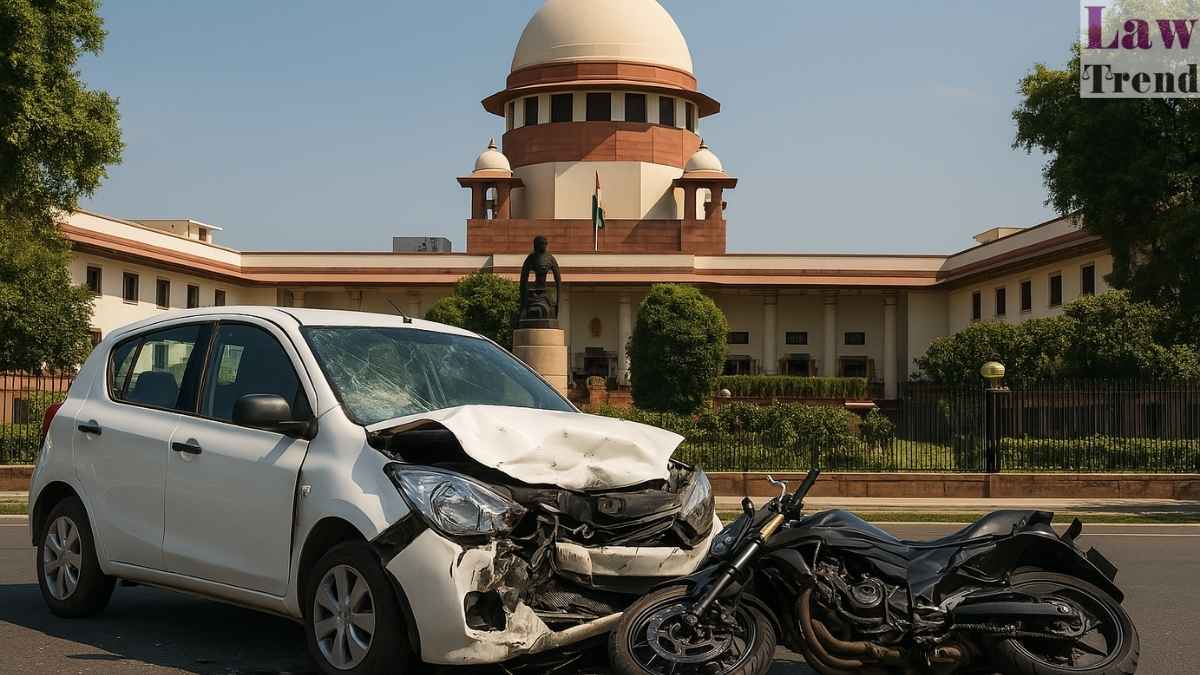
The Supreme Court of India, comprising a bench of Justice S.V.N. Bhatti and Justice N.V. Anjaria, has held that site maps depicting the post-impact positions of vehicles cannot serve as the sole basis to infer contributory negligence against a smaller vehicle in motor accident claims. Overturning a Karnataka High Court ruling that had attributed 50 per cent contributory negligence to the driver of a Hyundai Santro car, the apex court restored 100 per cent tortious liability on the Karnataka State Road Transport Corporation (KSRTC). The court further enhanced the compensation awarded to the victim’s surviving wife from ₹7.17 lakh to ₹50,81,876, along with 6 per cent interest per annum from the date of filing the claim petition.
Background of the Case
The case stems from a fatal road accident that occurred on October 14, 2005, at 1:20 AM on NH-48 near Siddeshwara Petrol Bunk, opposite Sapthagiri Hospital in Kunigal Town, Karnataka. A Hyundai Santro car (KA-04-MB-2073), driven by Nandan Shet, collided with a KSRTC heavy passenger bus (KA-01-F-7846), driven by Ramalingappa G. Poojari.
Nandan Shet (aged 30 years and 11 months), his mother Geetha Shet, and a family friend named Mahesh died in the accident. The claimant, Reena—who had married Nandan Shet just three months prior—survived the collision with grievous injuries.
Following the incident, FIR No. 275 of 2005 was registered at Kunigal Police Station, and a charge sheet was filed exclusively against the KSRTC bus driver. However, on October 3, 2008, a criminal court acquitted the bus driver in CC No. 1002 of 2005 by giving him the benefit of the doubt.
The claimant subsequently filed three separate claim petitions before the Motor Accidents Claims Tribunal (MACT):
- MVC No. 7828 of 2005: Seeking ₹1.5 crore for the death of her husband, Nandan Shet.
- MVC No. 7829 of 2005: Seeking compensation for the death of her mother-in-law, Geetha Shet.
- MVC No. 583 of 2006: Seeking compensation for personal injuries and medical expenses.
The MACT attributed 100 per cent negligence to the KSRTC bus driver. However, because the claimant was employed as an Associate Manager at Accenture, Bangalore, the Tribunal concluded she suffered no loss of dependency and awarded only ₹1,50,000 for loss of consortium and funeral expenses in MVC No. 7828 of 2005, ₹1,50,000 in MVC No. 7829 of 2005, and ₹1,67,000 in MVC No. 583 of 2006.
On appeal in MFA Nos. 5074, 5075, and 5076 of 2014, the High Court of Karnataka calculated the total compensation for the husband’s death at ₹14,35,267 (assessing his notional income at ₹20,000 per month). However, relying on the accident scene sketch, the High Court held the car driver equally responsible and reduced the award payable by KSRTC to ₹7,17,634 based on 50 per cent contributory negligence. The High Court also reduced the compensation in the other two appeals. Aggrieved by these orders, the claimant approached the Supreme Court.
Arguments of the Parties
The appellant, appearing in person, submitted that attributing 50 per cent contributory negligence to the deceased car driver was illegal and contrary to established legal principles regarding the evidentiary value of FIRs and charge sheets. She argued that the High Court erred in focusing solely on the final position of the car in the rough sketch while ignoring the curve at the scene and the drag marks caused by the heavy bus. The appellant also produced additional evidence under I.A. No. 1 of 2024—including bank records, degree certificates, and client invoices—to establish that her late husband was a qualified mechanical engineer and IT entrepreneur running his own firm, Geetha Technologies, and earning a substantial income.
Senior Counsel appearing for KSRTC argued that the findings of fact on contributory negligence recorded by the High Court were unassailable. Pointing to the rough sketch, counsel contended that the car driver was responsible for the collision. It was further argued that fixing a notional income of ₹20,000 per month was generous in the absence of original documentary proof before the Tribunal, and that the claimant, being an earning member and daughter-in-law, was not entitled to loss of dependency.
Counsel for the insurer of the Santro car supported the findings on contributory negligence and contended that since the car driver was negligent, the insurer was not liable. It was also argued that the vehicle was let out for “hire and reward,” breaching policy conditions.
The Court’s Analysis and Precedents
The Supreme Court rejected the insurer’s defense, observing that the argument was never put to trial or established. The court noted that the High Court’s earlier finding holding the insurer liable had remained unchallenged by the insurance company.
Addressing the issue of contributory negligence, the Supreme Court held that the High Court committed a fundamental error in ignoring the FIR and charge sheet, and in relying on the bus driver’s acquittal in the criminal case. The bench highlighted that criminal acquittals based on the benefit of the doubt do not erase tortious liability under the Motor Vehicles Act (MV Act), which operates under civil standards.
To reinforce these principles, the apex court referenced key binding precedents:
- “Police investigation records, including the FIR and final Charge-Sheet, constitute valid, admissible, and reliable prima facie evidence to establish rash and negligent driving in MACT proceedings.” (ICICI Lombard General Insurance Co. Ltd. v. Rajani Sahoo & Ors.)
- “Criminal proceedings and civil MACT Claim Petitions operate in entirely distinct legal realms, as the degree of ‘culpable rashness’ required under Section 304-A of the Indian Penal Code, 1860 (‘IPC’) is significantly higher than civil negligence under the law of torts.” (Mathew Alexander v. Mohd. Shafi & Anr.)
- “A site map or accident sketch cannot be read in isolation or used as the sole basis to record contributory negligence against a deceased driver in the absence of corroborating ocular evidence.” (Sunita & Ors. v. Rajasthan State Road Transport Corporation & Ors.)
- “The spot where a lighter vehicle is found lying on a site map post-accident cannot be assumed to be the spot where the collision occurred, nor that it was being driven on the wrong side, as a collision with a heavy, speeding vehicle naturally pushes or drags the smaller vehicle forward.” (Mangla Ram v. Oriental Insurance Co. Ltd. & Ors.)
- “Motor accident Claim Petitions under Section 166 of the MV Act must be adjudicated on the touchstone of ‘preponderance of probability’ rather than proof beyond reasonable doubt.” (Geeta Dubey & Ors. v. United India Insurance Co. Ltd. & Ors.)
The court noted that the High Court completely overlooked the statement of the bus conductor, who had explicitly admitted during investigation: “The driver of the KSRTC bus drove the bus in a rash and negligent manner and dashed against the car which was coming in the opposite direction. On account of the impact, the car was dragged to the extreme left side of the road by the bus to a distance of 50 to 60 feet, crossed the left side chamber, hit the P.W.D. compound wall and got stationed on the heap of the mud”.
On the application for additional evidence under Order XLI Rule 27(1)(b) of the Code of Civil Procedure, 1908, the court allowed the documents to be taken on record. The bench emphasized that the MV Act is welfare legislation meant to secure “just compensation,” and the claimant’s delay was understandable given the severe physical and mental shock of losing her family shortly after marriage, as well as systemic delays in retrieving dormant bank records following bank mergers.
Evaluating the deceased’s qualifications—a Bachelor of Engineering (Mechanical) degree, professional certifications in Oracle and Visual Basic, and commercial software invoices from his firm Geetha Technologies—the Supreme Court determined his realistic income at the time of death in October 2005 to be ₹70,000 per month, rather than the ₹20,000 assessed by the High Court.
Supreme Court Decision
The Supreme Court allowed Civil Appeal Nos. 10755 and 10758 of 2026, setting aside the High Court’s finding on contributory negligence and restoring the Tribunal’s finding of 100 per cent liability against the KSRTC bus driver.
The compensation for the death of Nandan Shet was recalculated as follows:
- Fixed Base Monthly Income: ₹70,000 (Gross Annual Income: ₹8,40,000)
- Less Statutory Tax Deductions: (-) ₹2,08,440
- Net Actual Annual Income: ₹6,31,560
- Add Future Prospects (+40%): (+) ₹2,52,624
- Net Effective Annual Income: ₹8,84,184
- Annual Savings to Estate (after 1/3rd personal deduction): ₹2,94,728 per year
- Substantive Loss to Estate (Multiplier 17 for age 30): ₹50,10,376
- Loss of Spousal Consortium: ₹52,000
- Funeral & Transportation Expenses: ₹19,500
- Total Compensation Awarded: ₹50,81,876
The apex court ordered KSRTC to pay the entire awarded sum of ₹50,81,876 with interest at 6 per cent per annum from the date of filing the claim petition until realization. The orders in Civil Appeal Nos. 10756 and 10757 of 2026 were modified to make all awarded amounts exclusively payable by KSRTC.
Case Title: Reena v. The Managing Director, Karnataka State Road Transport Corporation and Others
Case No.: Civil Appeal Nos. 10755-10758 of 2026
Bench: Justice S.V.N. Bhatti and Justice N.V. Anjaria
Date: August 19, 2026