

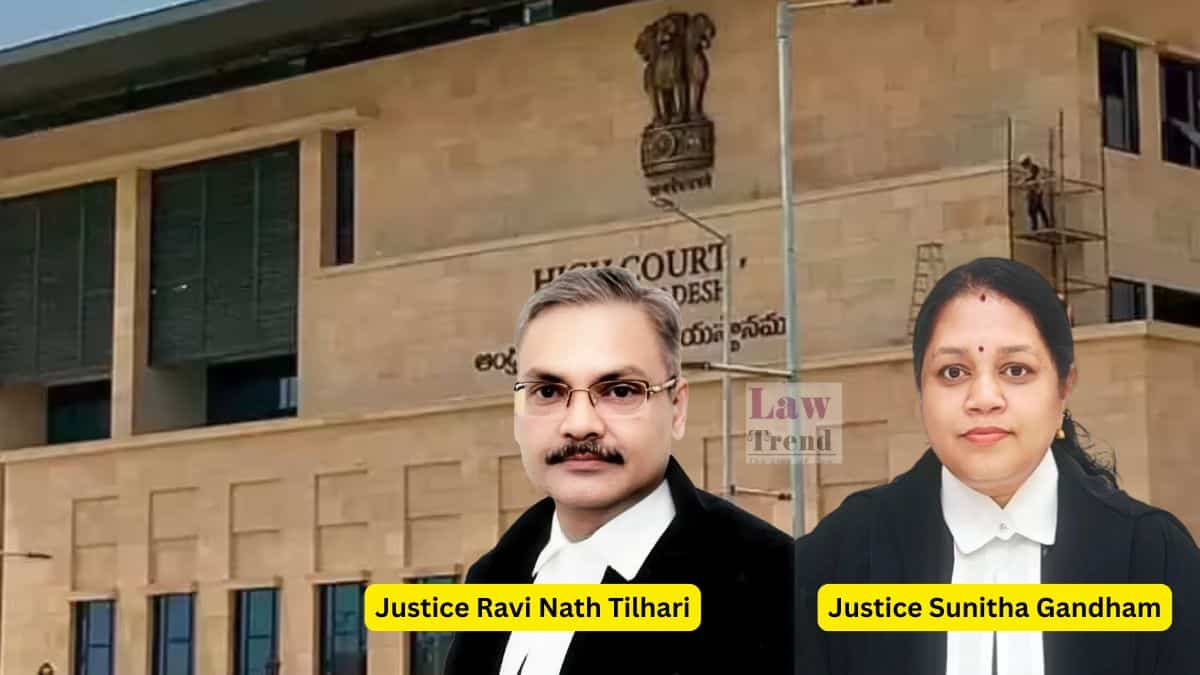
The High Court of Andhra Pradesh at Amaravati, comprising a Division Bench of Justice Ravi Nath Tilhari and Justice Sunitha Gandham, has held that administrative circulars prescribing lower rates of interest on delayed retirement dues do not restrict courts or tribunals from awarding higher compensation when an employee is compelled to litigate for their lawful retiral entitlements. Affirming an order of the Andhra Pradesh Administrative Tribunal (APAT), the Court ruled that the State cannot justify years of delay in disbursing retiral benefits by citing unproven financial allegations, thereby upholding the grant of 18% per annum interest to a retired officer whose dues were withheld for over seven years.
Background of the Case
The dispute arose after Sri Bollapalli Venkata Krishna Murthy (Respondent No. 1), who served as the Mandal Parishad Development Officer in Roddam, superannuated from service on August 31, 1995. During his tenure, the Audit Department had raised objections concerning an expenditure of Rs. 7,75,848/- incurred towards purchasing stationery, furniture, maps, charts, and sanctioning interest-bearing loans, alongside the diversion of funds from other heads of account.
On June 19, 1999, nearly four years after his retirement, the Commissioner of Panchayat Raj & Rural Employment submitted proposals to initiate disciplinary proceedings against him under Rule 9 of the Andhra Pradesh Revised Pension Rules, 1980. However, upon administrative examination, it was determined that disciplinary action could not be initiated due to the lapse of time. Although the Finance and Planning Department concurred with this position, it suggested pursuing criminal action or recovering the financial loss caused to the government.
Subsequently, the Chief Executive Officer of the Zilla Parishad, Ananthapur, reported on February 28, 2001, that financial irregularities had resulted in a loss of Rs. 7,75,848/-. However, the Audit Department had already dropped objections concerning Rs. 59,254/- and Rs. 3,16,200/-, leaving an unverified balance of Rs. 4,00,384/-. Faced with an indefinite withholding of his retiral dues, the employee approached the APAT by filing O.A. No. 4410 of 2001, praying for the immediate release of his pensionary benefits along with 18% interest per annum.
During the pendency of the original application, the Chief Executive Officer submitted another report on September 9, 2002, recommending a recovery of Rs. 7,007/- on account of excess payments made to printers. The retired officer promptly remitted this amount. Following the remittance, the Government issued G.O.Rt.No.251, PR&RD (E.VII.1) Department, on February 26, 2003, releasing his long-withheld pensionary benefits.
On March 21, 2006, the APAT disposed of the application by directing the State to release the full pension and other retirement benefits along with interest at the rate of 18% per annum for the delayed period from the date of retirement. The Government of Andhra Pradesh challenged this 18% interest component before the High Court.
Arguments of the Parties
Appearing for the petitioner State, Sri Challa Srinivas, Assistant Government Pleader for Services-III, argued that departmental proceedings could not be initiated solely because of the statutory lapse of time. He contended that because the employee had remitted the demanded sum of Rs. 7,007/-, he was deemed to have been found guilty of the financial irregularities.
The State further submitted that the interest rate awarded by the Tribunal was excessive and contrary to prevailing government policies. The counsel placed reliance on Government Circular Memo No. 37989/494/A2/Pen.1/98 dated April 21, 1999, which prescribed interest on delayed retirement gratuity at 7% per annum for delays beyond three months up to one year, and 10% per annum beyond one year. Reference was also made to a subsequent Circular Memo dated February 20, 2006, which lowered the rates to 4.5% and 5% per annum respectively. On these grounds, the State urged that the direction to pay 18% interest was unsustainable.
There was no representation on behalf of the respondents before the High Court.
Court’s Analysis and Observations
Delivering the judgment for the Bench, Justice Sunitha Gandham observed at the outset that the State had failed to file any counter-affidavit before the APAT or place its circular memos before the Tribunal at the appropriate stage. While noting that such failure cannot ordinarily be ignored, the Court nonetheless examined the legal questions to do complete justice.
The Court decisively rejected the State’s contention that remitting a small disputed sum amounted to an admission or establishment of guilt. Emphasizing the requirement of due process, the Bench observed:
“A finding of misconduct or guilt cannot be inferred merely from the fact of recovery of an amount. Such a finding has to be recorded in accordance with law, after following the procedure applicable to disciplinary proceedings. The remittance of Rs.7,007/- was admittedly made pursuant to the direction of the Government and, by itself, cannot constitute a finding of guilt.”
Addressing the obligation of the employer to settle dues upon retirement, the Bench reiterated that a retired employee is legally entitled to pensionary benefits under the relevant service rules, and the State bears a reciprocal duty to disburse them within a reasonable timeframe. Relying on the landmark judgment of the Supreme Court in State of Kerala and others v. M. Padmanabhan Nair (1985 SCC (L&S) 278), the Court noted that any unjustified delay in releasing lawfully due amounts obligates the State to pay compensation by way of interest.
The High Court also referred to the Full Bench ruling of the Punjab & Haryana High Court in A.J. Randhawa, Supg. Engineer (Retd.) v. State of Punjab (1997 SCC Online P&H 705), which established that a reasonable interest rate of up to 18% per annum may ordinarily be awarded depending on the circumstances, the extent of delay, and the conduct of the parties.
The Bench underscored that retiral benefits are earned constitutional entitlements rather than gratuitous payments, citing the Supreme Court’s pronouncement in D.D. Tewari (dead) through Legal representatives v. Uttar Haryana Bijli Vitran Nigam Limited and others ((2014) 8 SCC 894), wherein it was held:
“pension and gratuity are no longer any bounty to be distributed by the Government to its employees on the retirement but are valuable rights and property in their hands and any culpable delay in settlement and disbursement thereof must be visited with payment of interest.”
In response to the State’s reliance on departmental circulars capping interest rates, the Bench drew a sharp distinction between voluntary departmental settlements and cases where an employee is driven to litigation:
“With respect to the circular memo, we are of the view that if the State of its own had processed the retiral benefits and in such process there was delay, the interest at the rate as per the circular memo date 21.04.1999 could have been paid to the employee. But, here the employee had to approach the Tribunal for redressal of his grievance. The payment became due on superannuation on 31.08.1995 but was actually paid afterwards on 26.02.2003. The circular memo shall not bind the court or the Tribunal for interest at the rate mentioned therein. It could grant interest at the higher rate.”
To solidify its conclusion, the Bench drew direct support from the Supreme Court’s judgment in Vijay L. Mehrotra v. State of U.P and others ((2001) 9 SCC 687), quoting the operative observations:
“3. In case of an employee retiring after having rendered service, it is expected that all the payment of the retiral benefits should be paid on the date of retirement or soon thereafter if for some unforeseen circumstances the payments could not be made on the date of retirement.”
“4. In this case, there is absolutely no reason or justification for not making the payments for months together. We, therefore, direct the respondent to pay to the appellant within 12 weeks from today simple interest at the rate of 18 per cent with effect from the date of her retirement, i.e, 31-8-1997 till the date of payments.”
The Decision
Finding that there was no established misconduct and no justifiable cause for withholding the employee’s pensionary dues between August 31, 1995, and February 26, 2003, the High Court held that the APAT committed no illegality in granting 18% interest per annum.
The Court dismissed the writ petition as devoid of merit with no order as to costs, and directed the petitioner authorities to release the due amount to the pensioner without delay.
Case Title: Government of Andhra Pradesh and others v. Sri Bollapalli Venkata Krishna Murthy & others
Case No.: Writ Petition No. 18779 of 2006
Bench: Justice Ravi Nath Tilhari and Justice Sunitha Gandham
Date: 29.09.2026




