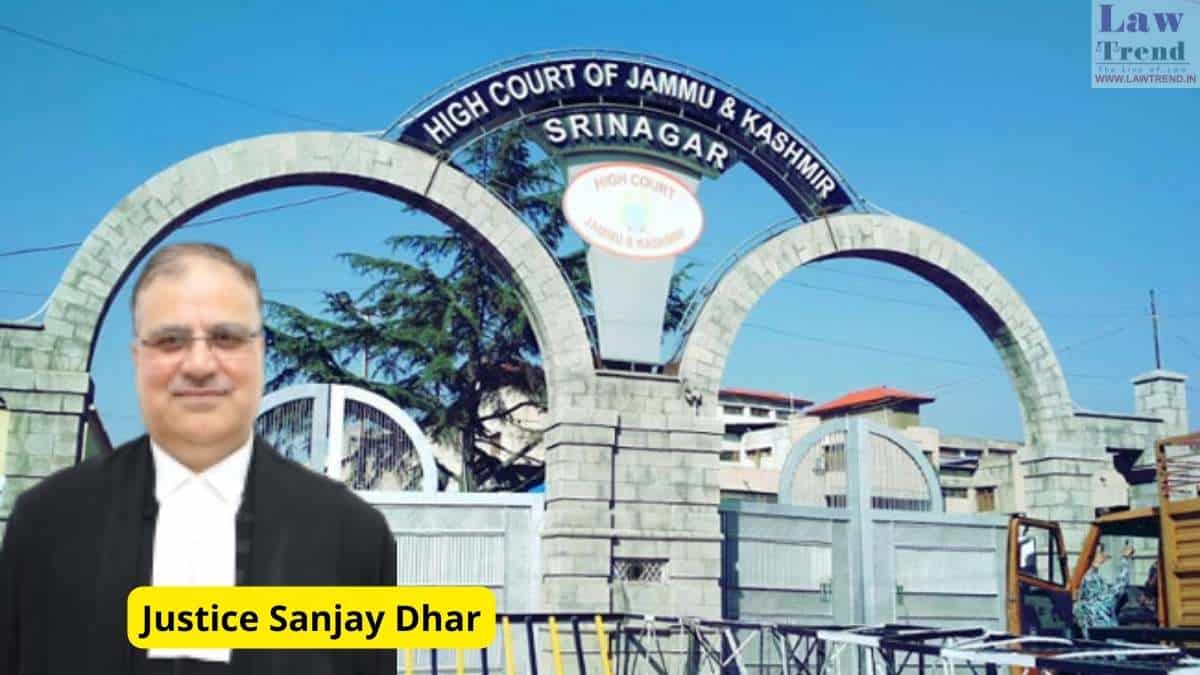
The High Court of Jammu & Kashmir and Ladakh has set aside a trial court’s order that rejected a plaint in a property dispute, ruling that a suit cannot be rejected partially and that the existence of a private partition is a factual matter requiring trial. Justice Sanjay Dhar held that even if a claim for adverse possession were to fail at the threshold, the plaintiffs’ right to seek a permanent prohibitory injunction based on settled possession would still necessitate a trial.
Background
The dispute pertains to land measuring approximately 47 kanals situated at Nandpora, Nigeen, Srinagar, originally belonging to the late Haji Mohammad Jamal Mir. An arbitral award dated July 3, 1971, which was later made a Rule of the Court, provided a mechanism for partitioning the estate.
The appellants (plaintiffs) filed a suit for declaration and injunction, claiming that following the award, a private partition took place in 1982. They asserted that they took possession of their share and subsequently occupied an adjoining portion (approximately 11 kanals) that had fallen to the respondents (defendants). The plaintiffs claimed that their “continuous, uninterrupted, and peaceful possession” of this additional land since 1985-86 had matured into ownership by way of adverse possession in 1994.
The respondents challenged the suit by filing an application under Order VII Rule 11 of the Civil Procedure Code (CPC), seeking rejection of the plaint. The trial court (1st Additional District Judge, Srinagar) allowed this application on July 31, 2024, concluding that the parties were co-owners and the plaintiffs had failed to plead “ouster” or establish a cause of action for adverse possession.
Arguments of the Parties
The respondents argued that the suit land remained a joint holding. They referenced the 1971 arbitral award, which suggested that partition should be done by revenue authorities. Since no such formal partition occurred, they contended that the possession of one co-owner (the plaintiffs) is deemed to be the possession of all co-owners in the eyes of the law, thereby nullifying the claim of adverse possession.
Conversely, the appellants argued that the trial court ignored their specific pleading regarding a “private partition.” They contended that the arbitral award did not prohibit private partition and that whether such a partition occurred is a question of fact that can only be determined through trial.
Court’s Analysis
Justice Sanjay Dhar observed that for the purpose of Order VII Rule 11(a) CPC, the court must only consider the averments in the plaint and documents annexed to it, taking them as true at their face value.
On Private Partition: The Court noted that the plaintiffs specifically pleaded that the land “came to be partitioned privately” following the arbitral award. The Court observed:
“The issue whether the parties partitioned the suit land privately without the help of revenue authorities is factual in nature… Once the question as to the status of the suit property, whether it was joint holding or partitioned, becomes a triable issue, the plaint could not have been rejected under Order VII Rule 11.”
On Adverse Possession and Injunction: The Court found that the plaintiffs had pleaded the essential ingredients of adverse possession, including the exact period and the hostile nature of their possession (fencing the land in 1985-86). More importantly, the Court highlighted that even if the adverse possession claim were excluded, the suit for an injunction remained viable.
On Partial Rejection of Plaint: The Court emphasized a critical legal principle:
“It is a settled law that a plaint cannot be rejected partially. Reference in this regard can be made to the judgment of the Supreme Court in the case of Kum. Geetha v. Nanjundaswamy and others (2024) 14 SCC 390… [which] held that a plaint cannot be rejected in part.”
The High Court noted that since the plaintiffs are admittedly in possession, they are entitled to seek protection of that possession against the defendants through a permanent prohibitory injunction, regardless of whether their claim for ownership via adverse possession succeeds.
Decision
The High Court allowed the appeal and set aside the trial court’s order dated July 31, 2024. The case has been remanded to the trial court with directions to frame issues based on the pleadings and proceed with the trial in accordance with law.
Case Details Block
- Case Title: Nazir Ahmad Mir & Ors. Vs. Ishfaq Ahmad Mir & Ors.
- Case No.: RFA No. 60/2024
- Bench: Justice Sanjay Dhar
- Date: April 30, 2026