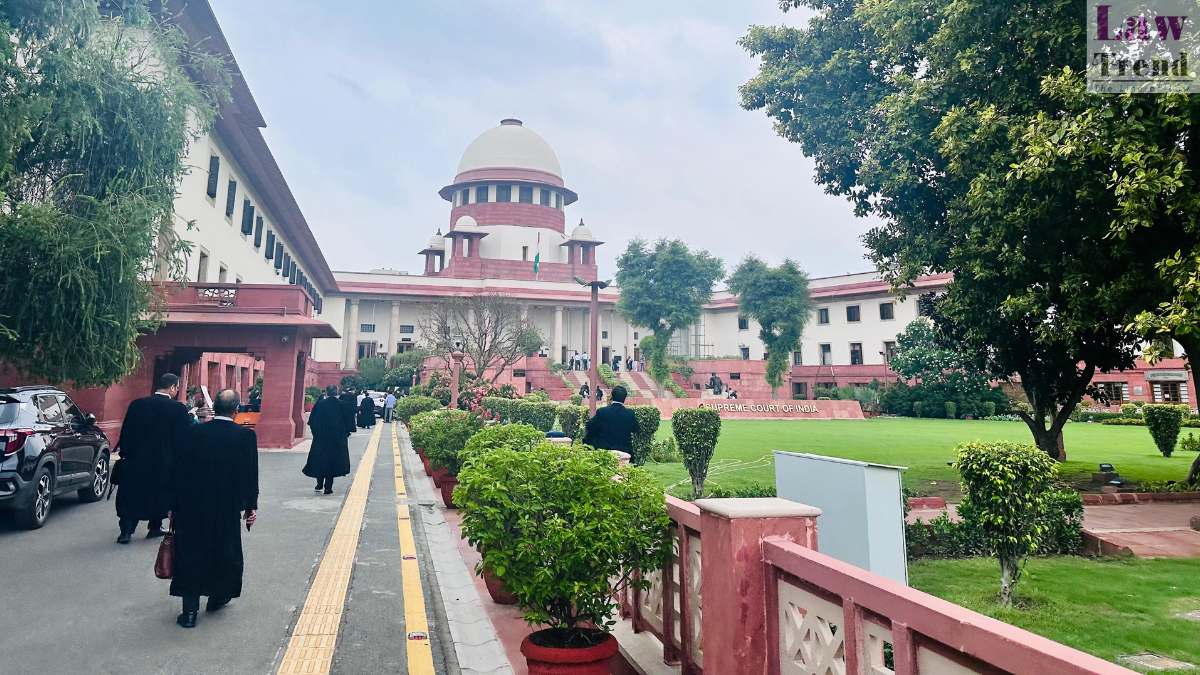
The Supreme Court of India has ruled that only organisations explicitly established for “intelligence and security” purposes can claim exemption from the Right to Information (RTI) Act, 2005 under Section 24(4), and that a state Lokayukta’s police wing does not qualify for such an exemption.
A Division Bench comprising Justice J.K. Maheshwari and Justice Atul S. Chandurkar delivered this ruling while dismissing an appeal filed by the Madhya Pradesh Special Police Establishment (SPE). The Court struck down a General Administration Department (GAD) notification dated August 25, 2011, which had sought to exclude the SPE from the purview of the transparency law.
Background of the Case
The case arose from a trap operation conducted on April 11, 2017, by the SPE, Bhopal, against the first respondent, Kamta Prasad Mishra, who was serving as a Town Inspector at the Madhav Nagar Police Station in Katni, Madhya Pradesh. The Home Department subsequently granted sanction for his prosecution under the Prevention of Corruption Act, 1988 on May 20, 2020.
Mishra filed an RTI application on July 1, 2020, seeking information on the decision-making process regarding the grant of sanction and the queries raised by the Lokayukt. The request was rejected by the SPE and subsequently by the State Information Commission, which ruled that the information was exempt under Section 8(1)(h) of the RTI Act.
On appeal, the High Court of Madhya Pradesh reversed this decision, noting that because the investigation was complete, Section 8(1)(h) could not be invoked to deny the information. The High Court directed the SPE to supply the information, leading to the present appeal before the Supreme Court.
Arguments of the Parties
The learned counsel for the appellant, SPE, contended that the High Court erred in its direction. They argued that the information was exempted under Section 8(1)(h) as its disclosure could impede ongoing criminal proceedings. The appellant also heavily relied on the state GAD notification dated August 25, 2011, which exempted the SPE from the RTI Act under Section 24(4). They argued that since Mishra had not challenged the validity of this notification before the High Court, it could not be examined by the Supreme Court.
The State of Madhya Pradesh, represented by its Advocate General, supported the SPE. They submitted that the Lokayukt is a statutory investigative authority and the SPE is its investigative arm. They argued that the notification was justified under the principle of institutional parity and that accused persons should not access investigative materials at the initial stages.
The learned counsel for the first respondent, Mishra, argued that Section 8(1)(h) did not apply because the investigation was complete and the charge-sheet had already been filed. He maintained that the requested information regarding the grant of sanction would not impede the prosecution.
The Court’s Analysis
The Supreme Court first addressed whether it could examine the validity of the GAD Notification without a formal challenge in the lower court. Citing Bihar Rajya Dafadar Chaukidar Panchayat v. State of Bihar, the Bench observed that Constitutional Courts possess the reserve power to suo motu declare subordinate legislation invalid if it is patently unconstitutional, provided the State is given an opportunity to defend it.
Quoting from the precedent, the Court noted:
“a writ court, when its finds its conscience to be pricked in a rare and very exceptional case by the patent unconstitutionality of a subordinate legislation connected with the issue it is seized of, may, upon grant of full opportunity to the State to defend the subordinate legislation and after hearing it, grant a declaration as to unconstitutionality and/or invalidity of such legislation.”
Distinguishing this from the ruling in Union of India v. Manjurani Routray, the Court highlighted that the State Government of Madhya Pradesh was given ample opportunity and was extensively heard on the notification’s validity.
Examining Section 24(4) of the RTI Act, the Court observed that the exemption is strictly restricted to “intelligence and security” organisations established by the State Government. The Bench analyzed the Second Schedule of the RTI Act, which lists Central organisations like the Directorate of Enforcement (ED), Border Security Force (BSF), and National Investigation Agency (NIA), noting that they are specifically tasked with intelligence and security.
In contrast, the Court found that the SPE, constituted under the Madhya Pradesh Special Police Establishment Act, 1947, has a limited jurisdiction confined to investigating offences under the Prevention of Corruption Act and specific provisions of the Penal Code (such as Sections 409, 420, and Chapter XVIII).
The Court observed that neither the Lokayukt nor the Up-Lokayukt under the Madhya Pradesh Lokayukt Evam Up-Lokayukt Adhiniyam, 1981 has been conferred any jurisdiction over “intelligence” and “security” affairs. Pointing to the Allahabad High Court’s decision in Dr. Nutan Thakur v. State of U.P., which struck down a similar exemption for the U.P. Lokayukt, the Bench concluded that the SPE cannot be classified as an intelligence and security organisation.
The Court’s Decision
The Supreme Court dismissed the appeal and struck down the notification of August 25, 2011, to the extent that it excluded the SPE from the RTI Act.
The Court concluded:
“The SPE having been conferred jurisdiction only to investigate offences punishable under the Act of 1988, Sections 409, 420 and Chapter XVIII of the Penal Code, it cannot be termed to be an intelligence and security’ organisation for the purposes of Section 24(4) of the Act of 2005. The Notification dated 28.05.2011 does not conform to Section 24(4) of the Act of 2005 and is, thus, excessive in nature.”
The Court upheld the Madhya Pradesh High Court’s judgment directing the supply of the requested information. It clarified that it did not examine the notification’s applicability to the State Bureau of Investigation of Economic Offences, which remains unaffected by this judgment.
Case Details
Case Title: Special Police Establishment v. Kamta Prasad Mishra and Others
Case No.: Criminal Appeal No. 3743 of 2024
Bench: Justice J.K. Maheshwari and Justice Atul S. Chandurkar
Date: June 15, 2026