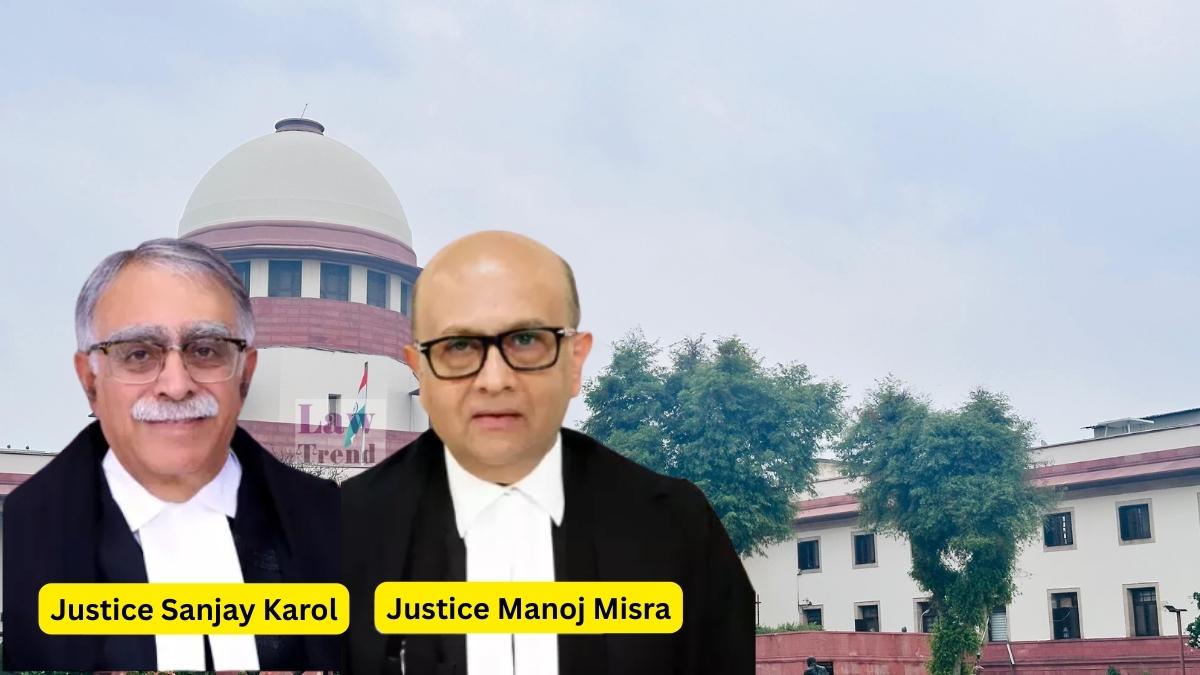
A division bench of the Supreme Court of India, comprising Justice Sanjay Karol and Justice Manoj Misra, has dismissed an appeal filed by a former Executive Engineer of the North Delhi Municipal Corporation, ruling that the Municipal Commissioner is the competent disciplinary authority empowered to dismiss Group ‘A’ officers post the 1993 statutory amendment. The Court resolved a long-standing legal conflict regarding whether the pre-existing 1959 Service Regulations, which named the “Corporation” as the disciplinary authority for Category ‘A’ posts, continued to limit the Commissioner’s disciplinary powers after the Delhi Municipal Corporation Act, 1957 was amended.
Background of the Case
The appellant, Rajesh Sharma, served as an Executive Engineer (Civil) with the North Delhi Municipal Corporation (the Corporation). While in service, he was convicted and sentenced under Section 13(1)(d) of the Prevention of Corruption Act, 1988, and Sections 420 and 120(B) of the Indian Penal Code, 1860, on July 15, 2011. Following his conviction, the Municipal Commissioner dismissed him from service on November 15, 2011.
Sharma challenged the dismissal order before the Central Administrative Tribunal (CAT), Principal Bench, New Delhi, in Original Application No. 4466/2011. He argued that on the date the order was passed, he was a Group ‘A’ officer and, therefore, the authority competent to take disciplinary action against him under the Delhi Municipal Corporation Service (Control and Appeal) Regulations, 1959, was the ‘Corporation’ and not the Commissioner.
On August 7, 2014, the CAT accepted his plea and set aside the dismissal, reserving the right for the competent disciplinary authority to issue a fresh penalty order. The Corporation challenged this decision before the Delhi High Court. On August 28, 2019, the High Court allowed the Corporation’s writ petition, holding that the Commissioner was indeed empowered to dismiss the appellant. Dissatisfied, Sharma appealed to the Supreme Court.
Arguments of the Parties
Appellant’s Contentions
The appellant argued that under Regulation 7 read with the Schedule of the 1959 Regulations, the authority competent to impose major penalties on Category ‘A’ officers is the Corporation, making the Commissioner’s dismissal order void. He contended that Section 59(d) of the 1957 Act, which was substituted by Act 67 of 1993, states that the Commissioner’s disciplinary authority is “subject to any regulation that may be made in this behalf.” The appellant argued that this meant the Commissioner’s power remains subject to the pre-existing 1959 Regulations, as the substituted clause must be read as if it were incorporated into the original Act from its inception.
Furthermore, the appellant asserted that the High Court breached judicial propriety by failing to refer the matter to a larger bench, given that its decision contradicted a coordinate bench ruling in MCD Thru Commissioner v. Ved Prakash Kanoji, which had affirmed a Single Judge’s decision in G.S. Matharoo v. CBI. He also maintained that Section 24 of the General Clauses Act, 1897, preserved the validity of the 1959 Regulations despite the subsequent statutory amendments.
Respondents’ Contentions
The respondents argued that the primary purpose of the 1993 statutory amendment was to streamline municipal administration in Delhi following the recommendations of the S. Balakrishnan Committee Report. The report had highlighted that the Commissioner’s administrative and disciplinary control was severely compromised by the interference of councilors, who shielded delinquent employees.
They contended that by amending Section 92 and substituting Section 59(d), Parliament intended to give the Commissioner complete control as both the appointing and disciplinary authority. The respondents asserted that the phrase “subject to any regulation that may be made in this behalf” refers strictly to regulations framed after the 1993 amendment, not the existing 1959 Regulations. Finally, they argued that in any conflict between a statute and a subordinate regulation, the statutory provision must prevail.
Court’s Analysis and Interpretation
The Supreme Court examined the statutory framework, the intent behind the 1993 amendment, and the principles governing amendments made by substituting existing provisions.
Amendment by Substitution and Retrospectivity
The Court analyzed the legal principles of statutory construction when a provision is amended by substitution. It cited the “pen and ink theory” from the Constitution Bench ruling in Shamarao V. Parulekar v. District Magistrate, Thana:
“The rule is that when a subsequent Act amends an earlier one in such a way as to incorporate itself, or a part of itself, into the earlier, then the earlier Act must thereafter be read and construed (except where that would lead to a repugnancy, inconsistency or absurdity) as if the altered words had been written into the earlier Act with pen and ink and the old words scored out so that thereafter there is no need to refer to the amending Act at all.”
However, citing Ram Narain v. Simla Banking and Industrial Company Limited, the Court clarified that an amended provision does not automatically relate back to the date of the original Act unless retrospective operation is expressly given or necessarily implied. Since nothing in Act 67 of 1993 suggested retrospective intent, the Court ruled that the substituted Section 59(d) operated prospectively from October 1, 1993.
Meaning of “May Be Made”
The Court addressed whether the Commissioner’s disciplinary powers were bound by the 1959 Regulations. In interpreting the phrase “subject to any regulation that may be made in this behalf,” the Court noted that the term “may be” has a future connotation. Referencing its previous decision in Vijay Kumar Shukal v. Lakhpat Ram, the Court held:
“the phrase ‘subject to any Regulation that may be made in this behalf’ refers to the Regulations that are made after the substitution of clause (d) of Section 59 by Act 67 of 1993 and not the existing 1959 Regulations.”
The Court observed that if Parliament had intended to preserve the limitations under the existing regulations, it would have used language such as “regulations made under this Act.” Interpreting the clause as applying to existing regulations would render the words “may be made” entirely redundant or superfluous.
Rejection of Section 24 of the General Clauses Act
The Court rejected the appellant’s argument that Section 24 of the General Clauses Act, 1897, saved the 1959 Regulations in a way that limited the Commissioner’s powers. Section 24 does not apply where subordinate regulations are inconsistent with the re-enacted statute. Citing Meera Gupta (Smt.) v. State of West Bengal, the Court observed:
“the legislature cannot be accused to have indulged in trickery or futilty in giving something with one hand and taking it away with the other.”
Harmonious Construction of the Act and Regulations
The Court found no conflict between Section 59(d) and Section 95(1) of the 1957 Act. Section 95(1) outlines the punishments that may be imposed on municipal employees by “such authority as may be prescribed by regulations” but does not designate any specific disciplinary authority on its own.
Thus, Section 59(d) and Section 95(1) operate in separate fields. Until new regulations are framed after October 1, 1993, specifying an alternative disciplinary authority, the Commissioner remains the competent authority to inflict punishments under Section 95(1).
Status of Precedents and Judicial Propriety
Addressing the issue of the Delhi High Court departing from its previous coordinate bench ruling in G.S. Matharoo v. CBI, the Supreme Court noted that the special leave petition against G.S. Matharoo had been dismissed with all questions of law left open. Therefore, the law laid down in that case had not been affirmed by the Supreme Court. The Court formally overruled G.S. Matharoo v. CBI to the extent that it contradicted the present judgment.
Decision of the Court
The Supreme Court concluded that the Municipal Commissioner was the competent disciplinary authority on the date the appellant was dismissed and possessed the power to issue the dismissal order. Finding no merit in the appeal, the Court dismissed the matter and discharged all pending interim orders.
Case Title: Rajesh Sharma v. North Delhi Municipal Corporation and Anr.
Case No.: Civil Appeal No. ______ of 2026 (Arising out of SLP (C) No. 28644 of 2019)
Bench: Justice Sanjay Karol, Justice Manoj Misra
Date: June 17, 2026