

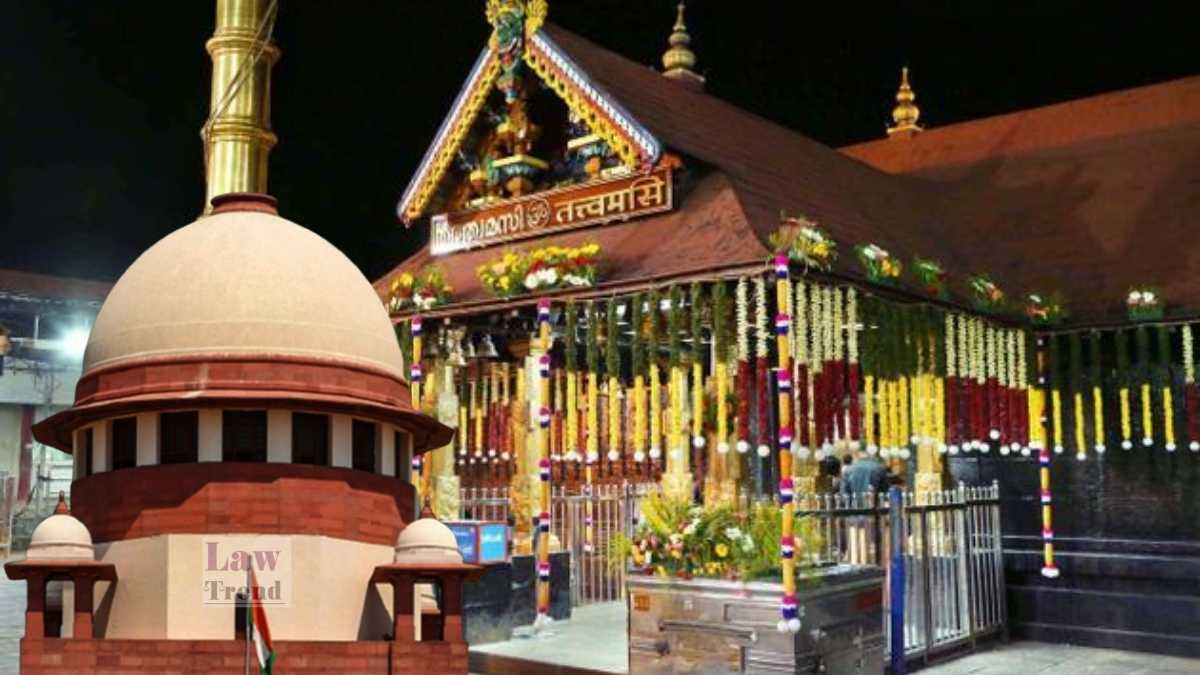
A nine-judge Constitution Bench of the Supreme Court, led by Chief Justice Surya Kant, has concluded a marathon 16-day hearing centered on the contentious entry of women into the Sabarimala temple and the broader intersection of religious faith and constitutional law.
The proceedings, which commenced on April 7 and were slated to wrap up by April 22, mark a pivotal moment in Indian jurisprudence. The court is tasked with evolving a “judicial policy” that will address not only the traditions of the Ayyappa shrine in Kerala but also similar restrictions faced by women in other faiths, including entry into mosques and Parsi fire temples.
The high-stakes matter saw intense deliberation between a powerhouse bench and the country’s top legal minds. Alongside CJI Surya Kant, the bench included Justices B.V. Nagarathna, M.M. Sundresh, Ahsanuddin Amanullah, Aravind Kumar, Augustine George Masih, Prasanna B. Varale, R. Mahadevan, and Joymalya Bagchi.
Arguments were led by Solicitor General Tushar Mehta for the Centre, alongside senior advocates Abhishek Singhvi, Mukul Rohatgi, Indira Jaising, C.S. Vaidyanathan, Neeraj Kishan Kaul, and Gopal Sankaranarayanan.
Representing the Union of India, Solicitor General Tushar Mehta urged the court to uphold the traditional restrictions on women of menstruating age (10 to 50 years) at Sabarimala.
The Centre argued that these practices fall “squarely within the domain of religious faith and denominational autonomy,” asserting that such matters should lie beyond the scope of judicial review. Mehta’s submissions supported the pending review petitions against the court’s previous 2018 ruling, which had initially lifted the ban.
The current hearing is the culmination of years of legal volatility:
- September 2018: A five-judge bench ruled 4:1 that the ban was unconstitutional, allowing women of all ages to enter the shrine.
- November 2019: A separate five-judge bench headed by then-CJI Ranjan Gogoi referred the matter to a larger bench, citing the need for clarity on discrimination across various religions.
- May 2020: The court affirmed its power to refer these questions of law to a larger bench even while exercising review jurisdiction.
The court’s eventual verdict will hinge on seven critical questions framed to test the limits of Article 25 (Freedom of Religion) and Article 26 (Rights of Religious Denominations). These include:
- The scope and ambit of the right to freedom of religion under Article 25.
- The interplay between individual rights and denominational rights under Article 26.
- Whether denominational rights are subject to fundamental rights other than public order, morality, and health.
- The definition of “Constitutional morality.”
- The extent of judicial review regarding religious practices.
- The interpretation of the expression “sections of Hindus.”
- Whether a person not belonging to a specific religious group has the standing to challenge its practices via public interest litigation (PIL).
While the Sabarimala temple remains the catalyst, the Supreme Court has signaled that its ruling will provide a definitive framework for “substantial and complete justice” regarding the entry of Muslim women into mosques and dargahs, as well as the rights of Parsi women married to non-Parsis to enter the holy fire place of an Agiary.
As the legal community and the nation await the verdict, the court’s decision is expected to redefine the boundary where personal faith ends and constitutional rights begin.




