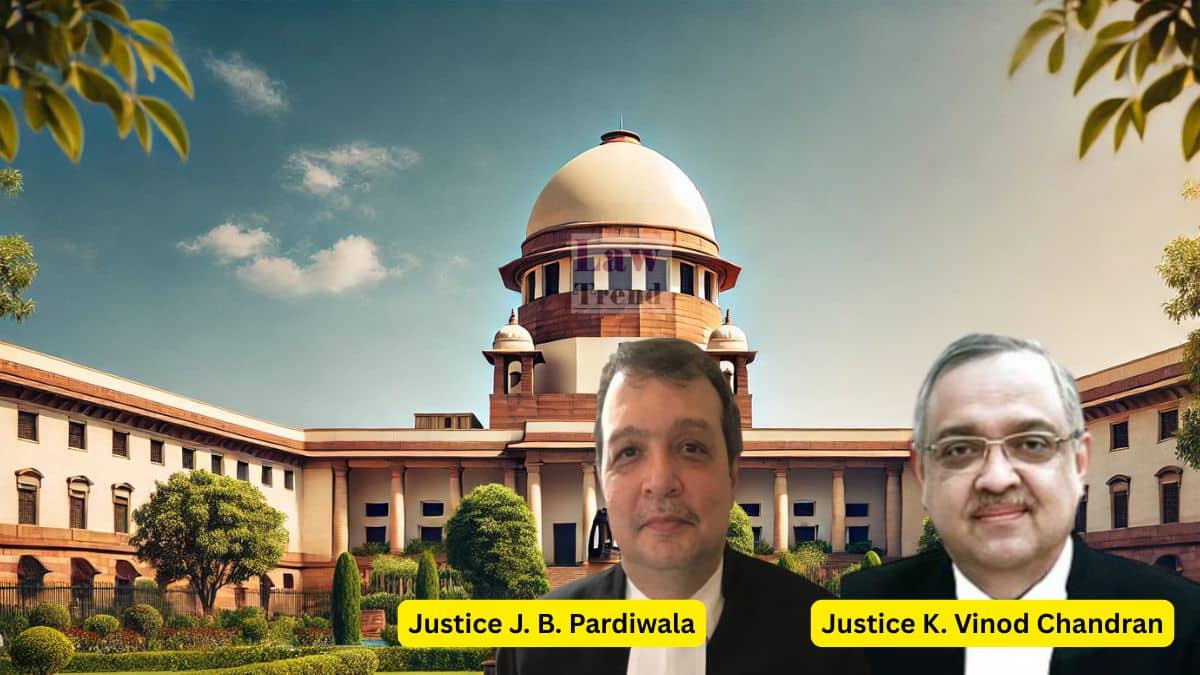
The Supreme Court, in a bench comprising Justice J. B. Pardiwala and Justice K. Vinod Chandran, ruled that a defendant is entitled to cross-examine a plaintiff regarding the period from which a brand name has been used in a trademark infringement suit, even if the defendant’s written statement is not taken on record. Reversing an order of the High Court that had expunged such a cross-examination question, the apex court allowed the civil appeal and directed the trial court to recall the plaintiff to record their answer.
Background of the Case
The respondent/plaintiff, Dharampal Premchand Limited, instituted a suit against the appellant/defendant, Shabu KN Achary, seeking multifarious reliefs. The plaintiff sought a permanent injunction restraining the defendant from infringing the trade-dress used in its product, a declaration that two trademarks are exclusive marks of the plaintiff under Section 2(1)(zg) read with Section 11(6) of the Trade Marks Act, 1999, as well as damages.
In the affidavit accompanying the prayer for injunction, the plaintiff specifically stated that the defendant was using the plaintiff’s brand name with a packaging and trade-dress identical to the unique trade-dress of the plaintiff’s product. The allegations pertained to the infringement of the plaintiff’s registered trademark and copyright.
During trial proceedings, the defendant put the following question to the plaintiff in cross-examination:
“Is it correct that you have no document to show that since when mark BABA is being used?”
The High Court expunged this question from the record on the grounds that it was a purely factual question beyond permissible cross-examination, given that the defendant’s written statement was not on record.
Arguments of the Parties
Senior Counsel Sri Ankur Chhibber represented the appellant (Shabu KN Achary), while Senior Counsel Sri Gagan Gupta appeared for the respondent (Dharampal Premchand Limited).
The primary contention raised against permitting the query was that because the defendant’s written statement was not taken on record, the defendant was not entitled to put that question to the plaintiff during cross-examination.
Court’s Analysis
The Supreme Court disagreed with the High Court’s view. The bench observed that the foundation of the relief for damages claimed by the plaintiff was the alleged infringement of the brand name asserted by the plaintiff.
The apex court held that even in the absence of a written statement on record, a defendant retains the right to question the plaintiff on documents regarding the duration of brand usage when trademark infringement is affirmed by the plaintiff.
The court observed:
“When the plaintiff affirms trademark infringement, even if the written statement is not on record, the defendant is entitled to put the question which queries the plaintiff on the document, to substantiate the time from which such brand name was used by the plaintiff.”
Decision
Holding that the question was permissible, the Supreme Court allowed the appeal and set aside the impugned order of the High Court. The court directed that the trial proceed after recalling the plaintiff and recording their answer to the disputed question.
The court clarified that it made no observations on the merits of the case and that both parties remain free to agitate their respective contentions during the trial.
Case Details:
Case Title: Shabu KN Achary v. Dharampal Premchand Limited
Case No.: Civil Appeal No. 10260 of 2026 (Arising out of SLP (C) No. 26887 of 2026)
Bench: Justice J. B. Pardiwala, Justice K. Vinod Chandran
Date: August 07, 2026