

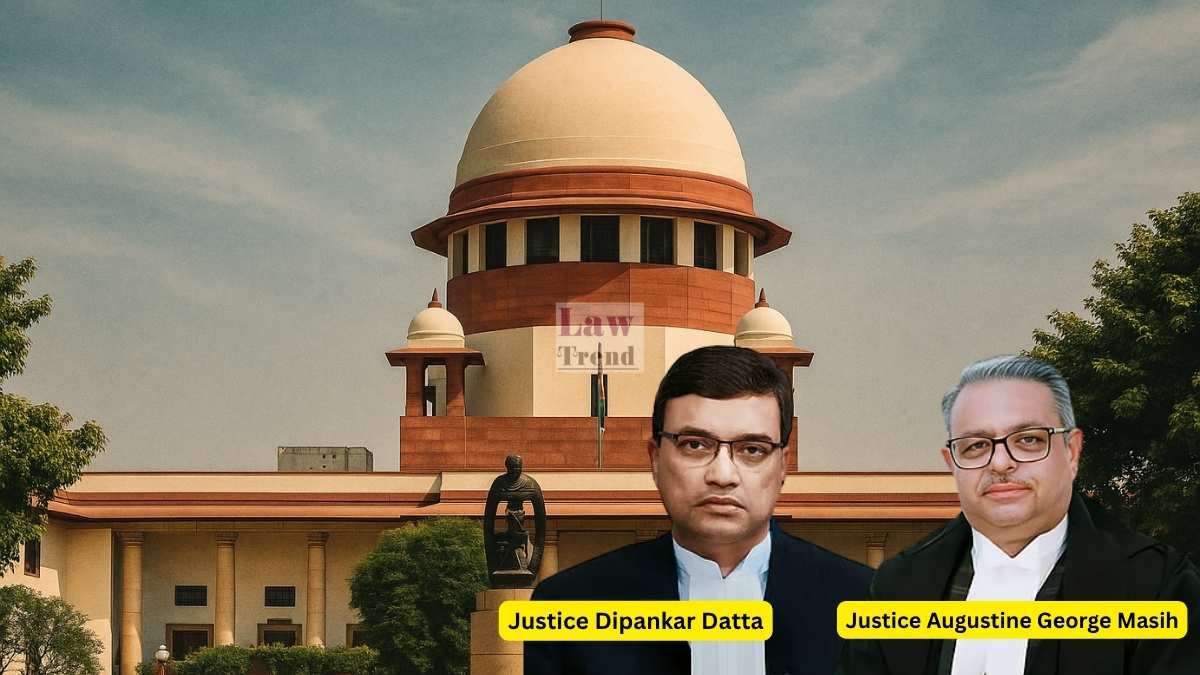
In a significant ruling clarifying the evidentiary threshold under the Insolvency and Bankruptcy Code, 2016 (IBC), the Supreme Court of India, comprising a Bench of Justice Dipankar Datta and Justice Augustine George Masih, held that an authenticated Information Utility record is by itself sufficient to establish default under Section 7 of the Code, carrying a high evidentiary presumption that cannot be displaced by bare denials or bookkeeping disagreements. Dismissing appeals filed by Deepak Raheja and another, the Court upheld the initiation of the Corporate Insolvency Resolution Process (CIRP) against GSTAAD Hotels Pvt. Ltd. (operator of JW Marriott Hotel, Bengaluru) and Neo Capricorn Plaza Pvt. Ltd. (operator of Crowne Plaza Hotel, Pune), ruling that Section 7 proceedings require a summary, prima facie determination on a preponderance of probabilities rather than a forensic examination of accounts.
Background of the Case
By a Loan Agreement dated December 26, 2017, Piramal Finance Ltd. (later Piramal Capital and Housing Finance Ltd. / PCHFL) extended credit facilities aggregating Rs 600 crore to GSTAAD Hotels Pvt. Ltd. (Corporate Debtor) and Neo Capricorn Plaza Pvt. Ltd. (Neo) as co-borrowers. This comprised a Rs 450 crore term loan and a Rs 50 crore Rolling Credit Facility (RCF) to the Corporate Debtor, and a Rs 100 crore term loan to Neo. Under an executed Cash Management Agreement (CMA), hotel revenues were routed into a Revenue Account, with 66 per cent transferred to an Expense Account and 34 per cent into a Retention Account for debt servicing. The borrowers were also required to maintain a Debt Service Reserve Account (DSRA) of Rs 8 crore and Rs 2 crore respectively. Undisbursed amounts of Rs 3 crore remained under the DSRA as on November 15, 2022. The Corporate Debtor additionally availed two facilities under the Emergency Credit Line Guarantee Scheme (ECLGS) of Rs 98 crore and Rs 65 crore, while Neo availed an ECLGS facility of Rs 19.5 crore.
Exercising unilateral assignment rights under Clauses 27.1 and 27.2 of the Loan Agreement, the lenders executed an Assignment Agreement on December 27, 2022, assigning the facilities in favour of Omkara Assets Reconstruction Pvt. Ltd. (Omkara). On February 9, 2023, four Form-D filings recording default were registered with National E-Governance Services Ltd. (NeSL). Following a loan recall notice issued on February 15, 2023, Omkara filed applications under Section 7 of the Code claiming default as of November 15, 2022.
The National Company Law Tribunal (NCLT), Mumbai Bench, Court-I, admitted the petitions on January 9, 2024. In an earlier round of challenge, the National Company Law Appellate Tribunal (NCLAT) remanded the matters on January 8, 2025, for fresh consideration of the CMA, DSRA, and ECLGS utilisation issues without expressing any conclusive opinion. Upon remand and hearing extensive submissions, NCLT again admitted both petitions on July 8, 2025, finding an existing debt and default crossing the statutory threshold under Section 4. On August 19, 2025, NCLAT dismissed the corporate debtors’ appeals and affirmed the NCLT orders. Concurrently, the Corporate Debtor had challenged the Assignment Agreement before the Karnataka High Court, where both a Single Judge and a Division Bench dismissed its writ petitions, and the Supreme Court subsequently dismissed the Special Leave Petition on August 25, 2025. The appellants then approached the Supreme Court under Section 62 of the Code.
Arguments of the Parties
Senior counsel appearing for the appellants contended that findings in the earlier remand order had attained finality and operated as res judicata. They argued that proper application of the CMA mechanism and an alleged excess withdrawal of Rs 10,35,88,444 from the retention account demonstrated that no default existed on November 15, 2022. It was submitted that the DSRA was meant to be appropriated against shortfalls, which would have averted any default. The appellants further submitted that both companies were running profitable hotels with positive EBITDA of Rs 81 crore and Rs 10 crore respectively for FY 2022-23, and placing running businesses into insolvency defeated the Code’s intent. Reliance was placed on Vidarbha Industries Power Ltd. v. Axis Bank Ltd. to argue that default must arise strictly from agreement and that cash liquidity and financial health remain relevant considerations.
Conversely, senior counsel for Omkara submitted that its status as an assignee and financial creditor under Section 5(7) stood conclusively settled up to the Supreme Court, barring any reopening under issue estoppel. It was urged that the corporate debtors never disputed the debt itself, and seeking adjustments through DSRA and CMA was an admission that default had occurred. Counsel stated that defaults on November 15, 2022, stood at Rs 17,16,29,518 for the Corporate Debtor and Rs 2,64,99,473 for Neo, comfortably above the Section 4 threshold. They relied upon precedents including Innoventive Industries Ltd. v. ICICI Bank, E.S. Krishnamurthy v. Bharath Hi-Tech Builders (P) Ltd., M. Suresh Kumar Reddy v. Canara Bank, the review order in Axis Bank Ltd. v. Vidarbha Industries Power Ltd., Maitreya Doshi v. Anand Rathi Global Finance Ltd., Devas Multimedia (P) Ltd. v. Antrix Corpn. Ltd., and Kalyani Transco v. Bhushan Power & Steel Ltd.
Court’s Analysis and Findings
Writing the judgment, Justice Masih first rejected the challenge to Omkara’s standing as a financial creditor, holding that the validity of the assignment was litigated to finality and was barred by issue estoppel:
“The doctrine rests upon finality, consistency and judicial discipline, and once a finding has attained finality between the parties, neither party may seek a fresh adjudication upon the same issue merely because the subsequent proceedings arise under a different statute or seek a different relief. To permit the Appellants to reopen a concluded legal issue in the present proceedings would tantamount to a collateral attack upon binding determinations that have attained finality up to this Court.”
Addressing the scope of appeal under Section 62, the Bench observed that concurrent findings of fact recorded by specialised tribunals on debt and default cannot be re-weighed unless perverse, arbitrary, or based on an erroneous legal standard, reiterating principles from Swiss Ribbons Pvt. Ltd. v. Union of India, Maitreya Doshi, and Kalyani Transco.
The Court framed and answered two primary questions of law:
1. Evidentiary Threshold Under Sections 3(12) and 7: The Court analysed Section 3(12) of the Code, emphasising that default means non-payment of the whole or any part or instalment once due and payable. Justice Masih drew a clear boundary between the fact of default and the computation of claims:
“The occurrence of default is a historical and static event which crystallises upon the date a debt became due and was not paid. The quantum of debt outstanding, by contrast, is dynamic, fluctuating upon account of accruing interest, default interest, charges, adjustments and part-repayments. The two enquiries are different in kind, and Section 7 is concerned with the first i.e. the occurrence of default.”
The Court held that the 14-day timeline under Section 7(4) precludes an exhaustive reconciliation:
“The standard applicable at the admission stage is one of preponderance of probabilities upon the documentary material placed on record. The threshold is deliberately modest which is a summary, prima facie finding of financial debt and default, grounded in documentary evidence, rather than a full trial upon disputed facts.”
The Bench highlighted that detailed claim collation and verification are administrative functions assigned to the Interim Resolution Professional under Section 18(b) and the IBBI (CIRP) Regulations, 2016, which would be rendered otiose if the Adjudicating Authority conducted forensic accounting at the admission stage.
2. Hierarchy of Documentary Material: Examining Section 7(3)(a), Section 7(4), and the IBBI (Information Utility) Regulations, the Court established a two-tier hierarchy of documentary evidence:
“At the first tier stands a record of default issued by an Information Utility, which is by itself sufficient, carrying a presumption of high evidentiary value displaceable only by clear, cogent, credible and compelling material. At the second tier stands the body of other documentary material enumerated in Part V of Form 1 of IBC (Application to Adjudicatory authority) Rules, 2016 and its analogues, none of which is individually sufficient in the same manner as record of default issued by an Information Utility, but which, if taken collectively, may establish default upon the summary standard governing Section 7.”
The Court observed that an unchallenged Information Utility record operates as an admission under Section 31 of the Indian Evidence Act, 1872 (or Section 25 of the Bharatiya Sakshya Adhiniyam, 2023) and creates an estoppel under Section 115 of the IEA (Section 121 of the BSA).
The Bench added that these conclusions are reinforced by the Insolvency and Bankruptcy Code (Amendment) Act, 2026, which amended Section 7(5) by substituting “shall” for “may” and introducing Explanations I and II, clarifying that a record of default from an Information Utility is statutorily sufficient and mandating admission when statutory preconditions are met.
Profitability vs. Solvency: Rejecting the appellants’ argument that operating hotels with positive EBITDA should not face CIRP, the Court clarified:
“EBITDA, being earnings before interest, taxes, depreciation and amortisation, is by definition computed before interest, and says nothing whatsoever about a company’s capacity to meet cash obligations to its lenders as and when they fall due. The metric relevant to that question is the Debt Service Coverage Ratio. The Corporate Debtor’s own audited financial statements record a Debt Service Coverage Ratio of 0.12 for the financial year 2022-23, meaning that its internal accruals covered only 12 per cent of that year’s debt obligations.”
The Court held that the legislative trigger under the Code is “default” and not commercial or balance-sheet insolvency, as the scheme is intended to facilitate timely intervention rather than await terminal collapse.
Decision of the Court
The Supreme Court concluded that defaults well exceeding the Section 4 statutory threshold were established on record through NeSL Form-D filings, account statements, the debtor’s letters admitting financial distress, and admissions recorded before the High Court. Finding no error of law in the concurrent determinations of the NCLT and NCLAT, the Court dismissed Civil Appeal No. 12195 of 2025 and the connected appeal, directing that the Corporate Insolvency Resolution Process in respect of both Corporate Debtors proceed in accordance with law.
Before parting, the Court recorded an undesirable incident during the hearing where a compilation containing AI-generated non-existent judgments was placed on record on behalf of the appellants. While the Court had initially proposed to impose exemplary costs, it noted the subsequent demise of the first appellant, and consequently directed that there shall be no order as to costs, noting under Order XXII Rule 6 of the Code of Civil Procedure, 1908, that the appeal did not abate.
Case Details:
Case Title: Deepak Raheja and Another v. Omkara Assets Reconstruction Private Ltd. and Another (with connected appeal)
Case No.: Civil Appeal No. 12195 of 2025 with Civil Appeal No. ___ of 2026 (Arising out of Diary No. 58001 of 2025)
Bench: Justice Dipankar Datta and Justice Augustine George Masih
Date: October 15, 2026




