

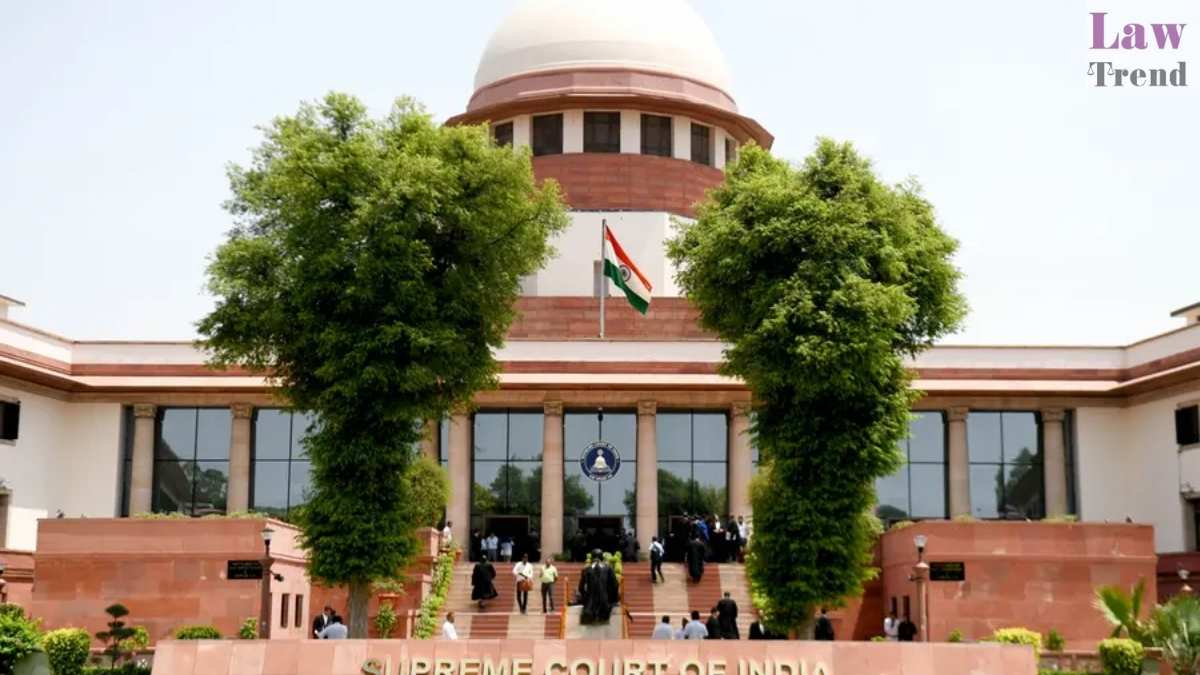
The Supreme Court of India has held that the period of limitation for filing a statutory appeal under Section 62 of the Insolvency and Bankruptcy Code, 2016 (IBC) commences from the date the National Company Law Appellate Tribunal (NCLAT) pronounces its order in open court, and not from the date on which an appellant chooses to apply for or physically collect a certified copy. A Bench comprising Justice S.V.N. Bhatti and Justice N.V. Anjaria sustained a preliminary objection on limitation raised by the respondent and dismissed an appeal filed by the Central Tax Department, reiterating that the maximum outer window of 60 days under Section 62 of the IBC cannot be rendered fluctuating or indefinite at the leisure of a litigant.
Background of the Case
The dispute arose out of corporate insolvency resolution proceedings concerning the Corporate Debtor, M/s Samyu Glass Private Limited, a manufacturer of glass containers registered as an Export Oriented Unit under the Companies Act, 1956. Multiple excise recovery proceedings were initiated against the company by the Central Excise and Service Tax Department between 2013 and 2017, while manufacturing activities halted around November/December 2016. The Corporate Debtor challenged the departmental demands before the Customs, Excise and Service Tax Appellate Tribunal (CESTAT).
Subsequently, Andhra Bank (now Union Bank of India), a financial creditor, filed an application under Section 7 of the IBC. The Adjudicating Authority admitted the application and initiated the Corporate Insolvency Resolution Process (CIRP), appointing Respondent No. 1 as the Resolution Professional.
When the Central Tax Department convened a Joint Pricing Committee meeting on 04.11.2019 to fix the reserve price to auction attached machinery, the Resolution Professional informed the Department that a moratorium had taken effect prohibiting third-party authorities from disposing of the Corporate Debtor’s assets. On 27.11.2019, the Deputy Commissioner of Central Tax submitted a proof of claim in Form F for Rs. 22,60,32,948/-. Although the Corporate Debtor had approached the Revenue under the Sabka Vishwas (Legacy Dispute Resolution) Scheme, 2019 with a settlement scheme of Rs. 4,32,80,741/-, the National Company Law Tribunal (NCLT), Hyderabad, on 13.08.2021, approved a Resolution Plan under which a sum of Rs. 1,34,657/- was allocated toward the excise arrears payable by the Corporate Debtor.
Aggrieved, the Revenue appealed to the NCLAT, Chennai. On 02.08.2023, the NCLAT dismissed the appeal and confirmed the NCLT’s order approving the Resolution Plan. The Revenue eventually filed a Civil Appeal under Section 62 of the IBC before the Supreme Court on 21.11.2023.
Arguments of the Parties
Appearing for Respondent No. 2, learned Senior Counsel Mr. Ritin Rai raised a preliminary objection, contending that the appeal was barred by limitation. He argued that the IBC is a complete code setting out strict statutory remedies. Under Section 62, the limitation period of 45 days, along with a condonable period of up to 15 days, commenced on 03.08.2023 and expired on 01.10.2023 (the 60th day), whereas the appeal was presented on the 111th day (21.11.2023).
In the alternative, he argued that even if the time taken to secure the certified copy were excluded under Section 12 of the Limitation Act, 1963, the Appellant applied for a certified copy only on 06.09.2023 and received it on 11.10.2023. Excluding that intervening period, the appeal ought to have been filed by 05.11.2023. Hence, the appeal remained time-barred on either count.
Learned Counsel for the Appellant, Mr. Saurav Roy, countered the objection by relying on the phrase “within forty-five days from the date of receipt of such order” in Section 62(1) of the IBC, read with Sections 421 and 423 of the Companies Act, 2013. He argued that the decisive starting point under Section 62 is the actual receipt of the order rather than the date of the order itself. Since the certified copy was received on 11.10.2023, the filing on 21.11.2023 took place within 41 days, falling squarely within the statutory limitation period.
Court’s Analysis and Precedents
Examining the statutory framework, the Supreme Court noted that under Section 238-A of the IBC, the Limitation Act, 1963 applies to proceedings and appeals under the Code “as far as may be.” The Court reviewed its binding precedents settling the principles governing limitation under the Code:
- In Sagufa Ahmed and Others v. Upper Assam Plywood Products Private Limited and Others, the Court held that limitation is rooted in the Latin maxim vigilantibus et non dormientibus jura subveniunt (the law assists only those who are vigilant, not those who sleep on their rights). The statutory “prescribed period” does not include the discretionary window allowed for condonation of delay.
- In V. Nagarajan v. SKS Ispat and Power Limited and Others, the Court affirmed that the IBC is an exhaustive, self-contained code that overrides conflicting statutes via Section 238. Applying for a certified copy is an affirmative obligation reflecting due diligence; litigants cannot claim exclusion under Section 12(2) of the Limitation Act for any period of inaction prior to submitting an application for a copy.
- In CA Ramchandra Dallaram Choudhary v. Adani Infrastructure and Developers Private Limited, the Court confirmed that under Section 62 of the IBC, the absolute ceiling for filing an appeal is 60 days (45 days plus a 15-day grace period). Beyond this 60-day limit, the Court loses jurisdiction to condone delay.
Clarifying the interplay between Section 62 of the IBC and Section 12(2) of the Limitation Act, the Bench made the following key observation:
“The phrase ‘from the date of receipt of the order’ in Section 62(1) cannot be read as the date on which a party chooses to apply for and collect a certified copy. If the limitation clock remained suspended until physical collection at the litigant’s leisure, the limitation period would then become fluctuating and indefinite. Furthermore, Section 12(2) of the Act, 1963 would be rendered wholly redundant.”
Referring to Rule 91 of the NCLAT Rules, 2016, which mandates the pronouncement of orders in open court, the Bench observed:
“On a bare reading of the Rule mandating pronouncement of the Order in open Court, knowledge and limitation would commence on the day the Rule is complied with. Consequently, the limitation period commences on the date the NCLAT pronounces the Order for an Appeal to this Court under Section 62 of the IBC.”
Applying these principles to the timeline:
- The NCLAT pronounced the judgment on 02.08.2023.
- The Appellant remained inactive for 35 days before applying for a certified copy on 06.09.2023. Under the Explanation to Section 12 of the Limitation Act, these 35 days of pre-application inaction could not be excluded and counted directly against the initial 45-day window.
- The period between 06.09.2023 and delivery of the copy on 11.10.2023 (35 days) constituted “time requisite” under Section 12(2) and was excluded.
- Upon delivery on 11.10.2023, only 10 days remained of the initial 45-day statutory window (expiring on 21.10.2023), followed by the 15-day discretionary condonable period under Section 62(2) (expiring on 05.11.2023).
- The Appellant waited another 41 days after receiving the copy, filing the appeal only on 21.11.2023.
Totalling the actionable periods (35 days before applying plus 41 days after receipt), the Appellant consumed 76 days—16 days beyond the absolute statutory ceiling of 60 days.
Decision of the Court
The Supreme Court concluded that accepting the Appellant’s interpretation:
“…would nullify both the limitation period and the condonable period, and make the right of Appeal subject to an indefinite and fluctuating period of limitation.”
Holding that the appeal was filed beyond the outer limit of its jurisdiction to condone delay, the Court sustained the preliminary objection and dismissed the Civil Appeal as barred by limitation, with no order as to costs.
Case Title: The Assistant Commissioner of Central Tax, CGST Division v. Sreenivasa Rao Ravinuthala and Another
Case No.: Civil Appeal No. 7882 of 2023
Bench: Justice S.V.N. Bhatti and Justice N.V. Anjaria
Date: October 14, 2026




