

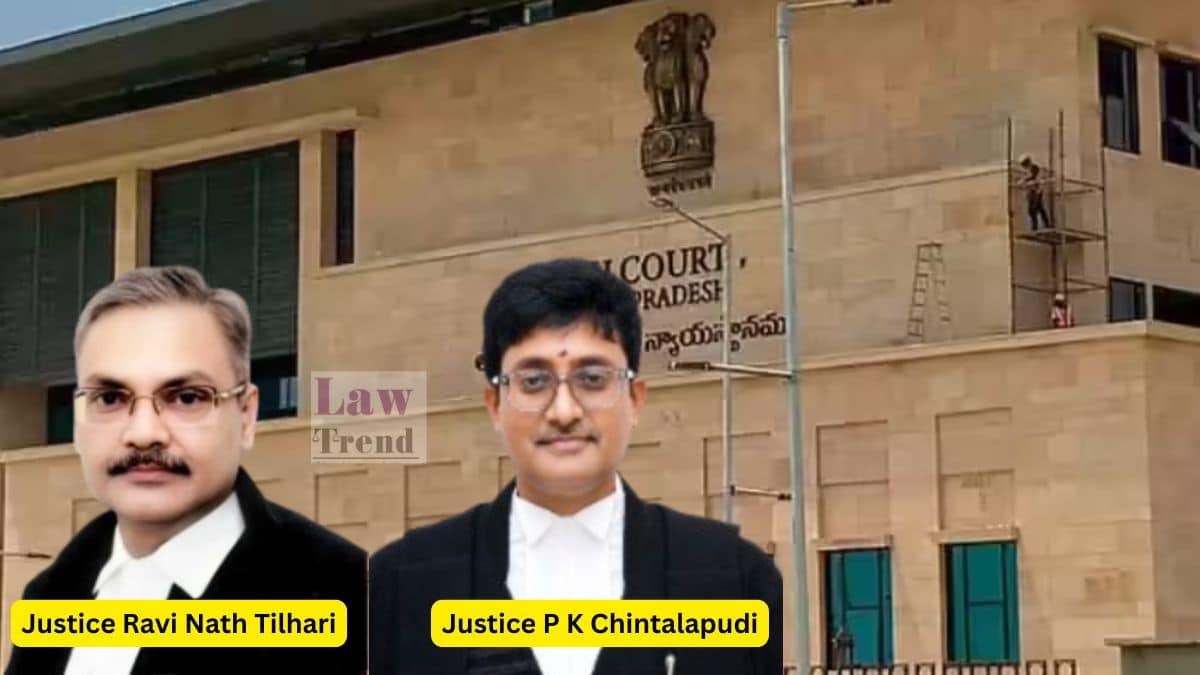
In a significant ruling on procedural safeguards under preventive detention laws, the High Court of Andhra Pradesh, comprising Justice Ravi Nath Tilhari and Justice Purushottam Kumar Chintalapudi, has set aside a preventive detention order and its subsequent confirmation against an alleged offender, holding that the failure of the detaining authority to consider existing bail orders granted to the detenu vitiates its subjective satisfaction. Allowing the habeas corpus petition, the Court ruled that bail orders and their conditions constitute vital material that must be placed before and examined by the detaining authority before passing an order of preventive detention.
Background of the Case
The petitioner, Komma Siva Haritha, moved the High Court by filing a writ of habeas corpus under Article 226 of the Constitution of India, challenging the preventive detention of the detenu, Yalapala Maruthi Prasad Reddy @ Talamarla Maruthi Reddy @ Maruthi.
The detention order was issued vide proceedings D.Dis. No. MAGL/E-37252 on April 2, 2026, by the Collector & District Magistrate, Sri Sathya Sai District, under Section 3 of the Andhra Pradesh Prevention of Dangerous Activities of Bootleggers, Dacoits, Drug Offenders, Goondas, Immoral Traffic Offenders and Land Grabbers Act, 1986. The detention was subsequently confirmed by the General Administration (SC-I) Department vide G.O.Rt.No.994 on May 18, 2026.
The detaining authority had founded the detention order on nine criminal cases registered against the detenu:
- Cr.No.232/2020 under Sections 143, 147, 341, 447, 506 read with 149 of the Indian Penal Code (IPC) at Kothacheruvu Police Station.
- Cr.No.116/2025 under Sections 79, 118(1), 329(3), 351(2) read with 3(5) of the Bharatiya Nyaya Sanhita, 2023 (BNS) at Kothacheruvu Police Station.
- Cr.No.14/2026 under Sections 79, 129(3), 329(3), 351(2) read with 3(5) of the BNS, 2023 at Kothacheruvu Urban Police Station.
- Cr.No.15/2026 under Sections 111, 132, 351(2) of the BNS at Kothacheruvu Urban Police Station.
- Cr.No.45/2022 under Sections 447, 353, 506 read with 34 of the IPC and Sections 3 & 4 of the AP Land Grabbing (Prohibition) Act, 1982 at Puttaparthy Urban Police Station.
- Cr.No.70/2025 under Sections 115(2), 351(2), 126(1) of the BNS at Puttaparthy Urban Police Station.
- Cr.No.01/2026 under Sections 103(2), 238 read with 3(5) of the BNS at Puttaparthy Urban Police Station.
- Cr.No.94/2022 under Sections 324, 354, 506 read with 34 of the IPC at Puttaparthy Rural Police Station.
- Cr.No.159/2019 under Sections 323, 506 read with 34 of the IPC at Gorantla Police Station.
Submissions of the Parties
Learned counsel for the petitioner, Sri Dushyanth Reddy (representing Sri K.V. Aditya Chowdary), contended that out of the nine cases cited as grounds, bail had already been granted to the detenu in two cases—namely ground Nos. 5 and 7. However, these bail orders were never placed before the detaining authority. Consequently, the detention order and its confirmation suffered from non-consideration of vital and relevant material, thereby vitiating the detaining authority’s subjective satisfaction.
The petitioner further pointed out that in ground No. 7, although the prosecution had filed an application for cancellation of bail on March 3, 2026, and the bail was subsequently cancelled on April 9, 2026 (after the detention order was issued), the sponsoring authority had failed to place the cancellation application before the detaining authority. Additionally, in five of the cases, notices under Section 41A of the Code of Criminal Procedure (Cr.P.C.) were served, and in the remaining two cases, the detenu had not been arrested. The petitioner argued that the alleged offenses were amenable to the ordinary law of the land without needing recourse to preventive detention, there being no disturbance to public order, relying on the Supreme Court ruling in Ameena Begum v. State of Telangana.
Sri Keerthi Teja Kondaveeti, learned Government Pleader appearing for the State respondents, could not dispute the fact that the bail orders in ground Nos. 5 and 7 were not considered by the detaining authority. He nonetheless contended that the detenu’s activities were prejudicial to the maintenance of public order, justifying the preventive detention order upon the recording of subjective satisfaction.
Court’s Analysis
Examining the legal position, the Division Bench reiterated that bail orders are indispensable and relevant materials that must be considered by the detaining authority to form a valid subjective satisfaction.
The Bench referred to the Supreme Court’s ruling in Rushikesh Tanaji Bhoite v. State of Maharashtra, observing:
“In a case where the detenu is released on bail and is enjoying his freedom under the order of the court at the time of passing the order of detention, then such order of bail, in our opinion, must be placed before the detaining authority to enable him to reach at the proper satisfaction.”
The Court further cited Rushikesh Tanaji Bhoite, noting:
“…suffice it to say that non-placing and non-consideration of the material as vital as the bail order has vitiated the subjective decision of the detaining authority.”
The Court also drew guidance from Joyi Kitty Joseph v. Union of India, where the Supreme Court held that when bail has been granted with conditions by a jurisdictional court, the detaining authority is bound to examine whether those conditions were sufficient to restrain the detenu from repeating identical offenses:
“We are more concerned with the aspect that the detaining authority did not consider the efficacy of the conditions and enter any satisfaction, however subjective it is, as to the conditions not being sufficient to restrain the detenu from indulging in such activities.”
Reliance was also placed on the Andhra Pradesh High Court’s earlier decision in Buddiga Dhana Lakshmi v. State of Andhra Pradesh (which discussed Ponnada Geetha and Vasanthu Sumalatha v. State of Andhra Pradesh), reaffirming that where a detenu has been released on bail in a crime made the basis of detention, non-placement and non-consideration of the bail order impairs the detaining authority’s subjective satisfaction and vitiates the detention order.
Applying these precedents to the present facts, the Bench observed that the detaining authority was not even aware that the detenu had been released on bail in the two criminal cases under ground Nos. 5 and 7, as the orders were never placed before it.
Addressing the arguments concerning “public order” versus “law and order” under Ameena Begum v. State of Telangana (which referenced Ram Manohar Lohia v. State of Bihar, Arun Ghosh v. State of W.B., Kuso Sah v. State of Bihar, and Rekha v. State of T.N.), the Bench held that because the detention order failed on the ground of non-consideration of bail orders, it could not be sustained regardless:
“With respect to the submission of the learned counsel for the petitioners, that it is a case of the breach of law and order situation not affecting the public order, we are of the view that since we are satisfied that the bail orders were not taken into consideration by the detaining authority, so the order of preventive detention cannot be sustained, even if it be a case of threat to public order, though we do not conclusively observe it to be a case of public order or law and order situation only.”
The Court fortified its reasoning by citing Shiv Parsad Bhatnagar v. State of M.P. and another, which established that “the single vicious ground is sufficient to vitiate an order of preventive detention.” The Bench additionally noted the Supreme Court’s ruling in Pramod Singla v. Union of India, which held that every procedural irregularity under Articles 21 and 22(5) of the Constitution of India must accrue in favor of the detenu.
Decision of the Court
The High Court allowed the writ petition and set aside the detention order dated April 2, 2026, as well as the confirmation order dated May 18, 2026.
The Court directed that the detenu be set at liberty immediately, provided he is not detained in connection with any other pending case. However, the Bench granted liberty to the detaining authority to pass a fresh order in accordance with law, clarifying that in the event a fresh order is passed, the total detention period shall not exceed the statutory maximum, including the period already served under the quashed order. No order was made as to costs.
Case Title: Komma Siva Haritha v. The State of Andhra Pradesh, General Administration Department (GAD), Rep. by its Principal Secretary, and 3 others
Case No.: Writ Petition No. 13273 of 2026
Bench: Justice Ravi Nath Tilhari and Justice Purushottam Kumar Chintalapudi




