

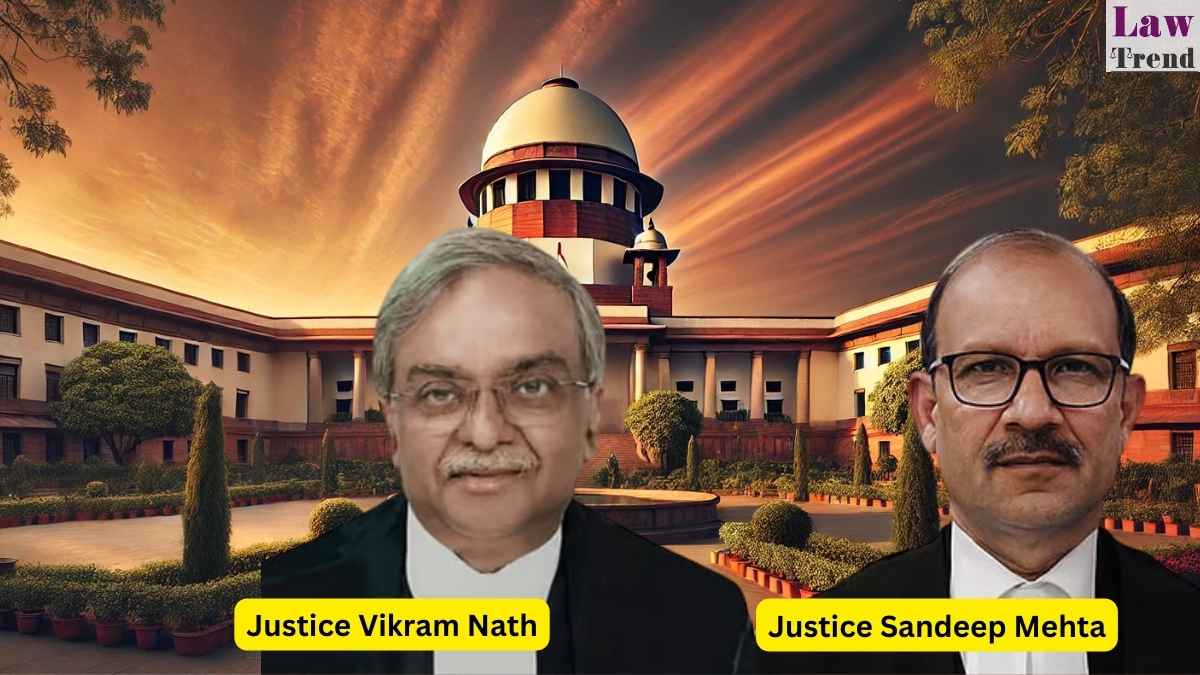
Addressing the critical issue of curbing unethical promotional practices in the pharmaceutical industry and safeguarding the fundamental right to health under Article 21 of the Constitution, the Supreme Court bench comprising Justice Vikram Nath and Justice Sandeep Mehta has directed the Union of India to constitute a high-level committee within two weeks to recommend an effective statutory and regulatory framework. Disposing of the ongoing deliberations in a writ petition, the Court instructed the proposed committee to conduct a comprehensive consultative exercise with stakeholders—including petitioner bodies and domain experts—and submit its recommendations within two months of its first meeting, with the Union Government required to take an expeditious, reasoned decision thereafter.
Background of the Case
The proceedings stem from a writ petition filed under Article 32 of the Constitution by the Federation of Medical & Sales Representatives Association of India (a registered trade union representing field workers across roughly 300 towns and cities), its Secretary, and the National Coordinator of Jan Swasthya Abhiyan. The petitioners approached the top court seeking enforcement of the fundamental right to health, asserting that unethical promotional strategies adopted by pharmaceutical companies directly impact patient welfare and the affordability of medical treatment.
According to the petitioners, pharmaceutical companies routinely offer financial inducements, sponsored travel, hospitality, gifts, and entertainment to healthcare professionals to influence prescribing habits. These practices allegedly result in the over-prescription or irrational prescription of drugs, the use of unnecessary combinations, and a preference for overpriced branded formulations. The petitioners highlighted that such practices exacerbate antimicrobial and antibiotic resistance and place an undue economic burden on patients. Crucially, they pointed out a stark regulatory asymmetry: while medical practitioners are subject to disciplinary action under the Indian Medical Council (Professional Conduct, Etiquette and Ethics) Regulations, 2002 for accepting inducements, there exists no corresponding, legally enforceable statutory regime to penalize pharmaceutical companies that offer them. They argued that the voluntary Uniform Code for Pharmaceutical Marketing Practices (UCPMP), 2015 lacked teeth, accountability, and punitive consequences.
Submissions of the Parties
Appearing for the petitioners, Senior Advocate Sanjay Parikh submitted that the voluntary nature of the marketing code had rendered it ineffective. While referring to an earlier High-Level Committee formed in September 2022 under the chairmanship of the Member (Health), NITI Aayog to examine legally enforceable mechanisms, he pointed out that no concrete statutory resolution had materialized from that exercise. However, Parikh fairly stated that the petitioners did not oppose the Centre’s fresh proposal to set up a three-member committee, acknowledging that the formulation of regulatory norms falls within the domain of executive policy. He urged that the decision-making process must be informed by a meaningful, wide-ranging consultation with all concerned stakeholders. Counsel appearing for the intervenors adopted these submissions and requested a similar opportunity to present their views.
Responding on behalf of the Union of India, Solicitor General Tushar Mehta placed on record an affidavit filed jointly by the Department of Pharmaceuticals and the Ministry of Health and Family Welfare following inter-departmental deliberations and meetings with industry bodies such as IDMA, IPA, and OPPI. Controverting the assertion that earlier efforts yielded no results, the Solicitor General clarified that the 2022 committee under Dr. V.K. Paul had evaluated global practices and domestic mechanisms under the Essential Commodities Act, 1955 and the Drugs and Cosmetics Act, 1940. That exercise catalyzed the introduction of the UCPMP, 2024, which brought in enhanced disclosure requirements, mandatory CEO self-declarations, tighter restrictions on gifts, samples, and CME activities, as well as an Apex Committee for Pharma Marketing Practices (ACPMP).
The Solicitor General apprised the bench that the Union Government now proposes to constitute a three-member committee to comprehensively examine whether an additional statutory or regulatory mechanism is required to hold pharmaceutical companies accountable, with the UCPMP, 2024 continuing to operate in the interim.
The Court’s Analysis
Examining the record, the Supreme Court observed that the issues raised touch upon the core of accessible and affordable public healthcare. The bench noted that the existing mechanisms had not proved entirely effective in curbing unethical practices, emphasizing that statutory norms alone are insufficient if enforcement is lacking.
The Court observed:
“In a sector which has a direct bearing upon the health and well-being of citizens, the efficacy of the regulatory framework cannot be assessed merely by the existence of prescribed norms; it must also be judged by their efficacy, implementation and enforcement.”
Elaborating further on the essential elements of an oversight structure, the bench observed:
“The efficacy of any regulatory framework depends not merely upon the standards and obligations prescribed therein, but equally upon the existence of effective mechanisms for implementation, monitoring, transparency and accountability.”
Deliberating on the institutional balance between the judiciary and the executive, the Court reiterated the importance of separation of powers, noting:
“This Court, while exercising its constitutional jurisdiction, must therefore remain mindful of the doctrine of separation of powers and cannot substitute its own policy determination for that of the executive.”
However, the Court made it clear that adherence to separation of powers does not preclude judicial oversight when fundamental rights are at stake:
“At the same time, judicial restraint cannot be understood as requiring this Court to remain indifferent where the material before it discloses concerns having a direct bearing upon public health and the right to health.”
The Court held that rather than directly legislating or dictating policy terms, its constitutional role under Articles 32 and 142 is to facilitate an effective, transparent, and structured consultative process that ensures legitimate industry interests are balanced against the paramount objective of patient protection.
The Decision and Directions
Invoking its powers under Articles 32 and 142 in furtherance of Article 21 of the Constitution, the Supreme Court issued the following binding directions:
- Constitution of the Committee: The Union of India must constitute the proposed three-member committee within two weeks from the date of the order, if not already formed.
- Mandate and Scope: The committee shall undertake a holistic review of all aspects of unethical pharmaceutical marketing, assessing the adequacy of existing laws, compliance mechanisms, oversight systems, and measures needed to enhance transparency and enforcement.
- Consultative Process: The committee must consider the material placed on record by the petitioners and intervenors, grant them a reasonable opportunity to present their views and concerns, and invite representations from other relevant stakeholders.
- Expert Assistance: The committee is at liberty to engage and seek input from technical, medical, pharmaceutical, and domain experts or institutions as deemed necessary.
- Timeline for Recommendations: The committee must complete its consultative process and submit its recommendations to the Union of India within two months from the date of its first meeting.
- Government Decision: Upon receiving the report, the Union of India must consider the recommendations and take an appropriate, reasoned decision at the earliest in the larger public interest.
- Compliance Review: The Union of India is directed to file a comprehensive compliance affidavit within two weeks after the expiry of the committee’s two-month period, outlining the constitution of the committee, dates of meetings, details of the consultative process, recommendations received, and policy decisions taken.
The Supreme Court has listed the matter as part-heard on January 29, 2027, to examine the compliance affidavit filed by the Centre.
Case Title: Federation of Medical & Sales Representatives Association of India & Ors. v. Union of India & Ors.
Case No.: Writ Petition (C) No(s). 323 of 2021
Bench: Justice Vikram Nath and Justice Sandeep Mehta
Date: October 08, 2026




